Department of Medical Microbiology and Immunology, University of Alberta, Edmonton, Canada.
BMC Cancer. 2012 Jun 8;12:229. doi: 10.1186/1471-2407-12-229.
Anaplastic lymphoma kinase-positive, anaplastic large cell lymphoma (ALK+ ALCL) is a T cell lymphoma defined by the presence of chromosomal translocations involving the ALK tyrosine kinase gene. These translocations generate fusion proteins (e.g. NPM-ALK) with constitutive tyrosine kinase activity, which activate numerous signalling pathways important for ALK+ ALCL pathogenesis. The molecular chaperone heat shock protein-90 (Hsp90) plays a critical role in allowing NPM-ALK and other signalling proteins to function in this lymphoma. Co-chaperone proteins are important for helping Hsp90 fold proteins and for directing Hsp90 to specific clients; however the importance of co-chaperone proteins in ALK+ ALCL has not been investigated. Our preliminary findings suggested that expression of the immunophilin co-chaperone, Cyclophilin 40 (Cyp40), is up-regulated in ALK+ ALCL by JunB, a transcription factor activated by NPM-ALK signalling. In this study we examined the regulation of the immunophilin family of co-chaperones by NPM-ALK and JunB, and investigated whether the immunophilin co-chaperones promote the viability of ALK+ ALCL cell lines.
NPM-ALK and JunB were knocked-down in ALK+ ALCL cell lines with siRNA, and the effect on the expression of the three immunophilin co-chaperones: Cyp40, FK506-binding protein (FKBP) 51, and FKBP52 examined. Furthermore, the effect of knock-down of the immunophilin co-chaperones, either individually or in combination, on the viability of ALK+ ALCL cell lines and NPM-ALK levels and activity was also examined.
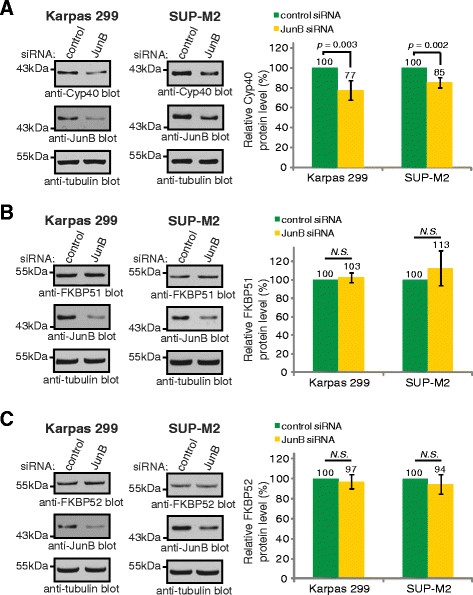
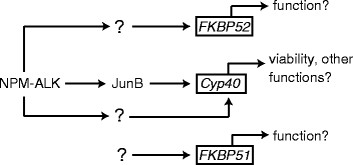
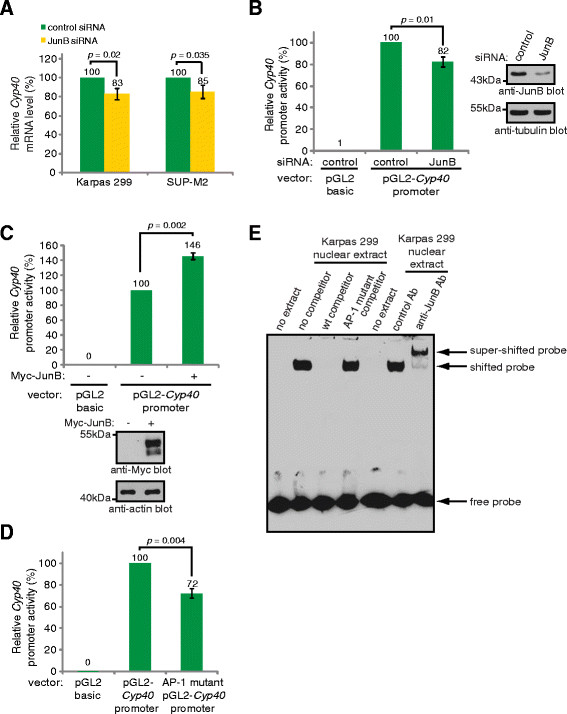
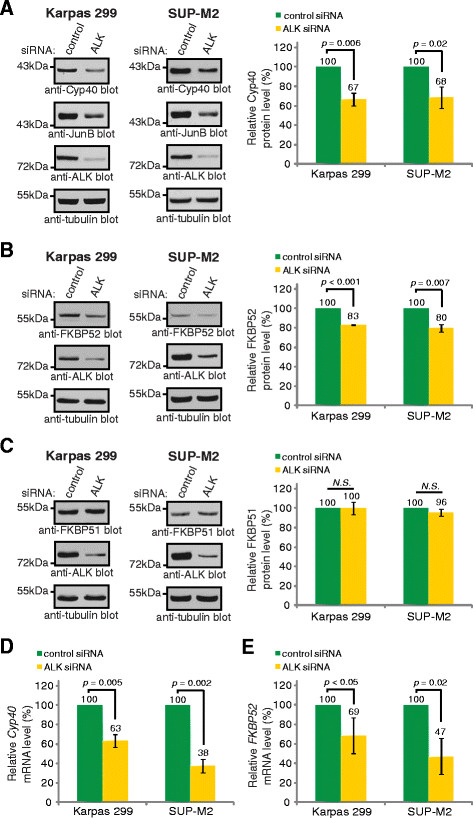
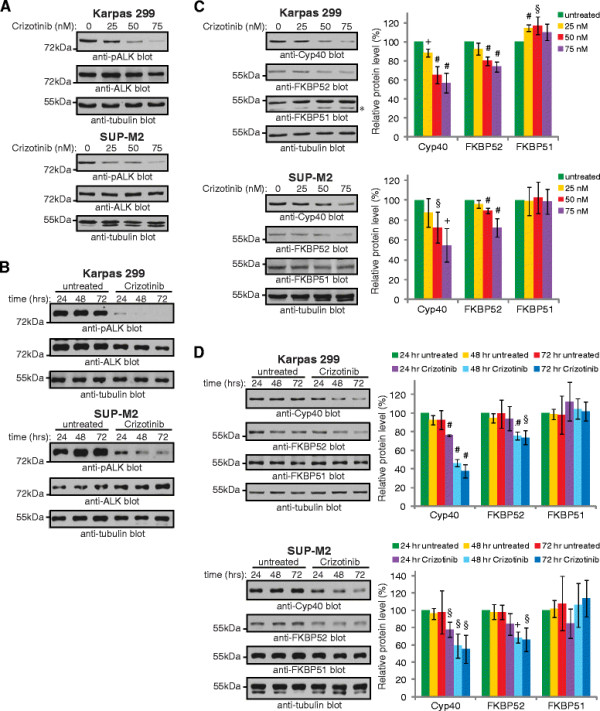
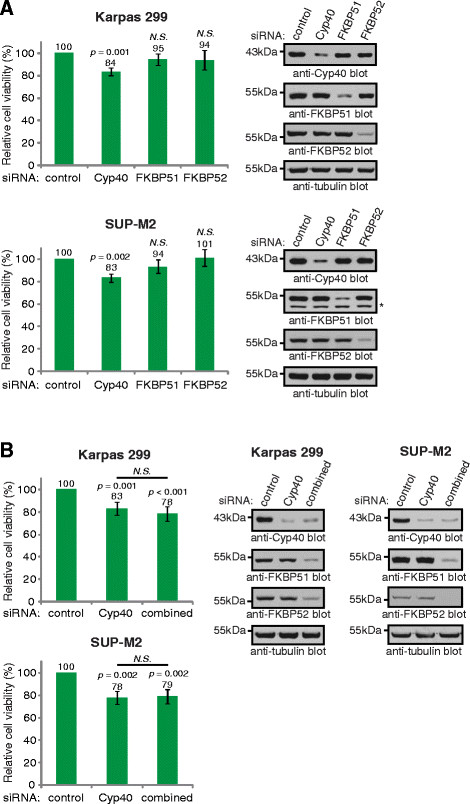
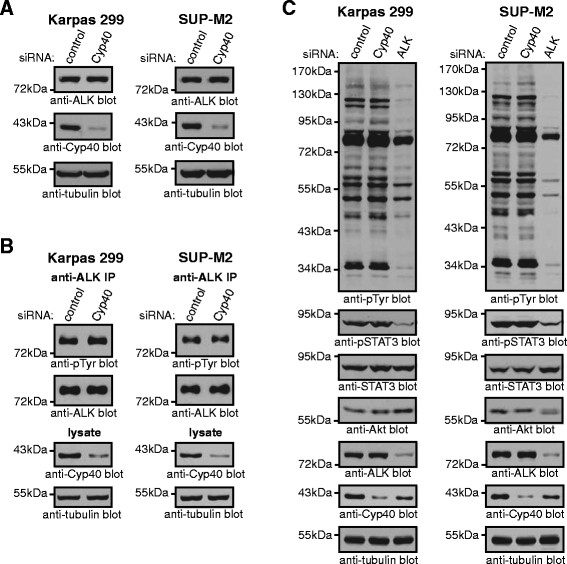
We found that NPM-ALK promoted the transcription of Cyp40 and FKBP52, but only Cyp40 transcription was promoted by JunB. We also observed reduced viability of ALK+ ALCL cell lines treated with Cyp40 siRNA, but not with siRNAs directed against FKBP52 or FKBP51. Finally, we demonstrate that the decrease in the viability of ALK+ ALCL cell lines treated with Cyp40 siRNA does not appear to be due to a decrease in NPM-ALK levels or the ability of this oncoprotein to signal.
This is the first study demonstrating that the expression of immunophilin family co-chaperones is promoted by an oncogenic tyrosine kinase. Moreover, this is the first report establishing an important role for Cyp40 in lymphoma.
间变性淋巴瘤激酶阳性间变大细胞淋巴瘤(ALK+ ALCL)是一种 T 细胞淋巴瘤,其特征是存在涉及 ALK 酪氨酸激酶基因的染色体易位。这些易位产生具有组成型酪氨酸激酶活性的融合蛋白(例如 NPM-ALK),其激活对于 ALK+ ALCL 发病机制很重要的许多信号通路。分子伴侣热休克蛋白-90(Hsp90)在允许 NPM-ALK 和其他信号蛋白在这种淋巴瘤中发挥作用方面起着至关重要的作用。伴侣蛋白对于帮助 Hsp90 折叠蛋白质和指导 Hsp90 到特定客户非常重要;然而,伴侣蛋白在 ALK+ ALCL 中的重要性尚未得到研究。我们的初步研究结果表明,免疫亲和素伴侣蛋白环孢素 40(Cyp40)的表达通过 NPM-ALK 信号传导激活的转录因子 JunB 在 ALK+ ALCL 中上调。在这项研究中,我们研究了 NPM-ALK 和 JunB 对免疫亲和素家族伴侣蛋白的调节作用,并研究了免疫亲和素伴侣蛋白是否促进 ALK+ ALCL 细胞系的存活。
用 siRNA 敲低 ALK+ ALCL 细胞系中的 NPM-ALK 和 JunB,并研究对三种免疫亲和素伴侣蛋白的表达的影响:Cyp40、FK506 结合蛋白(FKBP)51 和 FKBP52。此外,还研究了单独或组合敲低免疫亲和素伴侣蛋白对 ALK+ ALCL 细胞系的活力以及 NPM-ALK 水平和活性的影响。
我们发现 NPM-ALK 促进 Cyp40 和 FKBP52 的转录,但只有 JunB 促进 Cyp40 的转录。我们还观察到用 Cyp40 siRNA 处理的 ALK+ ALCL 细胞系活力降低,但用针对 FKBP52 或 FKBP51 的 siRNA 处理则没有。最后,我们证明用 Cyp40 siRNA 处理的 ALK+ ALCL 细胞系活力降低似乎不是由于 NPM-ALK 水平降低或这种致癌蛋白信号转导能力降低所致。
这是第一项证明免疫亲和素家族伴侣蛋白的表达受致癌酪氨酸激酶促进的研究。此外,这是第一项证明 Cyp40 在淋巴瘤中具有重要作用的报告。