Lee Peter A, Ross Judith, Germak John A, Gut Robert
Department of Pediatrics, The Milton S, Hershey Medical Center, Penn State College of Medicine, Hershey, PA, USA.
Int J Pediatr Endocrinol. 2012 Jun 8;2012(1):15. doi: 10.1186/1687-9856-2012-15.
Noonan syndrome (NS) is a genetic disorder characterized by phenotypic features, including facial dysmorphology, cardiovascular anomalies, and short stature. Growth hormone (GH) has been approved by the United States Food and Drug Administration for short stature in children with NS. The objective of this analysis was to assess the height standard deviation score (HSDS) and change in HSDS (ΔHSDS) for up to 4 years (Y4) of GH therapy in children with NS.
The American Norditropin Studies: Web-Enabled Research (ANSWER) Program®, a US-based registry, collects long-term efficacy and safety information on patients treated with Norditropin® (somatropin rDNA origin, Novo Nordisk A/S) at the discretion of participating physicians. A total of 120 children (90 boys, 30 girls) with NS, naïve to previous GH treatment, were included in this analysis.
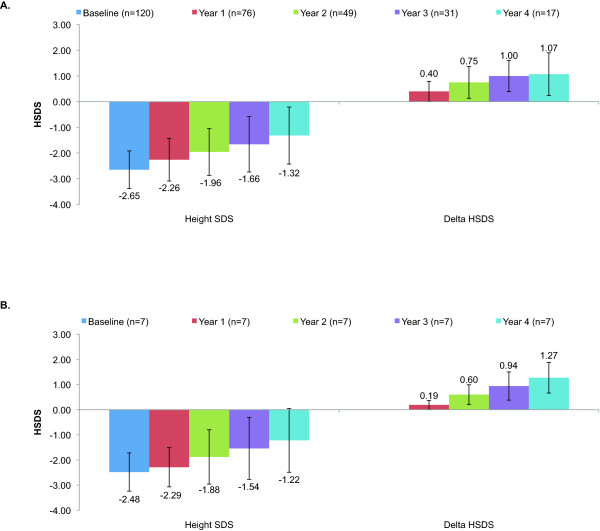
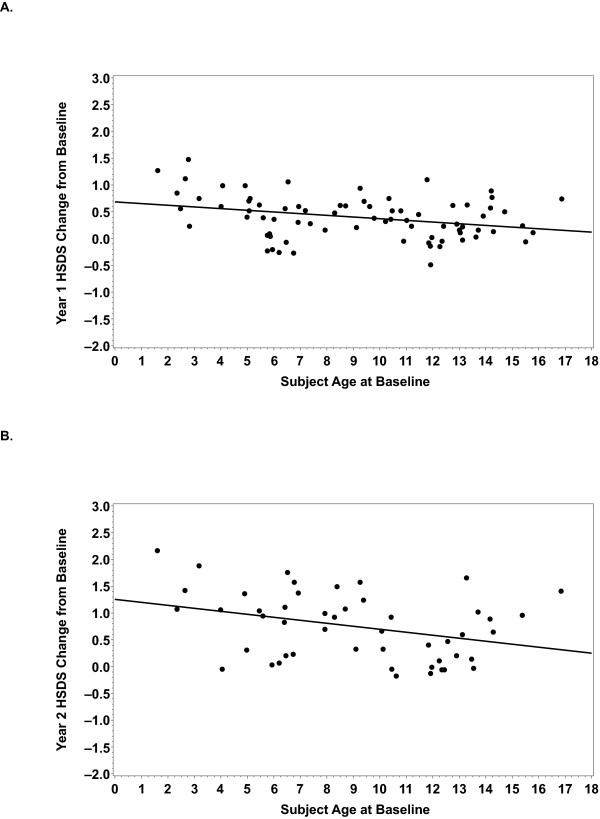
The mean (SD) baseline age of subjects (n = 120) was 9.2 (3.8) years. Mean (SD) HSDS increased from -2.65 (0.73) at baseline to -1.32 (1.11) at Y4 (n = 17). Subjects showed continued increase in HSDS from baseline to Y4 without significant differences between genders at Y1 or Y2. The mean (SD) GH dose was 47 (11) mcg/kg/day at baseline and 59 (16) mcg/kg/day at Y4. There was a negative correlation between baseline age and ΔHSDS at Y1 (R = -0.3156; P = 0.0055) and Y2 (R = -0.3394; P = 0.017). ΔHSDS at Y1 was significantly correlated with ΔHSDS at Y2 (n = 37; R = 0.8527, P < 0.0001) and Y3 (n = 20; R = 0.5145; P = 0.0203), but not Y4 (n = 12; R = 0.4066, P = 0.1896).
GH treatment-naïve patients with NS showed continued increases in HSDS during 4 years of treatment with GH with no significant differences between genders up to 2 years. Baseline age was negatively correlated with ΔHSDS at Y1 and Y2. Whether long-term therapy in NS results in continued increase in HSDS to adult height remains to be investigated.
ClinicalTrials.gov NCT01009905.
努南综合征(NS)是一种遗传性疾病,其特征包括面部畸形、心血管异常和身材矮小等表型特征。生长激素(GH)已获得美国食品药品监督管理局批准,用于治疗NS患儿的身材矮小。本分析的目的是评估NS患儿接受GH治疗长达4年(Y4)时的身高标准差评分(HSDS)及HSDS的变化(ΔHSDS)。
美国诺德生长激素研究:网络研究(ANSWER)项目®是一个美国的注册机构,由参与的医生自行决定收集使用诺德生长激素(生长激素重组DNA来源,诺和诺德公司)治疗的患者的长期疗效和安全性信息。本分析纳入了120例既往未接受过GH治疗的NS患儿(90例男孩,30例女孩)。
受试者(n = 120)的平均(标准差)基线年龄为9.2(3.8)岁。平均(标准差)HSDS从基线时的-2.65(0.73)增加到Y4时的-1.32(1.11)(n = 17)。受试者从基线到Y4的HSDS持续增加,在Y1或Y2时性别间无显著差异。基线时GH平均(标准差)剂量为47(11)μg/kg/天,Y4时为59(16)μg/kg/天。基线年龄与Y1时的ΔHSDS(R = -0.3156;P = 0.0055)和Y2时的ΔHSDS(R = -0.3394;P = 0.017)呈负相关。Y1时的ΔHSDS与Y2时的ΔHSDS(n = 37;R = 0.8527,P < 0.0001)和Y3时的ΔHSDS(n = 20;R = 0.5145;P = 0.0203)显著相关,但与Y4时的ΔHSDS(n = 12;R = 0.4066,P = 0.1896)无关。
未接受过GH治疗的NS患者在接受GH治疗的4年期间HSDS持续增加,在长达2年的时间里性别间无显著差异。基线年龄与Y1和Y2时的ΔHSDS呈负相关。NS的长期治疗是否会使HSDS持续增加至成人身高仍有待研究。
ClinicalTrials.gov NCT01009905。