School of Science and Technology, Nottingham Trent University, Nottingham, United Kingdom.
PLoS One. 2012;7(5):e36983. doi: 10.1371/journal.pone.0036983. Epub 2012 May 31.
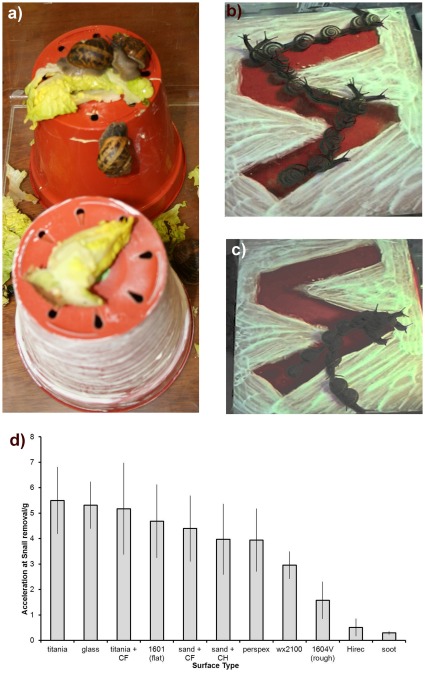
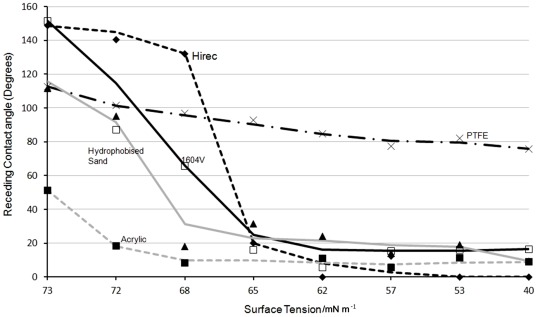
Creating surfaces capable of resisting liquid-mediated adhesion is extremely difficult due to the strong capillary forces that exist between surfaces. Land snails use this to adhere to and traverse across almost any type of solid surface of any orientation (horizontal, vertical or inverted), texture (smooth, rough or granular) or wetting property (hydrophilic or hydrophobic) via a layer of mucus. However, the wetting properties that enable snails to generate strong temporary attachment and the effectiveness of this adhesive locomotion on modern super-slippy superhydrophobic surfaces are unclear. Here we report that snail adhesion overcomes a wide range of these microscale and nanoscale topographically structured non-stick surfaces. For the one surface which we found to be snail resistant, we show that the effect is correlated with the wetting response of the surface to a weak surfactant. Our results elucidate some critical wetting factors for the design of anti-adhesive and bio-adhesion resistant surfaces.
由于表面之间存在很强的毛细作用力,因此制造能够抵抗液体介导的粘附的表面极其困难。陆地蜗牛通过一层黏液来实现对几乎任何类型的固体表面(无论其取向如何,水平、垂直或倒置)、质地(光滑、粗糙或粗糙)或润湿性(亲水或疏水)的附着和跨越。然而,使蜗牛能够产生强大的临时附着的润湿特性以及这种粘性运动在现代超滑超疏水表面上的有效性尚不清楚。在这里,我们报告说,蜗牛的附着力克服了广泛的微观和纳米尺度的这种具有非粘性的结构化表面。对于我们发现蜗牛抵抗的一种表面,我们表明,这种效果与表面对弱表面活性剂的润湿反应有关。我们的结果阐明了设计抗粘附和生物抗粘表面的一些关键润湿因素。