Bade Veronika N, Nickels Jochen, Keusekotten Kirstin, Praefcke Gerrit J K
Center for Molecular Medicine Cologne-CMMC, Institute for Genetics, University of Cologne, Cologne, Germany.
PLoS One. 2012;7(6):e38294. doi: 10.1371/journal.pone.0038294. Epub 2012 Jun 5.
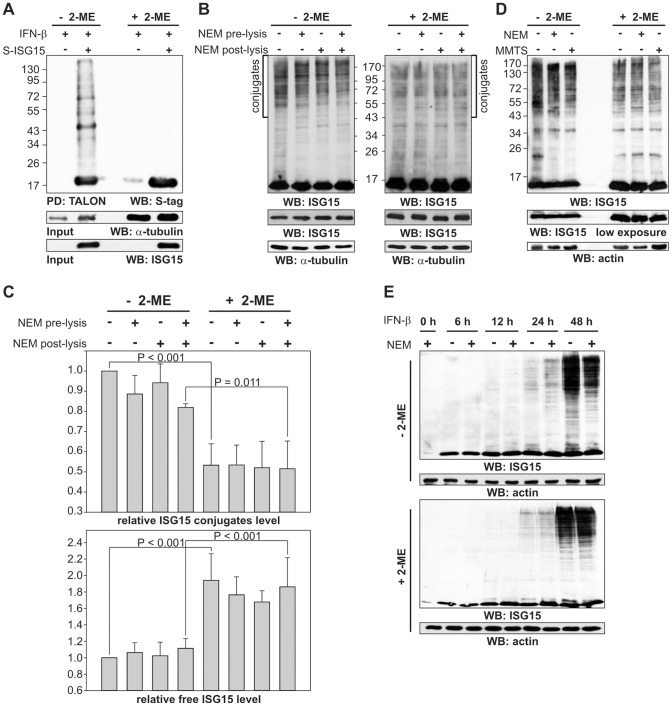
The ubiquitin-like protein ISG15 (interferon-stimulated gene of 15 kDa) is strongly induced by type I interferons and displays antiviral activity. As other ubiquitin-like proteins (Ubls), ISG15 is post-translationally conjugated to substrate proteins by an isopeptide bond between the C-terminal glycine of ISG15 and the side chains of lysine residues in the substrates (ISGylation). ISG15 consists of two ubiquitin-like domains that are separated by a hinge region. In many orthologs, this region contains a single highly reactive cysteine residue. Several hundred potential substrates for ISGylation have been identified but only a few of them have been rigorously verified. In order to investigate the modification of several ISG15 substrates, we have purified ISG15 conjugates from cell extracts by metal-chelate affinity purification and immunoprecipitations. We found that the levels of proteins modified by human ISG15 can be decreased by the addition of reducing agents. With the help of thiol blocking reagents, a mutational analysis and miRNA mediated knock-down of ISG15 expression, we revealed that this modification occurs in living cells via a disulphide bridge between the substrates and Cys78 in the hinge region of ISG15. While the ISG15 activating enzyme UBE1L is conjugated by ISG15 in the classical way, we show that the ubiquitin conjugating enzyme Ubc13 can either be classically conjugated by ISG15 or can form a disulphide bridge with ISG15 at the active site cysteine 87. The latter modification would interfere with its function as ubiquitin conjugating enzyme. However, we found no evidence for an ISG15 modification of the dynamin-like GTPases MxA and hGBP1. These findings indicate that the analysis of potential substrates for ISG15 conjugation must be performed with great care to distinguish between the two types of modification since many assays such as immunoprecipitation or metal-chelate affinity purification are performed with little or no reducing agent present.
类泛素蛋白ISG15(15 kDa干扰素刺激基因)受I型干扰素强烈诱导并具有抗病毒活性。与其他类泛素蛋白(Ubls)一样,ISG15通过ISG15 C末端甘氨酸与底物中赖氨酸残基侧链之间的异肽键在翻译后与底物蛋白缀合(ISGylation修饰)。ISG15由两个类泛素结构域组成,中间由一个铰链区隔开。在许多直系同源物中,该区域含有一个单一的高反应性半胱氨酸残基。已鉴定出数百种可能的ISGylation修饰底物,但其中只有少数经过严格验证。为了研究几种ISG15底物的修饰情况,我们通过金属螯合亲和纯化和免疫沉淀从细胞提取物中纯化了ISG15缀合物。我们发现,添加还原剂可降低人ISG15修饰的蛋白质水平。借助硫醇阻断试剂、突变分析以及miRNA介导的ISG15表达敲低,我们揭示这种修饰在活细胞中通过底物与ISG15铰链区Cys78之间的二硫键发生。虽然ISG15激活酶UBE1L以经典方式被ISG15缀合,但我们发现泛素缀合酶Ubc13既可以被ISG15以经典方式缀合,也可以在活性位点半胱氨酸87处与ISG15形成二硫键。后一种修饰会干扰其作为泛素缀合酶的功能。然而,我们没有发现动力蛋白样GTP酶MxA和hGBP1被ISG15修饰的证据。这些发现表明,对ISG15缀合潜在底物的分析必须格外小心,以区分这两种修饰类型,因为许多检测方法,如免疫沉淀或金属螯合亲和纯化,都是在几乎没有或完全没有还原剂的情况下进行的。