Laboratory for Gynecological Oncology, Women's Hospital/Department of Biomedicine, University of Basel, Hebelstrasse 20, CH 4031 Basel, Switzerland.
BMC Cancer. 2012 Jun 13;12:244. doi: 10.1186/1471-2407-12-244.
Invasion and metastasis are two important hallmarks of malignant tumors caused by complex genetic and epigenetic alterations. The present study investigated the contribution of aberrant methylation profiles of cancer related genes, APC, BIN1, BMP6, BRCA1, CST6, ESR-b, GSTP1, P14 (ARF), P16 (CDKN2A), P21 (CDKN1A), PTEN, and TIMP3, in the matched axillary lymph node metastasis in comparison to the primary tumor tissue and the adjacent normal tissue from the same breast cancer patients to identify the potential of candidate genes methylation as metastatic markers.
The quantitative methylation analysis was performed using the SEQUENOM's EpiTYPER™ assay which relies on matrix-assisted laser desorption/ionization time-of-flight mass spectrometry (MALDI-TOF MS).
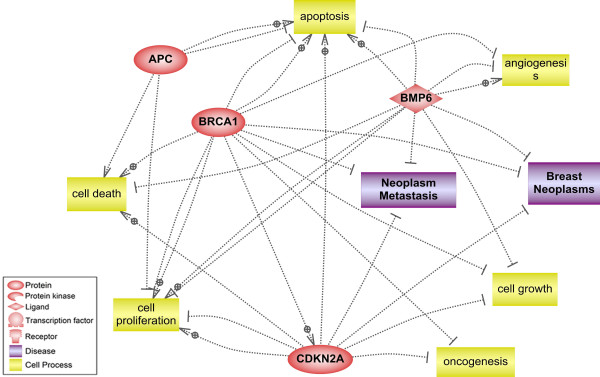
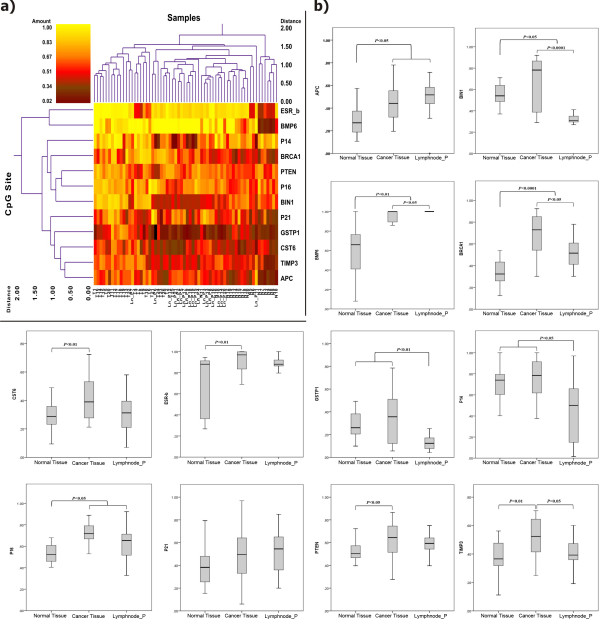
The quantitative DNA methylation analysis of the candidate genes showed higher methylation proportion in the primary tumor tissue than that of the matched normal tissue and the differences were significant for the APC, BIN1, BMP6, BRCA1, CST6, ESR-b, P16, PTEN and TIMP3 promoter regions (P<0.05). Among those candidate methylated genes, APC, BMP6, BRCA1 and P16 displayed higher methylation proportion in the matched lymph node metastasis than that found in the normal tissue (P<0.05). The pathway analysis revealed that BMP6, BRCA1 and P16 have a role in prevention of neoplasm metastasis.
The results of the present study showed methylation heterogeneity between primary tumors and metastatic lesion. The contribution of aberrant methylation alterations of BMP6, BRCA1 and P16 genes in lymph node metastasis might provide a further clue to establish useful biomarkers for screening metastasis.
侵袭和转移是恶性肿瘤的两个重要特征,是由复杂的遗传和表观遗传改变引起的。本研究调查了 APC、BIN1、BMP6、BRCA1、CST6、ESR-b、GSTP1、P14(ARF)、P16(CDKN2A)、P21(CDKN1A)、PTEN 和 TIMP3 等癌症相关基因异常甲基化谱在匹配的腋窝淋巴结转移中的作用,与原发性肿瘤组织以及来自同一乳腺癌患者的相邻正常组织进行比较,以确定候选基因甲基化作为转移标志物的潜力。
采用 SEQUENOM 的 EpiTYPER™assay 进行定量甲基化分析,该方法依赖于基质辅助激光解吸/电离飞行时间质谱(MALDI-TOF MS)。
候选基因的定量 DNA 甲基化分析显示,原发性肿瘤组织中的甲基化比例高于匹配的正常组织,APC、BIN1、BMP6、BRCA1、CST6、ESR-b、P16、PTEN 和 TIMP3 启动子区域的差异具有统计学意义(P<0.05)。在这些候选甲基化基因中,APC、BMP6、BRCA1 和 P16 在匹配的淋巴结转移中比在正常组织中显示出更高的甲基化比例(P<0.05)。通路分析显示,BMP6、BRCA1 和 P16 在预防肿瘤转移中具有作用。
本研究结果表明原发性肿瘤和转移灶之间存在甲基化异质性。BMP6、BRCA1 和 P16 基因异常甲基化改变在淋巴结转移中的作用可能为建立用于筛选转移的有用生物标志物提供进一步线索。