Center for Translational Medicine, Department of Pharmacology, Temple University School of Medicine, 3420 North Broad Street MRB, 706A, Philadelphia, PA 19140, USA.
J Neuroinflammation. 2012 Jun 14;9:127. doi: 10.1186/1742-2094-9-127.
The 5-lipoxygenase enzyme is widely distributed within the central nervous system and its activity is regulated by the presence and availability of another protein, called 5-lipoxygenase activating protein. While previous works have shown that 5-lipoxygenase is involved in the pathogenesis of Alzheimer's disease, no data are available on the role that 5-lipoxygenase activating protein plays in Alzheimer's disease.
In the present paper, we studied the effect of pharmacologic inhibition of 5-lipoxygenase activating protein on the amyloidotic phenotype of Tg2576 mice.
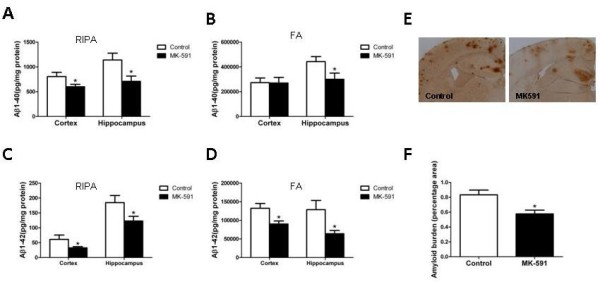
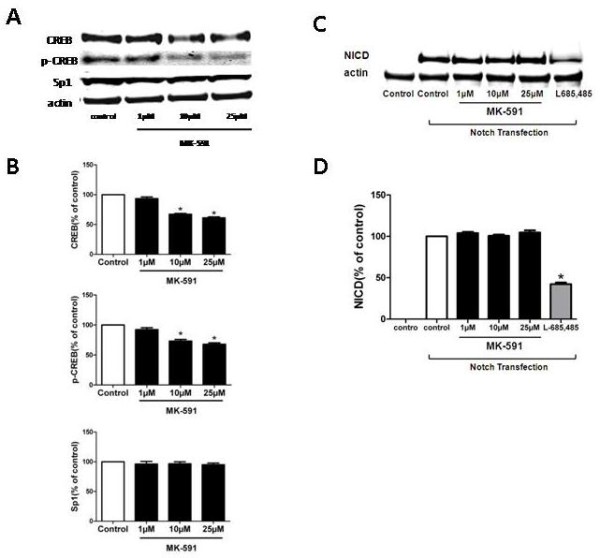
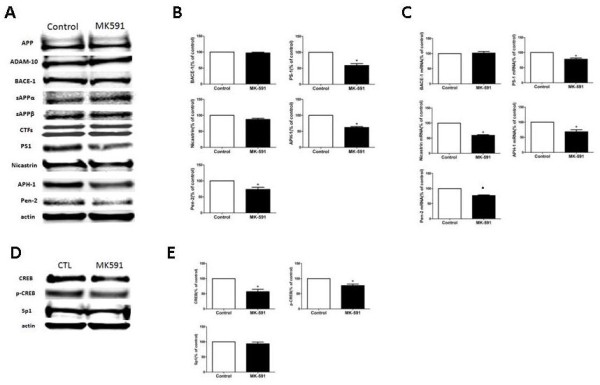
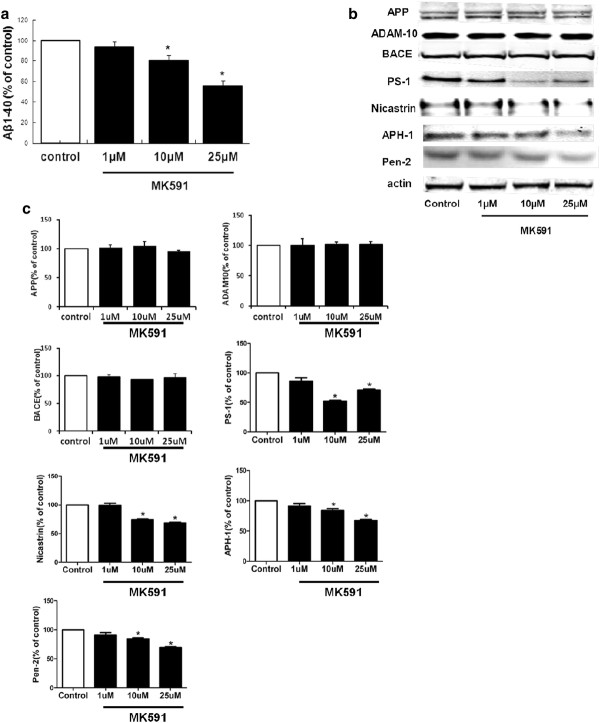
Amyloid β peptide (Aβ) deposition in the brains of mice receiving MK-591, a selective and specific 5-lipoxygenase activating protein inhibitor, was significantly reduced when compared with controls. This reduction was associated with a similar decrease in brain Aβ peptides levels. MK-591 treatment did not induce any change in the steady-state levels of amyloid-β precursor protein, β-site amyloid precursor protein cleaving enzyme 1 or disintegrin and metalloproteinase domain-containing protein 10. By contrast, it resulted in a significant reduction of the γ-secretase complex, at the protein and message level. Furthermore, in vitro studies confirmed that MK-591 prevents Aβ formation by modulating γ-secretase complex levels without affecting Notch signaling.
These data establish a novel functional role for 5-lipoxygenase activating protein in the pathogenesis of Alzheimer's disease-like amyloidosis, and suggest that its pharmacological inhibition could provide a novel therapeutic opportunity for Alzheimer's disease.
5-脂氧合酶广泛分布于中枢神经系统,其活性受到另一种蛋白质(称为 5-脂氧合酶激活蛋白)的存在和可用性的调节。虽然以前的研究表明 5-脂氧合酶参与阿尔茨海默病的发病机制,但尚无关于 5-脂氧合酶激活蛋白在阿尔茨海默病中的作用的数据。
在本文中,我们研究了 5-脂氧合酶激活蛋白的药理学抑制对 Tg2576 小鼠淀粉样表型的影响。
与对照组相比,接受 MK-591(一种选择性和特异性的 5-脂氧合酶激活蛋白抑制剂)的小鼠大脑中的淀粉样 β 肽(Aβ)沉积明显减少。这种减少与大脑 Aβ肽水平的类似降低有关。MK-591 治疗不会引起淀粉样前体蛋白、β-位点淀粉样前体蛋白切割酶 1 或解整合素和金属蛋白酶域蛋白 10 的稳态水平发生任何变化。相比之下,它导致 γ-分泌酶复合物在蛋白质和信使水平上显著减少。此外,体外研究证实 MK-591 通过调节 γ-分泌酶复合物水平而不是影响 Notch 信号转导来防止 Aβ形成。
这些数据确立了 5-脂氧合酶激活蛋白在阿尔茨海默病样淀粉样变性发病机制中的新功能作用,并表明其药理学抑制可能为阿尔茨海默病提供新的治疗机会。