Department of Psychological Sciences, University of Missouri, Columbia, MO 65211, USA.
J Exp Child Psychol. 2012 Sep;113(1):49-65. doi: 10.1016/j.jecp.2012.03.003. Epub 2012 Jun 12.
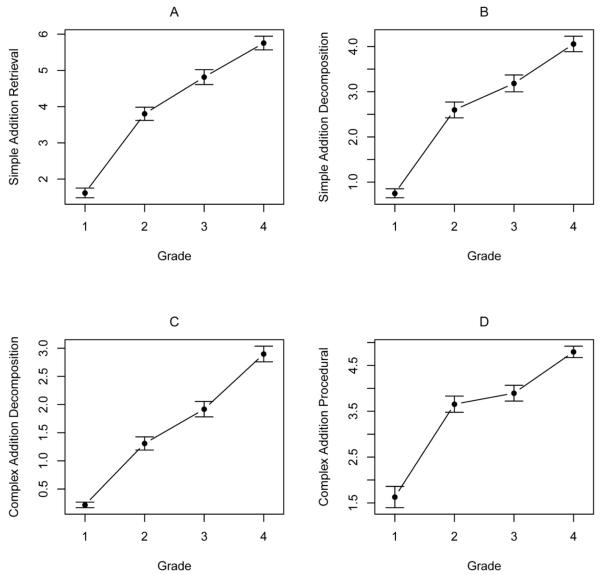
Children's (N=275) use of retrieval, decomposition (e.g., 7=4+3 and thus 6+7=6+4+3), and counting to solve additional problems was longitudinally assessed from first grade to fourth grade, and intelligence, working memory, and in-class attentive behavior was assessed in one or several grades. The goal was to assess the relation between capacity of the central executive component of working memory, controlling for intelligence and in-class attentive behavior, and grade-related changes in children's use of these strategies. The predictor on intercept effects from multilevel models revealed that children with higher central executive capacity correctly retrieved more facts and used the most sophisticated counting procedure more frequently and accurately than their lower capacity peers at the beginning of first grade, but the predictor on slope effects indicated that this advantage disappeared (retrieval) or declined in importance (counting) from first grade to fourth grade. The predictor on slope effects also revealed that from first grade to fourth grade, children with higher capacity adopted the decomposition strategy more quickly than other children. The results remained robust with controls for children's sex, race, school site, speed of encoding Arabic numerals and articulating number words, and mathematics achievement in kindergarten. The results also revealed that intelligence and in-class attentive behavior independently contributed to children's strategy development.
儿童(N=275)在解决其他问题时使用检索、分解(例如,7=4+3,因此 6+7=6+4+3)和计数的能力,从一年级到四年级进行了纵向评估,并且在一个或多个年级评估了智力、工作记忆和课堂注意力行为。目标是评估工作记忆的中央执行成分的容量与智力和课堂注意力行为的关系,以及儿童在这些策略的使用上与年级相关的变化。多层次模型的截距效应预测因子表明,在一年级开始时,具有较高中央执行能力的儿童比其低能力同伴正确检索更多事实,并更频繁和准确地使用最复杂的计数程序,但斜率效应的预测因子表明,这种优势在从一年级到四年级的过程中消失(检索)或变得不重要(计数)。斜率效应的预测因子还表明,从一年级到四年级,具有较高能力的儿童比其他儿童更快地采用分解策略。在控制了儿童的性别、种族、学校地点、阿拉伯数字编码速度和说出数字词的速度以及幼儿园的数学成绩后,结果仍然稳健。结果还表明,智力和课堂注意力行为独立地促进了儿童策略的发展。