Department of Systems Biology, Harvard Medical School, Boston, MA 02115, USA.
Science. 2012 Jun 15;336(6087):1440-4. doi: 10.1126/science.1218351.
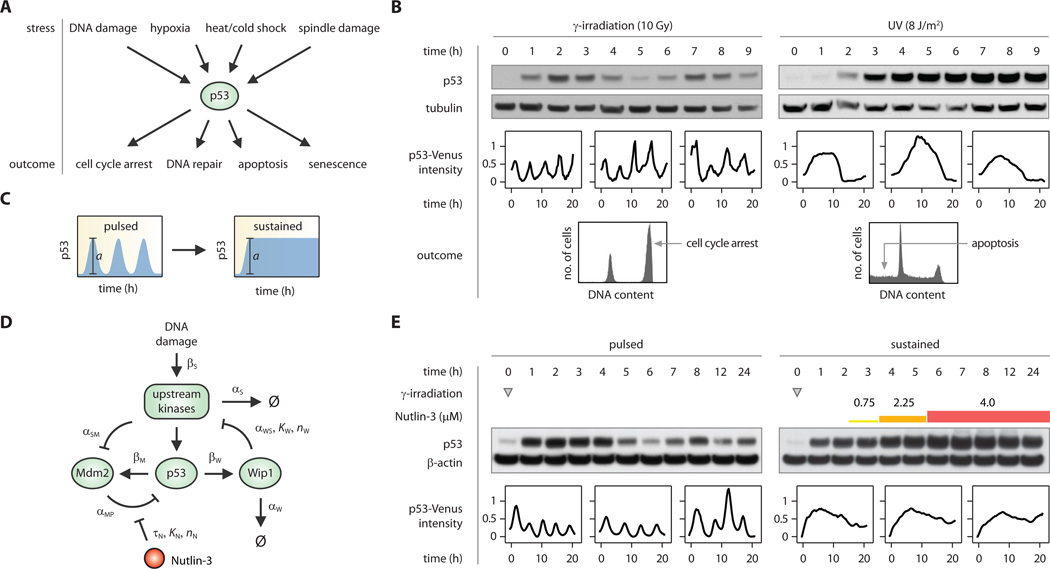
Cells transmit information through molecular signals that often show complex dynamical patterns. The dynamic behavior of the tumor suppressor p53 varies depending on the stimulus; in response to double-strand DNA breaks, it shows a series of repeated pulses. Using a computational model, we identified a sequence of precisely timed drug additions that alter p53 pulses to instead produce a sustained p53 response. This leads to the expression of a different set of downstream genes and also alters cell fate: Cells that experience p53 pulses recover from DNA damage, whereas cells exposed to sustained p53 signaling frequently undergo senescence. Our results show that protein dynamics can be an important part of a signal, directly influencing cellular fate decisions.
细胞通过分子信号传递信息,这些信号通常呈现复杂的动态模式。肿瘤抑制因子 p53 的动态行为因刺激而异;在响应双链 DNA 断裂时,它会显示一系列重复的脉冲。我们使用计算模型确定了一系列精确定时的药物添加,这些添加会改变 p53 脉冲,转而产生持续的 p53 反应。这会导致一组不同的下游基因表达,并改变细胞命运:经历 p53 脉冲的细胞会从 DNA 损伤中恢复,而暴露于持续的 p53 信号下的细胞经常经历衰老。我们的结果表明,蛋白质动力学可能是信号的重要组成部分,直接影响细胞命运决策。