Center for Medical, Agricultural and Veterinary Entomology, Agricultural Research Service, United States Department of Agriculture (USDA-ARS), Gainesville, Florida, United States of America.
PLoS One. 2012;7(6):e38735. doi: 10.1371/journal.pone.0038735. Epub 2012 Jun 6.
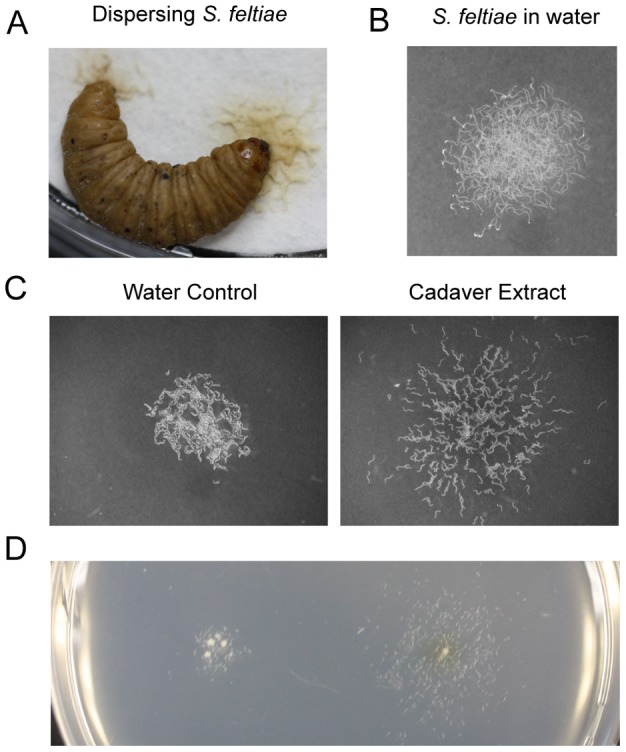
Dispersal is an important nematode behavior. Upon crowding or food depletion, the free living bacteriovorus nematode Caenorhabditis elegans produces stress resistant dispersal larvae, called dauer, which are analogous to second stage juveniles (J2) of plant parasitic Meloidogyne spp. and infective juveniles (IJ)s of entomopathogenic nematodes (EPN), e.g., Steinernema feltiae. Regulation of dispersal behavior has not been thoroughly investigated for C. elegans or any other nematode species. Based on the fact that ascarosides regulate entry in dauer stage as well as multiple behaviors in C. elegans adults including mating, avoidance and aggregation, we hypothesized that ascarosides might also be involved in regulation of dispersal behavior in C. elegans and for other nematodes such as IJ of phylogenetically related EPNs.
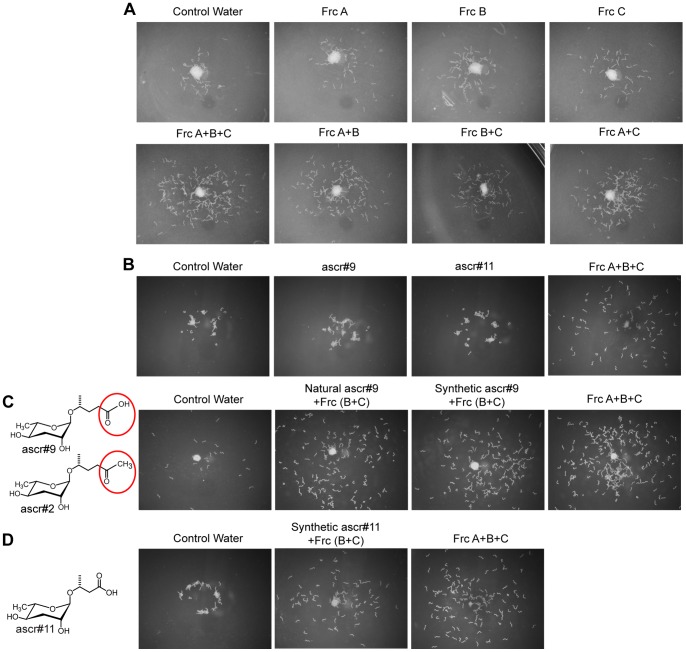
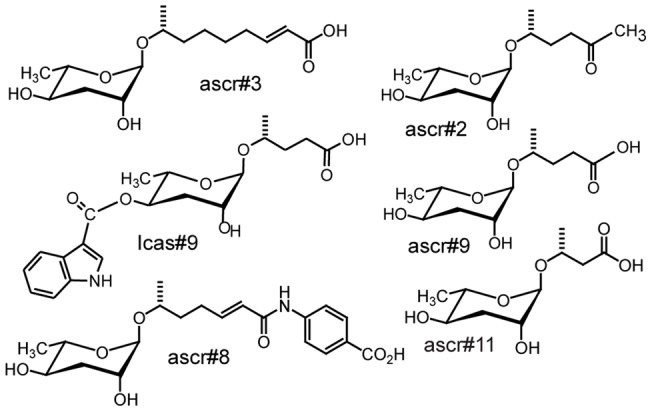
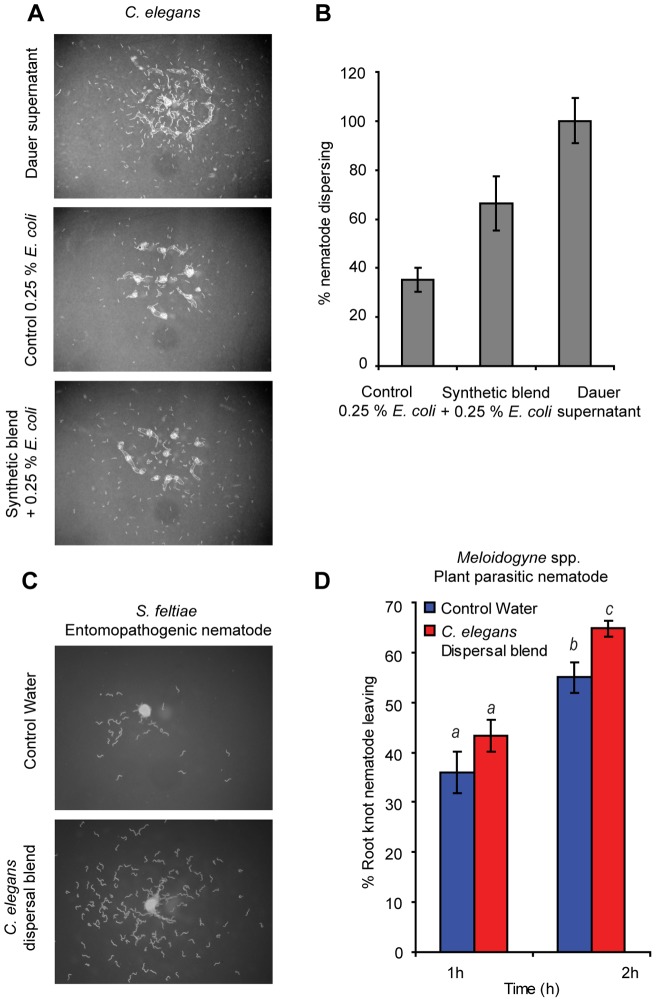
METHODOLOGY/PRINCIPAL FINDINGS: Liquid chromatography-mass spectrometry analysis of C. elegans dauer conditioned media, which shows strong dispersing activity, revealed four known ascarosides (ascr#2, ascr#3, ascr#8, icas#9). A synthetic blend of these ascarosides at physiologically relevant concentrations dispersed C. elegans dauer in the presence of food and also caused dispersion of IJs of S. feltiae and J2s of plant parasitic Meloidogyne spp. Assay guided fractionation revealed structural analogs as major active components of the S. feltiae (ascr#9) and C. elegans (ascr#2) dispersal blends. Further analysis revealed ascr#9 in all Steinernema spp. and Heterorhabditis spp. infected insect host cadavers.
CONCLUSIONS/SIGNIFICANCE: Ascaroside blends represent evolutionarily conserved, fundamentally important communication systems for nematodes from diverse habitats, and thus may provide sustainable means for control of parasitic nematodes.
扩散是线虫的一种重要行为。在拥挤或食物匮乏的情况下,自由生活的食细菌线虫秀丽隐杆线虫会产生具有抗应激能力的扩散幼虫,称为 dauer,类似于植物寄生线虫根结线虫的第二阶段幼虫 (J2) 和昆虫病原线虫 (EPN) 的侵染性幼虫 (IJ)。对于秀丽隐杆线虫或任何其他线虫物种,其扩散行为的调节尚未得到彻底研究。基于以下事实:ascarosides 调节 dauer 阶段的进入以及秀丽隐杆线虫成虫的多种行为,包括交配、回避和聚集,我们假设 ascarosides 可能也参与了秀丽隐杆线虫和其他线虫(如亲缘关系密切的 EPN 的 IJ)的扩散行为调节。
方法/主要发现:对具有强烈扩散活性的 dauer 条件培养基进行液相色谱-质谱分析,发现了四种已知的 ascarosides (ascr#2、ascr#3、ascr#8、icas#9)。这些 ascarosides 的生理相关浓度的混合物在有食物存在的情况下分散了 dauer 的秀丽隐杆线虫,也导致了 S. feltiae 的 IJ 和植物寄生线虫根结线虫的 J2 的分散。基于测定的分离揭示了结构类似物是 S. feltiae(ascr#9)和 C. elegans(ascr#2)分散混合物的主要活性成分。进一步的分析表明,所有 Steinernema spp. 和 Heterorhabditis spp. 感染的昆虫宿主尸体中都存在 ascr#9。
结论/意义:ascaroside 混合物代表了来自不同生境的线虫进化保守的、非常重要的通讯系统,因此可能为寄生线虫的控制提供可持续的手段。