Srinivasan Jagan, Kaplan Fatma, Ajredini Ramadan, Zachariah Cherian, Alborn Hans T, Teal Peter E A, Malik Rabia U, Edison Arthur S, Sternberg Paul W, Schroeder Frank C
Howard Hughes Medical Institute and Biology Division, California Institute of Technology, 1200 E. California Boulevard, Pasadena, California 91125, USA.
Nature. 2008 Aug 28;454(7208):1115-8. doi: 10.1038/nature07168. Epub 2008 Jul 23.
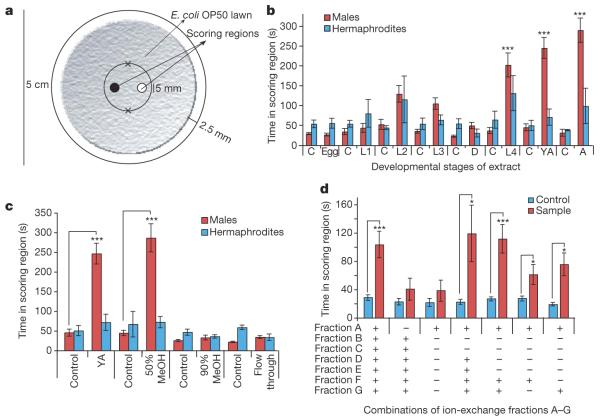
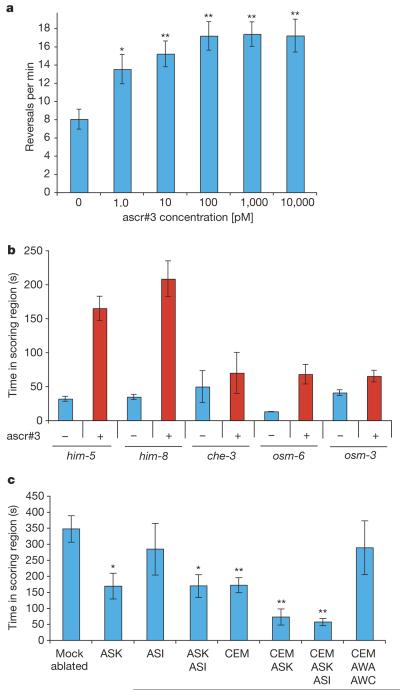
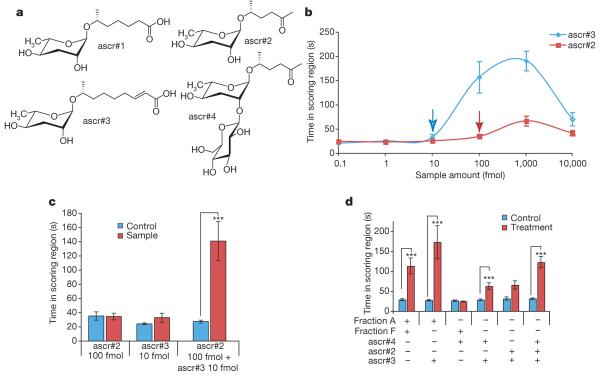
In many organisms, population-density sensing and sexual attraction rely on small-molecule-based signalling systems. In the nematode Caenorhabditis elegans, population density is monitored through specific glycosides of the dideoxysugar ascarylose (the 'ascarosides') that promote entry into an alternative larval stage, the non-feeding and highly persistent dauer stage. In addition, adult C. elegans males are attracted to hermaphrodites by a previously unidentified small-molecule signal. Here we show, by means of combinatorial activity-guided fractionation of the C. elegans metabolome, that the mating signal consists of a synergistic blend of three dauer-inducing ascarosides, which we call ascr#2, ascr#3 and ascr#4. This blend of ascarosides acts as a potent male attractant at very low concentrations, whereas at the higher concentrations required for dauer formation the compounds no longer attract males and instead deter hermaphrodites. The ascarosides ascr#2 and ascr#3 carry different, but overlapping, information, as ascr#3 is more potent as a male attractant than ascr#2, whereas ascr#2 is slightly more potent than ascr#3 in promoting dauer formation. We demonstrate that ascr#2, ascr#3 and ascr#4 are strongly synergistic, and that two types of neuron, the amphid single-ciliated sensory neuron type K (ASK) and the male-specific cephalic companion neuron (CEM), are required for male attraction by ascr#3. On the basis of these results, male attraction and dauer formation in C. elegans appear as alternative behavioural responses to a common set of signalling molecules. The ascaroside signalling system thus connects reproductive and developmental pathways and represents a unique example of structure- and concentration-dependent differential activity of signalling molecules.
在许多生物体中,种群密度感知和性吸引依赖于基于小分子的信号系统。在秀丽隐杆线虫中,通过双脱氧糖蛔苷(“ascarosides”)的特定糖苷来监测种群密度,这些糖苷会促使线虫进入另一个幼虫阶段,即不进食且高度持久的滞育期。此外,成年秀丽隐杆线虫雄虫会被一种此前未鉴定出的小分子信号吸引到雌雄同体线虫处。在此,我们通过对秀丽隐杆线虫代谢组进行组合活性导向分级分离表明,交配信号由三种诱导滞育的ascarosides协同混合而成,我们将其称为ascr#2、ascr#3和ascr#4。这种ascarosides混合物在极低浓度下就是一种有效的雄虫引诱剂,而在形成滞育所需的较高浓度下,这些化合物不再吸引雄虫,反而会阻止雌雄同体线虫。ascr#2和ascr#3携带不同但有重叠的信息,因为ascr#3作为雄虫引诱剂比ascr#2更有效,而ascr#2在促进滞育形成方面比ascr#3稍强。我们证明ascr#2、ascr#3和ascr#4具有很强的协同作用,并且ascr#3吸引雄虫需要两种类型的神经元,即两性单纤毛感觉神经元K型(ASK)和雄性特异性头部伴神经元(CEM)。基于这些结果,秀丽隐杆线虫中的雄虫吸引和滞育形成似乎是对一组共同信号分子的不同行为反应。因此,ascaroside信号系统连接了生殖和发育途径,代表了信号分子结构和浓度依赖性差异活性的一个独特例子。