Clin Epigenetics. 2010 Sep;1(1-2):25-44. doi: 10.1007/s13148-010-0006-2. Epub 2010 Jul 28.
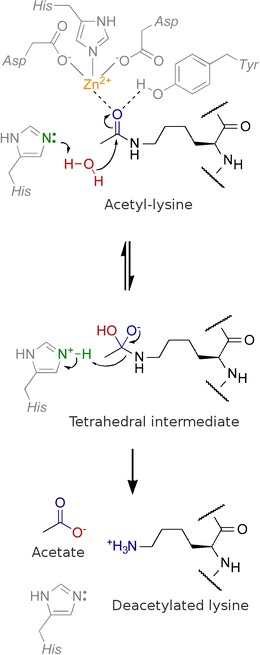
Histone modifications have widely been implicated in cancer development and progression and are potentially reversible by drug treatments. The N-terminal tails of each histone extend outward through the DNA strand containing amino acid residues modified by posttranslational acetylation, methylation, and phosphorylation. These modifications change the secondary structure of the histone protein tails in relation to the DNA strands, increasing the distance between DNA and histones, and thus allowing accessibility of transcription factors to gene promoter regions. A large number of HDAC inhibitors have been synthesized in the last few years, most being effective in vitro, inducing cancer cells differentiation or cell death. The majority of the inhibitors are in clinical trials, unlike the suberoylanilide hydroxamic acid, a pan-HDACi, and Romidepsin (FK 228), a class I-selective HDACi, which are only approved in the second line treatment of refractory, persistent or relapsed cutaneous T-cell lymphoma, and active in approximately 150 clinical trials, in monotherapy or in association. Preclinical studies investigated the use of these drugs in clinical practice, as single agents and in combination with chemotherapy, hypomethylating agents, proteasome inhibitors, and MTOR inhibitors, showing a significant effect mostly in hematological malignancies. The aim of this review is to focus on the biological features of these drugs, analyzing the possible mechanism(s) of action and outline an overview on the current use in the clinical practice.
组蛋白修饰广泛参与癌症的发生和发展,并且可以通过药物治疗来逆转。每个组蛋白的 N 端尾部通过包含翻译后乙酰化、甲基化和磷酸化修饰的氨基酸残基的 DNA 链向外延伸。这些修饰改变了组蛋白尾部的二级结构与 DNA 链之间的关系,增加了 DNA 和组蛋白之间的距离,从而允许转录因子接近基因启动子区域。在过去的几年中,已经合成了大量的 HDAC 抑制剂,其中大多数在体外有效,诱导癌细胞分化或死亡。大多数抑制剂都在临床试验中,而不像泛 HDACi 中的 suberoylanilide 羟肟酸和选择性 I 类 HDACi Romidepsin(FK 228),它们仅被批准用于治疗难治性、持续性或复发性皮肤 T 细胞淋巴瘤的二线治疗,并且在大约 150 项临床试验中活跃,单独使用或联合使用。临床前研究调查了这些药物在临床实践中的应用,作为单一药物以及与化疗、去甲基化剂、蛋白酶体抑制剂和 MTOR 抑制剂联合使用,在血液恶性肿瘤中显示出显著效果。本文的目的是关注这些药物的生物学特征,分析可能的作用机制,并概述它们在临床实践中的当前应用。