Department of Internal Medicine, Kyungpook National University School of Medicine, Daegu, Korea.
Korean J Intern Med. 2012 Jun;27(2):171-9. doi: 10.3904/kjim.2012.27.2.171. Epub 2012 May 31.
BACKGROUND/AIMS: Frequent pathogens of nosocomial meningitis were investigated and the adequacy of empiric antibiotic therapy was assessed. Outcomes of nosocomial meningitis were also evaluated.
Ninety-one patients, who were diagnosed and treated for nosocomial meningitis at a single tertiary hospital in Daegu, Korea for 10 years, were included. Medical record and electronic laboratory data on the causative pathogens, antibiotics used, and outcomes were retrospectively investigated.
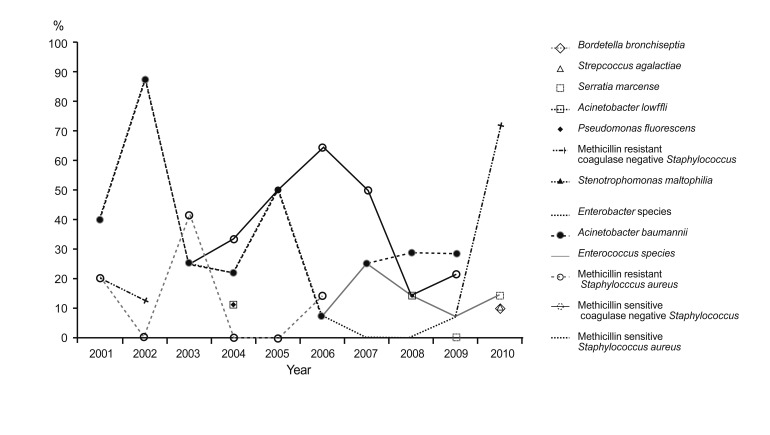
Coagulase-negative Staphylococcus (40.9%) was the most common pathogen, followed by Acinetobacter (32.5%). Both were cultured as a single organism in cerebrospinal fluid (CSF). Seventy-eight patients (85.7%) had infections related to external ventricular drains (EVD). The most common empirical antibiotics were extended-spectrum beta-lactam antibiotics plus vancomycin (35/91, 38.6%). Of the 27 patients who had cultured Acinetobacter in CSF, 10 (37%) were given the wrong empirical antibiotic treatment. Seven of the 27 patients (26.9%) with cultured Acinetobacter died, and overall mortality of the 91 patients was 16.5%. In the multivariate analysis, the presence of combined septic shock (p < 0.001) and a persistent EVD state (p = 0.021) were associated with a poor prognosis.
Acinetobacter is one of the leading pathogens of nosocomial meningitis and may lead to inadequate coverage of empiric antibiotic therapy due to increasing resistance. An EVD should be removed early in cases of suspected nosocomial meningitis, and carbapenem might be required for the poor treatment response.
背景/目的:调查医院获得性脑膜炎的常见病原体,并评估经验性抗生素治疗的充分性。还评估了医院获得性脑膜炎的结局。
纳入韩国大邱一家三级医院 10 年来诊断和治疗的 91 例医院获得性脑膜炎患者。回顾性调查了病原体、使用的抗生素和结局的病历和电子实验室数据。
凝固酶阴性葡萄球菌(40.9%)是最常见的病原体,其次是不动杆菌(32.5%)。两者均在脑脊液(CSF)中培养为单一生物。78 例(85.7%)患者的感染与外部脑室引流(EVD)有关。最常见的经验性抗生素是广谱β-内酰胺抗生素加万古霉素(35/91,38.6%)。在 27 例 CSF 培养出不动杆菌的患者中,10 例(37%)接受了错误的经验性抗生素治疗。27 例培养出不动杆菌的患者中有 7 例(26.9%)死亡,91 例患者的总死亡率为 16.5%。多变量分析显示,合并败血症性休克(p<0.001)和持续 EVD 状态(p=0.021)与不良预后相关。
不动杆菌是医院获得性脑膜炎的主要病原体之一,由于耐药性增加,可能导致经验性抗生素治疗覆盖不足。在疑似医院获得性脑膜炎的情况下,应尽早移除 EVD,对于治疗反应不佳的患者可能需要使用碳青霉烯类药物。