Interfaculty Institute for Biochemistry, University of Tübingen, Tübingen, Germany.
Curr Protein Pept Sci. 2012 Jun;13(4):284-93. doi: 10.2174/138920312801619493.
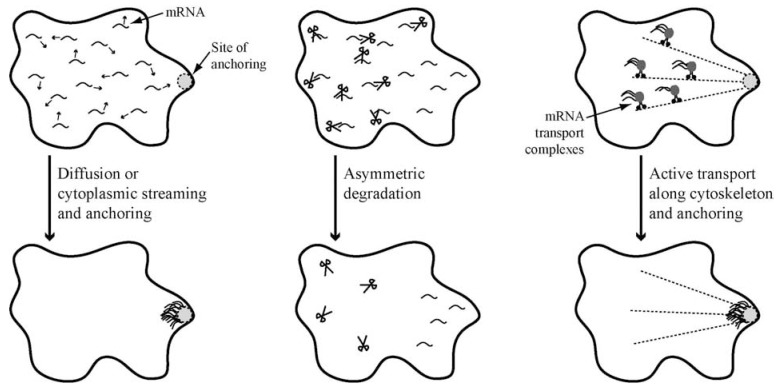
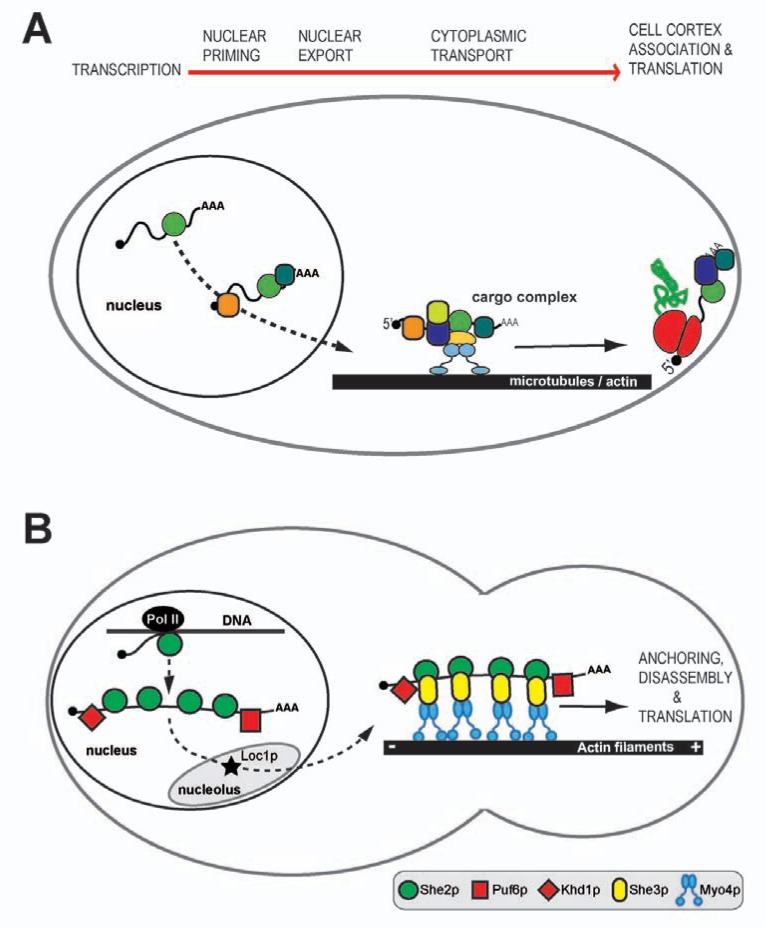
At all steps from transcription to translation, RNA-binding proteins play important roles in determining mRNA function. Initially it was believed that for the vast majority of transcripts the role of RNA-binding proteins is limited to general functions such as splicing and translation. However, work from recent years showed that members of this class of proteins also recognize several mRNAs via cis-acting elements for their incorporation into large motor-containing particles. These particles are transported to distant subcellular sites, where they become subsequently translated. This process, called mRNA localization, occurs along microtubules or actin filaments, and involves kinesins, dyneins, as well as myosins. Although mRNA localization has been detected in a large number of organisms from fungi to humans, the underlying molecular machineries are not well understood. In this review we will outline general principles of mRNA localization and highlight three examples, for which a comparably large body of information is available. The first example is She2p/She3p-dependent localization of ASH1 mRNA in budding yeast. It is particularly well suited to highlight the interdependence between different steps of mRNA localization. The second example is Staufen-dependent localization of oskar mRNA in the Drosophila embryo, for which the importance of nuclear events for cytoplasmic localization and translational control has been clearly demonstrated. The third example summarizes Egalitarian/Bicaudal D-dependent mRNA transport events in the oocyte and embryo of Drosophila. We will highlight general themes and differences, point to similarities in other model systems, and raise open questions that might be answered in the coming years.
在从转录到翻译的所有步骤中,RNA 结合蛋白在确定 mRNA 功能方面发挥着重要作用。最初人们认为,对于绝大多数转录物来说,RNA 结合蛋白的作用仅限于一般功能,如剪接和翻译。然而,近年来的工作表明,该蛋白类的成员还通过顺式作用元件识别几种 mRNA,将其纳入大型运动蛋白包含的颗粒中。这些颗粒被运送到远离细胞质的亚细胞部位,在那里它们随后被翻译。这个过程称为 mRNA 定位,沿着微管或肌动蛋白丝发生,并涉及驱动蛋白、动力蛋白以及肌球蛋白。尽管已经在从真菌到人类的大量生物体中检测到 mRNA 定位,但对于其潜在的分子机制还了解甚少。在这篇综述中,我们将概述 mRNA 定位的一般原则,并重点介绍三个例子,这些例子提供了大量相关信息。第一个例子是芽殖酵母中 She2p/She3p 依赖性 ASH1 mRNA 的定位。它特别适合于突出 mRNA 定位的不同步骤之间的相互依赖性。第二个例子是果蝇胚胎中 Staufen 依赖性 oskar mRNA 的定位,其中核事件对细胞质定位和翻译控制的重要性已经得到明确证明。第三个例子总结了果蝇卵子和胚胎中 Egalitarian/Bicaudal D 依赖性 mRNA 运输事件。我们将强调一般主题和差异,指出其他模型系统中的相似之处,并提出可能在未来几年得到解答的开放性问题。