
莫顿神经瘤的磁共振成像和超声检查:诊断准确性及相关性
MRI and ultrasonography in Morton's neuroma: Diagnostic accuracy and correlation.
作者信息
Torres-Claramunt R, Ginés A, Pidemunt G, Puig Ll, de Zabala S
机构信息
Orthopaedic Department of the Parc de Salut Mar. Passeig Marítim 25-29, 08003 Barcelona, Spain.
出版信息
Indian J Orthop. 2012 May;46(3):321-5. doi: 10.4103/0019-5413.96390.
BACKGROUND
The diagnosis of Morton's neuroma is based primarily on clinical findings. Ultrasonography (US) and magnetic resonance image (MRI) studies are considered complementary diagnostic techniques. The aim of this study was to establish the correlation and sensitivity of both techniques used to diagnose Morton's neuroma.
MATERIALS AND METHODS
Thirty seven patients (43 intermetatarsal spaces) with Morton's neuroma operated were retrospectively reviewed. In all cases MRI or ultrasound was performed to complement clinical diagnosis of Morton's neuroma. In all cases, a histopathological examination confirmed the diagnosis. Estimates of sensitivity were made and correlation (kappa statistics) was assessed for both techniques.
RESULTS
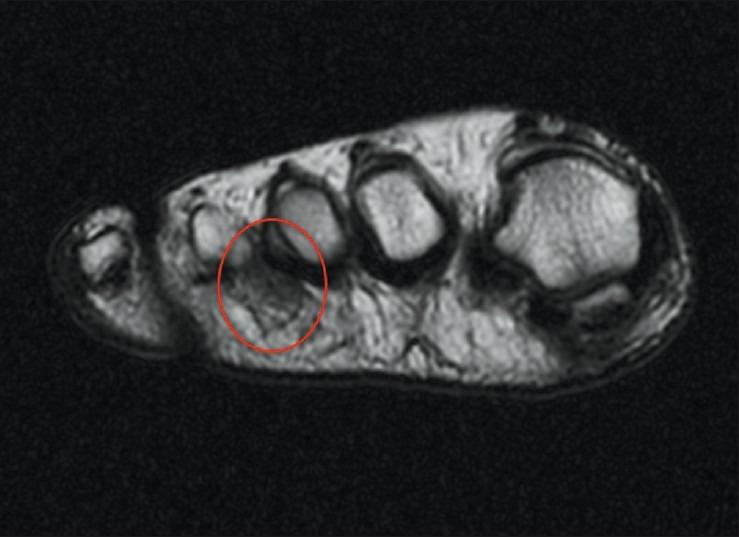
Twenty seven women and 10 men participated with a mean age of 60 years. Double lesions presented in six patients. The second intermetatarsal space was affected in 10 patients and the third in 33 patients. An MRI was performed in 41 cases and a US in 23 cases. In 21 patients, both an MRI and a US were performed. With regard to the 41 MRIs performed, 34 were positive for Morton's neuroma and 7 were negative. MRI sensitivity was 82.9% [95% confidence interval (CI): 0.679-0.929]. Thirteen out of 23 US performed were positive and 10 US were negative. US sensitivity was 56.5% (95% CI: 0.345-0.768). Relative to the 21 patients on whom both techniques were carried out, the agreement between both techniques was poor (kappa statistics 0.31).
CONCLUSION
Although ancillary studies may be required to confirm the clinical diagnosis in some cases, they are probably not necessary for the diagnosis of Morton's neuroma. MRI had a higher sensitivity than US and should be considered the technique of choice in those cases. However, a negative result does not exclude the diagnosis (false negative 17%).
背景
Morton 神经瘤的诊断主要基于临床表现。超声检查(US)和磁共振成像(MRI)研究被认为是辅助诊断技术。本研究的目的是确定用于诊断 Morton 神经瘤的这两种技术的相关性和敏感性。
材料与方法
回顾性分析 37 例接受 Morton 神经瘤手术的患者(43 个跖间隙)。所有病例均进行了 MRI 或超声检查以辅助 Morton 神经瘤的临床诊断。所有病例均经组织病理学检查确诊。对两种技术进行了敏感性评估并评估了相关性(kappa 统计量)。
结果
27 名女性和 10 名男性参与,平均年龄 60 岁。6 例患者出现双侧病变。10 例患者的第二跖间隙受累,33 例患者的第三跖间隙受累。41 例患者进行了 MRI 检查,23 例患者进行了超声检查。21 例患者同时进行了 MRI 和超声检查。在进行的 41 次 MRI 检查中,34 次对 Morton 神经瘤呈阳性,7 次呈阴性。MRI 的敏感性为 82.9%[95%置信区间(CI):0.679 - 0.929]。23 次超声检查中有 13 次呈阳性,10 次呈阴性。超声的敏感性为 56.5%(95%CI:0.345 - 0.768)。相对于同时进行两种技术检查的 21 例患者,两种技术之间的一致性较差(kappa 统计量为 0.31)。
结论
尽管在某些情况下可能需要辅助检查来确认临床诊断,但对于 Morton 神经瘤的诊断可能并非必要。MRI 的敏感性高于超声,在这些情况下应被视为首选技术。然而,阴性结果并不能排除诊断(假阴性率为 17%)。

 Zotero 插件