Chaikuad Apirat, Pilka Ewa S, De Riso Antonio, von Delft Frank, Kavanagh Kathryn L, Vénien-Bryan Catherine, Oppermann Udo, Yue Wyatt W
Structural Genomics Consortium, Old Road Research Campus Building, Oxford OX3 7DQ, UK.
BMC Struct Biol. 2012 Jun 21;12:14. doi: 10.1186/1472-6807-12-14.
Aspartyl aminopeptidase (DNPEP), with specificity towards an acidic amino acid at the N-terminus, is the only mammalian member among the poorly understood M18 peptidases. DNPEP has implicated roles in protein and peptide metabolism, as well as the renin-angiotensin system in blood pressure regulation. Despite previous enzyme and substrate characterization, structural details of DNPEP regarding ligand recognition and catalytic mechanism remain to be delineated.
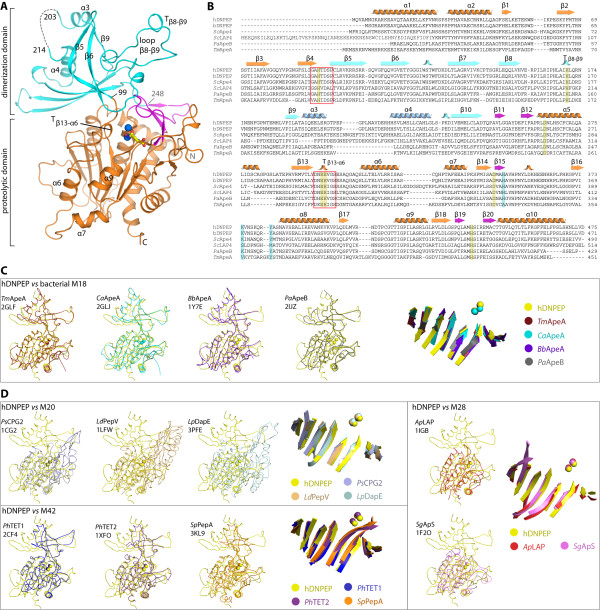
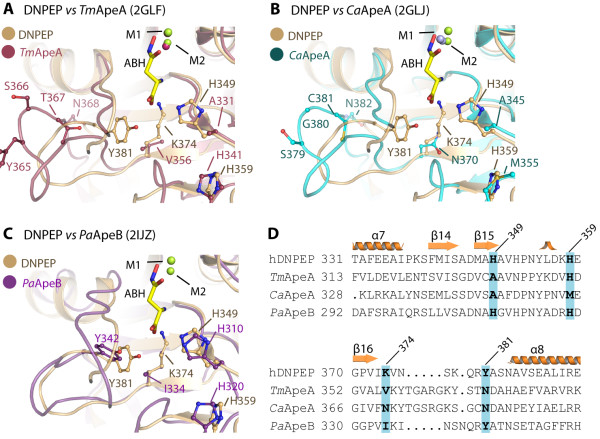
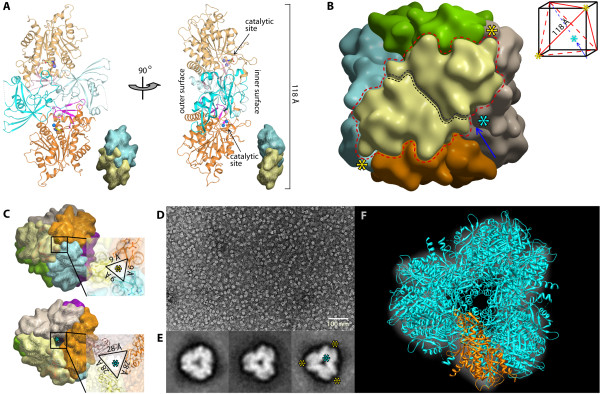
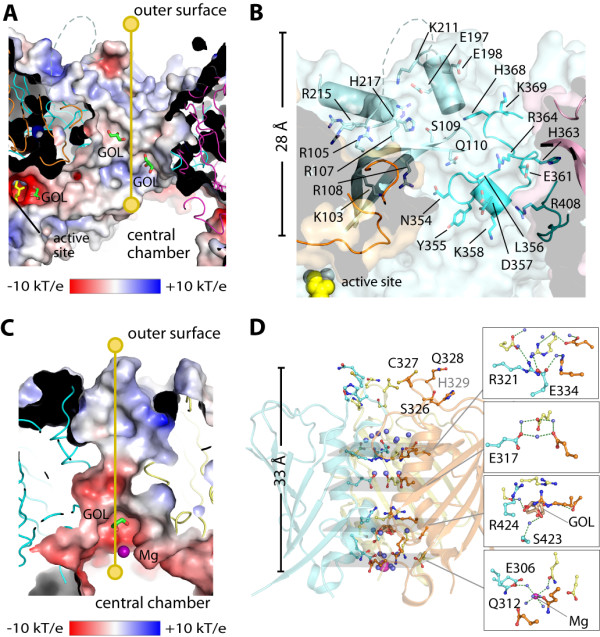
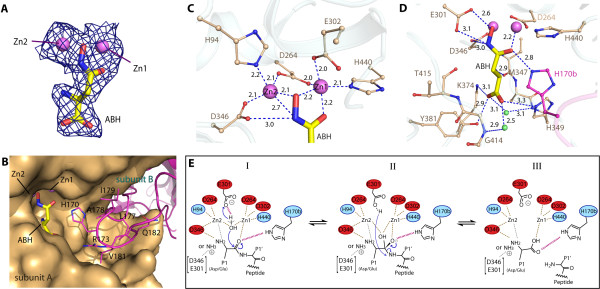
The crystal structure of human DNPEP complexed with zinc and a substrate analogue aspartate-β-hydroxamate reveals a dodecameric machinery built by domain-swapped dimers, in agreement with electron microscopy data. A structural comparison with bacterial homologues identifies unifying catalytic features among the poorly understood M18 enzymes. The bound ligands in the active site also reveal the coordination mode of the binuclear zinc centre and a substrate specificity pocket for acidic amino acids.
The DNPEP structure provides a molecular framework to understand its catalysis that is mediated by active site loop swapping, a mechanism likely adopted in other M18 and M42 metallopeptidases that form dodecameric complexes as a self-compartmentalization strategy. Small differences in the substrate binding pocket such as shape and positive charges, the latter conferred by a basic lysine residue, further provide the key to distinguishing substrate preference. Together, the structural knowledge will aid in the development of enzyme-/family-specific aminopeptidase inhibitors.
天冬氨酰氨基肽酶(DNPEP)对N端的酸性氨基酸具有特异性,是了解较少的M18肽酶中唯一的哺乳动物成员。DNPEP在蛋白质和肽代谢以及血压调节中的肾素 - 血管紧张素系统中发挥作用。尽管先前对该酶及其底物进行了表征,但DNPEP在配体识别和催化机制方面的结构细节仍有待阐明。
与锌和底物类似物天冬氨酸-β-异羟肟酸复合的人DNPEP晶体结构揭示了由结构域交换二聚体构建的十二聚体结构,这与电子显微镜数据一致。与细菌同源物的结构比较确定了在了解较少的M18酶中统一的催化特征。活性位点中的结合配体还揭示了双核锌中心的配位模式以及酸性氨基酸的底物特异性口袋。
DNPEP结构提供了一个分子框架,以了解其由活性位点环交换介导的催化作用,这种机制可能也被其他形成十二聚体复合物作为自我区室化策略的M18和M42金属肽酶所采用。底物结合口袋中的微小差异,如形状和正电荷(由碱性赖氨酸残基赋予),进一步提供了区分底物偏好的关键。总之,这些结构知识将有助于开发酶/家族特异性氨基肽酶抑制剂。