Faculty of Social and Behavioral Sciences, Institute of Psychology, Unit Developmental and Educational Psychology, Leiden University, Pieter de la Court building, P.O. Box 9555, 2300 RB, Leiden, The Netherlands.
J Abnorm Child Psychol. 2013 Jan;41(1):97-110. doi: 10.1007/s10802-012-9651-6.
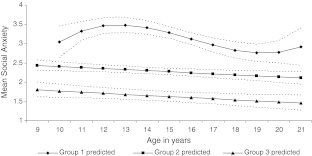
This cohort-sequential study examined developmental trajectories of social anxiety in a nonclinical sample (N = 331, 161 girls) aged 9 to 17 years at initial and 12 to 21 years at final assessment. We tested whether variables assessing cognition, social competence, and temperament discriminated between the trajectories. Variables were collected from different sources: participants, independent observers, parents, and teachers. Using Latent Class Growth Modeling (LCGM) we identified three distinct social anxiety trajectory groups: i) high and changing; ii) moderate and decreasing; and iii) low and decreasing. Multinomial regression analyses showed that the cognition variables, negative interpretations of ambiguous social situations and self-focused attention, differentiated between all three trajectories. A lack of social skills and having social problems at school were specifically related to the chance of following the high trajectory versus the moderate trajectory. Neuroticism differentiated between the low and moderate trajectories. Findings indicate that adolescents at risk of belonging to a high social anxiety trajectory can be discriminated from peers belonging to a less anxious trajectory using both cognition and social competence variables.
本队列序列研究在非临床样本(N=331 名,其中 161 名为女孩)中考察了社交焦虑的发展轨迹,这些样本在初始时年龄为 9 至 17 岁,在最终评估时年龄为 12 至 21 岁。我们检验了评估认知、社交能力和气质的变量是否可以区分不同的轨迹。变量来自不同的来源:参与者、独立观察者、父母和教师。我们使用潜在类别增长模型(LCGM)识别了三个不同的社交焦虑轨迹组:i)高且变化;ii)中且下降;iii)低且下降。多项回归分析表明,认知变量,即对模棱两可的社交情境的负面解释和自我关注,可区分所有三个轨迹。缺乏社交技能和在学校存在社交问题与处于高轨迹而非中轨迹的几率相关。神经质则可区分低和中轨迹。研究结果表明,使用认知和社交能力变量,可以将处于高社交焦虑轨迹风险的青少年与属于焦虑程度较低的轨迹的同龄人区分开来。