Department of Otorhinolaryngology, University of Regensburg, Regensburg, Germany.
PLoS One. 2012;7(6):e38887. doi: 10.1371/journal.pone.0038887. Epub 2012 Jun 19.
Tinnitus is considered to be highly heterogeneous with respect to its etiology, its comorbidities and the response to specific interventions. Subtyping is recommended, but it remains to be determined which criteria are useful, since it has not yet been clearly demonstrated whether and to which extent etiologic factors, comorbid states and interventional response are related to each other and are thus applicable for subtyping tinnitus. Analyzing the Tinnitus Research Initiative Database we differentiated patients according to presence or absence of comorbid temporomandibular joint (TMJ) disorder complaints and compared the two groups with respect to etiologic factors.
1204 Tinnitus patients from the Tinnitus Research Initiative (TRI) Database with and without subjective TMJ complaints were compared with respect to demographic, tinnitus and audiological characteristics, questionnaires, and numeric ratings. Data were analysed according to a predefined statistical analysis plan.
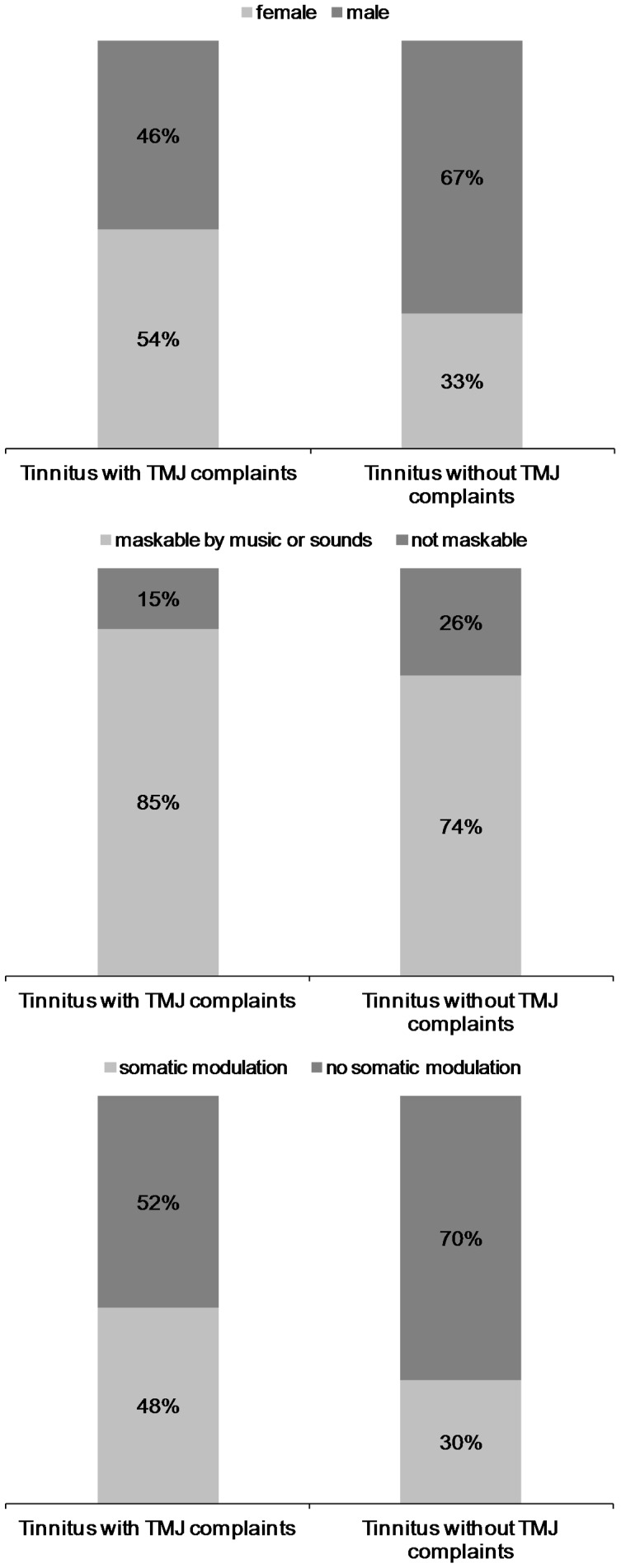
Tinnitus patients with TMJ complaints (22% of the whole group) were significantly younger, had a lower age at tinnitus onset, and were more frequently female. They could modulate or mask their tinnitus more frequently by somatic maneuvers and by music or sound stimulation. Groups did not significantly differ for tinnitus duration, type of onset (gradual/abrupt), onset related events (whiplash etc.), character (pulsatile or not), hyperacusis, hearing impairment, tinnitus distress, depression, quality of life and subjective ratings (loudness etc.).
Replicating previous work in tinnitus patients with TMJ complaints, classical risk factors for tinnitus like older age and male gender are less relevant in tinnitus patients with TMJ complaints. By demonstrating group differences for modulation of tinnitus by movements and sounds our data further support the notion that tinnitus with TMJ complaints represents a subgroup of tinnitus with clinical features that are highly relevant for specific therapeutic management.
耳鸣在病因、合并症和对特定干预措施的反应方面被认为具有高度异质性。推荐进行亚型分类,但仍需确定哪些标准是有用的,因为尚未清楚表明病因因素、合并症状态和干预反应之间是否以及在何种程度上相互关联,因此是否适用于耳鸣的亚型分类。通过分析耳鸣研究倡议数据库,我们根据是否存在合并颞下颌关节(TMJ)紊乱的抱怨来区分患者,并比较了两组患者在病因因素方面的差异。
将来自耳鸣研究倡议(TRI)数据库的 1204 名耳鸣患者(有或无主观 TMJ 抱怨)根据人口统计学、耳鸣和听力特征、问卷和数字评分进行比较。根据预先规定的统计分析计划对数据进行分析。
有 TMJ 抱怨的耳鸣患者(占总人群的 22%)明显更年轻,耳鸣发病年龄更小,且女性更为常见。他们通过躯体运动以及音乐或声音刺激更频繁地调节或掩蔽耳鸣。两组患者在耳鸣持续时间、起病类型(逐渐/突然)、起病相关事件(鞭打等)、特征(搏动性或非搏动性)、听觉过敏、听力损失、耳鸣困扰、抑郁、生活质量和主观评分(响度等)方面无显著差异。
与 TMJ 抱怨的耳鸣患者的先前工作相吻合,耳鸣的经典危险因素,如年龄较大和男性,在 TMJ 抱怨的耳鸣患者中相关性较低。通过证明运动和声音对耳鸣调节的组间差异,我们的数据进一步支持这样一种观点,即 TMJ 抱怨的耳鸣代表了耳鸣的一个亚组,其临床特征与特定治疗管理密切相关。