Neurobiology Sector and Italian Institute of Technology Unit, Scuola Internazionale Superiore di Studi Avanzati (SISSA), 34136 Trieste, Italy.
J Gen Physiol. 2012 Jul;140(1):3-15. doi: 10.1085/jgp.201210780.
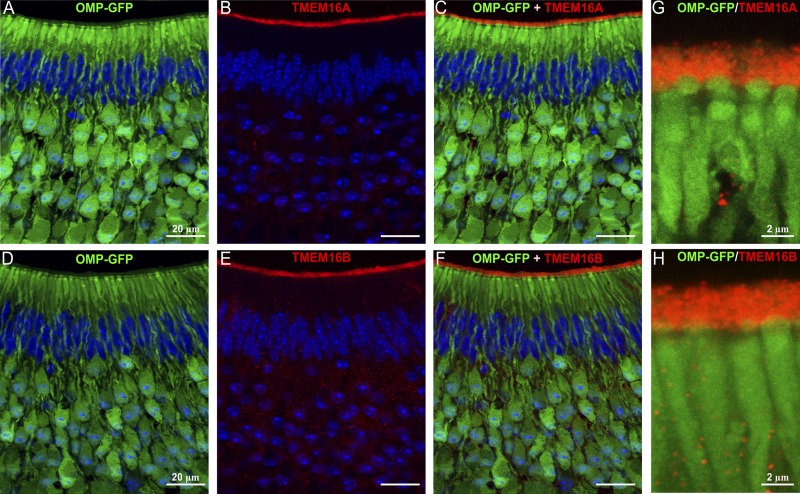
The rodent vomeronasal organ plays a crucial role in several social behaviors. Detection of pheromones or other emitted signaling molecules occurs in the dendritic microvilli of vomeronasal sensory neurons, where the binding of molecules to vomeronasal receptors leads to the influx of sodium and calcium ions mainly through the transient receptor potential canonical 2 (TRPC2) channel. To investigate the physiological role played by the increase in intracellular calcium concentration in the apical region of these neurons, we produced localized, rapid, and reproducible increases in calcium concentration with flash photolysis of caged calcium and measured calcium-activated currents with the whole cell voltage-clamp technique. On average, a large inward calcium-activated current of -261 pA was measured at -50 mV, rising with a time constant of 13 ms. Ion substitution experiments showed that this current is anion selective. Moreover, the chloride channel blockers niflumic acid and 4,4'-diisothiocyanatostilbene-2,2'-disulfonic acid partially inhibited the calcium-activated current. These results directly demonstrate that a large chloride current can be activated by calcium in the apical region of mouse vomeronasal sensory neurons. Furthermore, we showed by immunohistochemistry that the calcium-activated chloride channels TMEM16A/anoctamin1 and TMEM16B/anoctamin2 are present in the apical layer of the vomeronasal epithelium, where they largely colocalize with the TRPC2 transduction channel. Immunocytochemistry on isolated vomeronasal sensory neurons showed that TMEM16A and TMEM16B coexpress in the neuronal microvilli. Therefore, we conclude that microvilli of mouse vomeronasal sensory neurons have a high density of calcium-activated chloride channels that may play an important role in vomeronasal transduction.
啮齿动物的犁鼻器在几种社会行为中起着至关重要的作用。信息素或其他分泌信号分子的检测发生在犁鼻感觉神经元的树突微绒毛中,其中分子与犁鼻受体的结合导致钠离子和钙离子主要通过瞬时受体电位经典型 2(TRPC2)通道内流。为了研究这些神经元细胞内钙浓度增加所发挥的生理作用,我们使用笼锁钙的光解产生局部、快速且可重现的钙浓度升高,并使用全细胞膜片钳技术测量钙激活电流。平均而言,在 -50 mV 时测量到-261 pA 的大内向钙激活电流,其上升时间常数为 13 ms。离子取代实验表明,该电流具有阴离子选择性。此外,氯通道阻滞剂 niflumic acid 和 4,4'-二异硫氰酸基-stilbene-2,2'-disulfonic acid 部分抑制了钙激活电流。这些结果直接表明,在小鼠犁鼻感觉神经元的顶端区域,氯离子可以被钙激活。此外,我们通过免疫组织化学显示,钙激活氯离子通道 TMEM16A/anoctamin1 和 TMEM16B/anoctamin2 存在于犁鼻上皮的顶端层中,在那里它们与 TRPC2 转导通道大量共定位。对分离的犁鼻感觉神经元进行免疫细胞化学染色显示,TMEM16A 和 TMEM16B 在神经元微绒毛中共表达。因此,我们得出结论,小鼠犁鼻感觉神经元的微绒毛具有高密度的钙激活氯离子通道,这可能在犁鼻转导中发挥重要作用。