• 文献检索
  • 文档翻译
  • 深度研究
  • 学术资讯
  • Suppr Zotero 插件Zotero 插件
  • 邀请有礼
  • 套餐&价格
  • 历史记录
应用&插件
Suppr Zotero 插件Zotero 插件浏览器插件Mac 客户端Windows 客户端微信小程序
定价
高级版会员购买积分包购买API积分包
服务
文献检索文档翻译深度研究API 文档MCP 服务
关于我们
关于 Suppr公司介绍联系我们用户协议隐私条款
关注我们

Suppr 超能文献

核心技术专利:CN118964589B侵权必究
粤ICP备2023148730 号-1Suppr @ 2026

文献检索

告别复杂PubMed语法,用中文像聊天一样搜索,搜遍4000万医学文献。AI智能推荐,让科研检索更轻松。

立即免费搜索

文件翻译

保留排版,准确专业,支持PDF/Word/PPT等文件格式,支持 12+语言互译。

免费翻译文档

深度研究

AI帮你快速写综述,25分钟生成高质量综述,智能提取关键信息,辅助科研写作。

立即免费体验

踝足矫形器对 II 期胫骨后肌腱功能障碍患者足部运动学的影响。

Effect of ankle-foot orthotic devices on foot kinematics in Stage II posterior tibial tendon dysfunction.

机构信息

SUNY Upstate Medical University, Syracuse, NY 13210, USA.

出版信息

Foot Ankle Int. 2012 May;33(5):406-14. doi: 10.3113/FAI.2012.0406.

DOI:10.3113/FAI.2012.0406
PMID:22735283
原文链接:https://pmc.ncbi.nlm.nih.gov/articles/PMC5771477/
Abstract

BACKGROUND

Data are limited on the various orthotic devices available for patients with Stage II posterior tibial tendon dysfunction (PTTD). Foot kinematics observed while walking with an orthotic device are hypothesized to be associated with clinical outcomes and could be used to refine future device designs.

METHODS

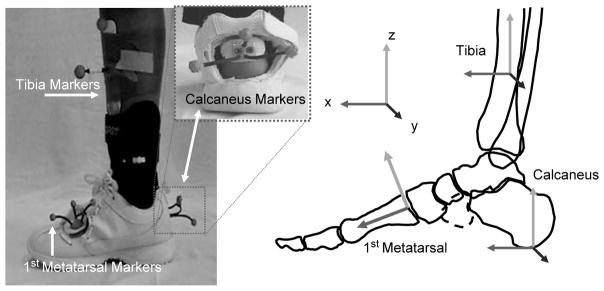
Fifteen subjects (age, 63.6 ± 6.8 years) with Stage II PTTD walked in the lab under four conditions: (1) shoe only (control condition), (2) shoe with a custom solid AFO (Arizona Co, Mesa, AZ), (3) shoe with a custom articulated AFO (Arizona Co, Mesa, AZ), and (4) shoe with an off-the-shelf AFO (AirLift, DJ Orthopedics). Kinematic data were collected to determine the degree of hindfoot inversion, forefoot plantarflexion (reflective of raising the MLA), and forefoot adduction associated with each condition.

RESULTS

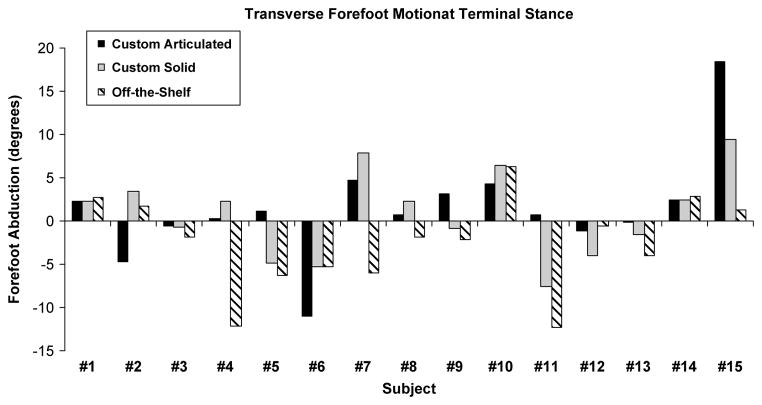
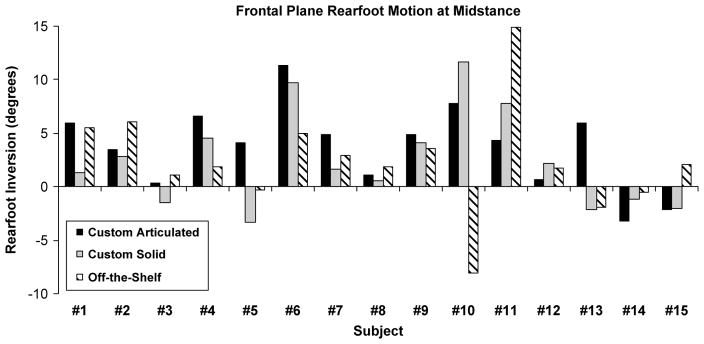
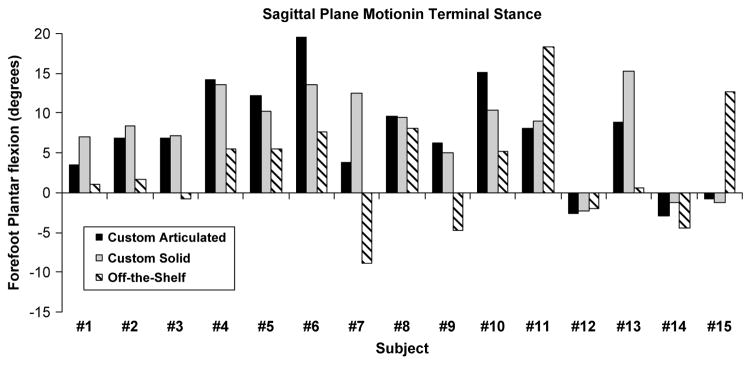
The custom articulated device was associated with greater hindfoot inversion compared to the shoe only condition at loading response (p = 0.002), mid-stance (p < 0.001), and terminal stance (p = 0.02). The custom articulated device, custom solid device, and off-the-shelf device were associated with greater forefoot plantarflexion compared to the shoe only condition across all four phases of stance. There were no differences between any of the devices and the shoe condition associated with forefoot adduction.

CONCLUSION

The custom devices were associated with greater hindfoot inversion and forefoot plantarflexion compared to walking with only a shoe, while the off-the-shelf device was associated with forefoot plantarflexion but no change in hindfoot motion. None of the devices corrected forefoot abduction compared to the shoe only condition.

CLINICAL RELEVANCE

The current biomechanical data may aid in understanding the clinical outcomes seen using these devices as well as provide data to support new designs.

摘要

背景

对于患有 II 期胫骨后肌腱功能障碍 (PTTD) 的患者,可提供的各种矫形器数据有限。 当使用矫形器行走时,观察到的足部运动学被假设与临床结果相关,并可用于改进未来的设备设计。

方法

15 名年龄为 63.6 ± 6.8 岁的 II 期 PTTD 患者在实验室中在四种情况下行走:(1)仅穿鞋(对照条件),(2)鞋加定制实心 AFO(Arizona Co, Mesa,AZ),(3)鞋加定制铰接式 AFO(Arizona Co,Mesa,AZ)和(4)带现成 AFO(AirLift,DJ Orthopedics)的鞋。 收集运动学数据以确定与每种情况相关的后足内翻,前足跖屈(反映抬高 MLA)和前足内收的程度。

结果

与仅穿鞋的情况相比,定制铰接式装置在负荷反应(p = 0.002),中步(p <0.001)和终步(p = 0.02)时与更大的后足内翻相关。 与仅穿鞋的情况相比,定制铰接式装置,定制实心装置和现成装置在整个四个站立阶段都与更大的前足跖屈相关。 任何设备与鞋子条件之间都没有与前脚内收相关的差异。

结论

与仅穿鞋相比,定制设备与更大的后足内翻和前足跖屈相关,而现成设备与前足跖屈相关,但后足运动没有变化。 与仅穿鞋的情况相比,没有任何设备纠正前脚外展。

临床相关性

当前的生物力学数据可能有助于理解使用这些设备获得的临床结果,并提供支持新设计的数据。
https://cdn.ncbi.nlm.nih.gov/pmc/blobs/b452/5771477/dee2edcda120/nihms933427f4.jpg
https://cdn.ncbi.nlm.nih.gov/pmc/blobs/b452/5771477/8c0f5f6ff088/nihms933427f1.jpg
https://cdn.ncbi.nlm.nih.gov/pmc/blobs/b452/5771477/67d05f950f6a/nihms933427f2.jpg
https://cdn.ncbi.nlm.nih.gov/pmc/blobs/b452/5771477/d3262f903dad/nihms933427f3.jpg
https://cdn.ncbi.nlm.nih.gov/pmc/blobs/b452/5771477/dee2edcda120/nihms933427f4.jpg
https://cdn.ncbi.nlm.nih.gov/pmc/blobs/b452/5771477/8c0f5f6ff088/nihms933427f1.jpg
https://cdn.ncbi.nlm.nih.gov/pmc/blobs/b452/5771477/67d05f950f6a/nihms933427f2.jpg
https://cdn.ncbi.nlm.nih.gov/pmc/blobs/b452/5771477/d3262f903dad/nihms933427f3.jpg
https://cdn.ncbi.nlm.nih.gov/pmc/blobs/b452/5771477/dee2edcda120/nihms933427f4.jpg

相似文献

1
Effect of ankle-foot orthotic devices on foot kinematics in Stage II posterior tibial tendon dysfunction.踝足矫形器对 II 期胫骨后肌腱功能障碍患者足部运动学的影响。
Foot Ankle Int. 2012 May;33(5):406-14. doi: 10.3113/FAI.2012.0406.
2
An Ankle-Foot Orthosis With a Lateral Extension Reduces Forefoot Abduction in Subjects With Stage II Posterior Tibial Tendon Dysfunction.一种带有外侧延伸的踝足矫形器可减少II期胫后肌腱功能障碍患者的前足外展。
J Orthop Sports Phys Ther. 2016 Jan;46(1):26-33. doi: 10.2519/jospt.2016.5618. Epub 2015 Dec 11.
3
Choosing among 3 ankle-foot orthoses for a patient with stage II posterior tibial tendon dysfunction.为一位患有 II 期胫骨后肌腱功能障碍的患者在 3 种踝足矫形器中进行选择。
J Orthop Sports Phys Ther. 2009 Nov;39(11):816-24. doi: 10.2519/jospt.2009.3107.
4
Effects of the AirLift PTTD brace on foot kinematics in subjects with stage II posterior tibial tendon dysfunction.AirLift PTTD 支具对 II 期胫后肌腱功能不全患者足部运动学的影响。
J Orthop Sports Phys Ther. 2009 Mar;39(3):201-9. doi: 10.2519/jospt.2009.2908.
5
Comparison of foot kinematics between subjects with posterior tibialis tendon dysfunction and healthy controls.患有胫后肌腱功能障碍的受试者与健康对照组之间足部运动学的比较。
J Orthop Sports Phys Ther. 2006 Sep;36(9):635-44. doi: 10.2519/jospt.2006.2293.
6
Comparison of changes in posterior tibialis muscle length between subjects with posterior tibial tendon dysfunction and healthy controls during walking.患有胫后肌腱功能障碍的受试者与健康对照者在行走过程中胫后肌长度变化的比较。
J Orthop Sports Phys Ther. 2007 Nov;37(11):661-9. doi: 10.2519/jospt.2007.2539.
7
Biomechanical effects of three types of foot orthoses in individuals with posterior tibial tendon dysfunction.三种足弓垫对胫骨后肌腱功能障碍患者的生物力学影响。
Gait Posture. 2021 Jan;83:237-244. doi: 10.1016/j.gaitpost.2020.11.001. Epub 2020 Nov 6.
8
Ankle and foot kinematics associated with stage II PTTD during stance.站立期与II期胫后肌腱功能障碍相关的踝关节和足部运动学。
Foot Ankle Int. 2009 Jun;30(6):530-9. doi: 10.3113/FAI.2009.0530.
9
Foot and ankle kinematics in patients with posterior tibial tendon dysfunction.胫后肌腱功能障碍患者的足踝关节运动学
Gait Posture. 2008 Feb;27(2):331-9. doi: 10.1016/j.gaitpost.2007.04.014. Epub 2007 Jun 20.
10
Gait alterations in posterior tibial tendonitis: A systematic review and meta-analysis.胫后肌腱炎的步态改变:一项系统评价和荟萃分析。
Gait Posture. 2020 Feb;76:28-38. doi: 10.1016/j.gaitpost.2019.11.002. Epub 2019 Nov 4.

引用本文的文献

1
Republication of "Uses of Braces and Orthotics for Conservative Management of Foot and Ankle Disorders".《支具和矫形器在足踝疾病保守治疗中的应用》再版
Foot Ankle Orthop. 2023 Aug 6;8(3):24730114231193419. doi: 10.1177/24730114231193419. eCollection 2023 Jul.
2
Characteristics and Future Direction of Tibialis Posterior Tendinopathy Research: A Scoping Review.跟腱后滑囊炎的研究特点及未来方向:范围综述。
Medicina (Kaunas). 2022 Dec 16;58(12):1858. doi: 10.3390/medicina58121858.
3
[Etiology, pathogenesis, clinical features, diagnostics and conservative treatment of adult flatfoot].

本文引用的文献

1
Choosing among 3 ankle-foot orthoses for a patient with stage II posterior tibial tendon dysfunction.为一位患有 II 期胫骨后肌腱功能障碍的患者在 3 种踝足矫形器中进行选择。
J Orthop Sports Phys Ther. 2009 Nov;39(11):816-24. doi: 10.2519/jospt.2009.3107.
2
Effects of the AirLift PTTD brace on foot kinematics in subjects with stage II posterior tibial tendon dysfunction.AirLift PTTD 支具对 II 期胫后肌腱功能不全患者足部运动学的影响。
J Orthop Sports Phys Ther. 2009 Mar;39(3):201-9. doi: 10.2519/jospt.2009.2908.
3
Nonsurgical management of posterior tibial tendon dysfunction with orthoses and resistive exercise: a randomized controlled trial.
[成人扁平足的病因、发病机制、临床特征、诊断及保守治疗]
Orthopade. 2020 Nov;49(11):942-953. doi: 10.1007/s00132-020-03995-5.
4
Reported selection criteria for adult acquired flatfoot deformity and posterior tibial tendon dysfunction: Are they one and the same? A systematic review.成人获得性平足畸形和胫后肌腱功能障碍的报告选择标准:它们是相同的吗?一项系统评价。
PLoS One. 2017 Dec 1;12(12):e0187201. doi: 10.1371/journal.pone.0187201. eCollection 2017.
5
[Degeneration of the posterior tibial tendon : Established and new concepts].[胫后肌腱退变:既定概念与新概念]
Unfallchirurg. 2017 Dec;120(12):1031-1037. doi: 10.1007/s00113-017-0390-6.
6
An Ankle-Foot Orthosis With a Lateral Extension Reduces Forefoot Abduction in Subjects With Stage II Posterior Tibial Tendon Dysfunction.一种带有外侧延伸的踝足矫形器可减少II期胫后肌腱功能障碍患者的前足外展。
J Orthop Sports Phys Ther. 2016 Jan;46(1):26-33. doi: 10.2519/jospt.2016.5618. Epub 2015 Dec 11.
使用矫形器和抗阻运动对胫后肌腱功能障碍进行非手术治疗:一项随机对照试验。
Phys Ther. 2009 Jan;89(1):26-37. doi: 10.2522/ptj.20070242. Epub 2008 Nov 20.
4
Results of non-surgical treatment of stage II posterior tibial tendon dysfunction: a 7- to 10-year followup.II期胫后肌腱功能障碍的非手术治疗结果:7至10年随访
Foot Ankle Int. 2008 Aug;29(8):781-6. doi: 10.3113/FAI.2008.0781.
5
Systematic accuracy and precision analysis of video motion capturing systems--exemplified on the Vicon-460 system.视频运动捕捉系统的系统准确性和精确性分析——以Vicon - 460系统为例。
J Biomech. 2008 Aug 28;41(12):2776-80. doi: 10.1016/j.jbiomech.2008.06.024. Epub 2008 Jul 30.
6
The effects of sectioning the spring ligament on rearfoot stability and posterior tibial tendon efficiency.切断弹簧韧带对后足稳定性和胫后肌腱效率的影响。
J Foot Ankle Surg. 2008 May-Jun;47(3):219-24. doi: 10.1053/j.jfas.2008.02.002. Epub 2008 Mar 28.
7
Arch height index measurement system: establishment of reliability and normative values.足弓高度指数测量系统:可靠性的确立及正常值
J Am Podiatr Med Assoc. 2008 Mar-Apr;98(2):102-6. doi: 10.7547/0980102.
8
Comparison of changes in posterior tibialis muscle length between subjects with posterior tibial tendon dysfunction and healthy controls during walking.患有胫后肌腱功能障碍的受试者与健康对照者在行走过程中胫后肌长度变化的比较。
J Orthop Sports Phys Ther. 2007 Nov;37(11):661-9. doi: 10.2519/jospt.2007.2539.
9
Functional bracing of the adult acquired flatfoot.成人获得性平足的功能性支具治疗
Clin Podiatr Med Surg. 2007 Oct;24(4):645-56, vii. doi: 10.1016/j.cpm.2007.06.002.
10
Foot and ankle kinematics in patients with posterior tibial tendon dysfunction.胫后肌腱功能障碍患者的足踝关节运动学
Gait Posture. 2008 Feb;27(2):331-9. doi: 10.1016/j.gaitpost.2007.04.014. Epub 2007 Jun 20.