Irving Institute for Clinical and Translational Research, Department of Medicine, Columbia University Medical Center, New York, New York 10032, USA.
Ther Drug Monit. 2012 Aug;34(4):398-405. doi: 10.1097/FTD.0b013e31825c827a.
Polymyxin B is an old antibiotic with increasing clinical relevance in the treatment of multidrug-resistant Gram-negative bacterial infections. However, current dosing regimens are largely empiric as clinical pharmacological characterization of the drug has been hindered by the lack of assays to measure polymyxin B in human plasma.
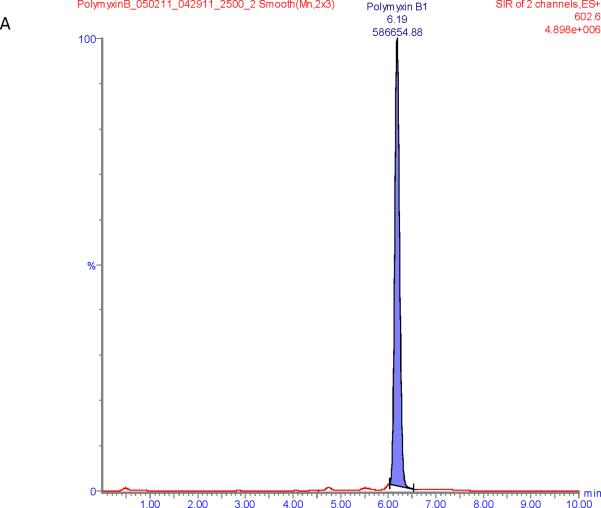
A high-performance liquid chromatography-mass spectrometry assay was developed to quantify polymyxin B1 and B2 in human plasma using pure calibrators. After purification with a solid-phase extraction column, polymyxin B1 and B2 were separated on a C18 column by gradient chromatography with an overall runtime of 12 minutes. Polymyxin B1 and B2 were ionized by positive electrospray ionization, and the resulting ions specific to polymyxin B1 and B2 were monitored (selected ion recording).
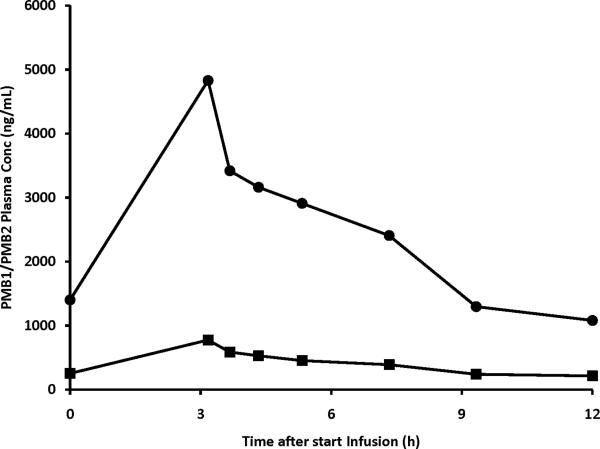
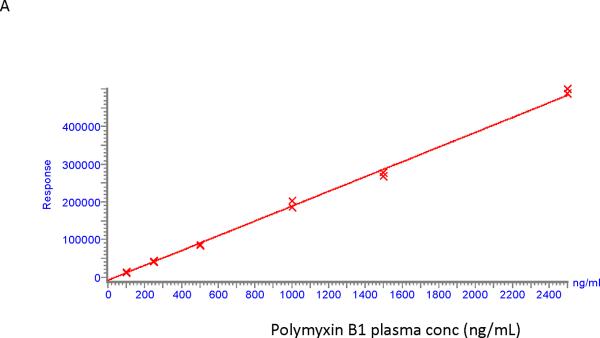
The dominant ions produced were (M + 2H) at m/z 602.6 and 595.5 for polymyxin B1 and polymyxin B2, respectively. The assay was linear between concentrations of 100 and 2500 ng/mL, with interday precision of 5.9% and 3.4% at 100 ng/mL and 5.3% and 4.0% at 2000 ng/mL for polymyxin B1 and polymyxin B2, respectively. Accuracy was 80.2% and 82.2% at 100 ng/mL and 99.9% and 109.6% at 2000 ng/mL for polymyxin B1 and polymyxin B2, respectively. No interference from other drugs commonly administered with polymyxin B was detected. The performance of the assay is affected by gross hemolysis and hyperlipemia. The method was successfully applied to patient samples. Interestingly, in a single patient the ratio of B1 and B2 did not change over a period of 12 hours after administration of the drug.
A simple method for the simultaneous measurement of polymyxin B1 and polymyxin B2 in human plasma is described, which has the potential to optimize clinical use of this valuable antibiotic by permitting pharmacokinetic studies and therapeutic drug monitoring.
多黏菌素 B 是一种古老的抗生素,在治疗多重耐药革兰氏阴性菌感染方面的临床相关性日益增加。然而,目前的剂量方案在很大程度上是经验性的,因为缺乏测定人血浆中多黏菌素 B 的检测方法,药物的临床药理学特征受到了阻碍。
开发了一种使用纯校准品定量测定人血浆中多黏菌素 B1 和 B2 的高效液相色谱-质谱法。用固相萃取柱纯化后,多黏菌素 B1 和 B2 在 C18 柱上通过梯度色谱分离,总运行时间为 12 分钟。多黏菌素 B1 和 B2 通过正电喷雾电离离子化,监测到特定于多黏菌素 B1 和 B2 的离子(选择离子记录)。
产生的主要离子为 m/z 602.6 和 595.5 的(M+2H),分别为多黏菌素 B1 和多黏菌素 B2。该测定法在 100-2500ng/mL 浓度范围内呈线性,多黏菌素 B1 和 B2 在 100ng/mL 时的日内精密度分别为 5.9%和 3.4%,在 2000ng/mL 时分别为 5.3%和 4.0%。多黏菌素 B1 和 B2 在 100ng/mL 时的准确度分别为 80.2%和 82.2%,在 2000ng/mL 时分别为 99.9%和 109.6%。未检测到与多黏菌素 B 一起常用的其他药物的干扰。该测定法的性能受严重溶血和高脂血症的影响。该方法已成功应用于患者样本。有趣的是,在一个单一的病人中,在给药后 12 小时内,B1 和 B2 的比值没有变化。
描述了一种用于同时测量人血浆中多黏菌素 B1 和 B2 的简单方法,该方法有可能通过允许进行药代动力学研究和治疗药物监测来优化这种有价值抗生素的临床应用。