Li Ying, Deng Yang, Zhu Zhen-Yu, Liu Yi-Ping, Xu Ping, Li Xin, Xie Yue-Liang, Yao Heng-Chang, Yang Liu, Zhang Bi-Kui, Zhou Yan-Gang
Department of Pharmacy, The Second Xiangya Hospital, Central South University, Changsha, China.
Institute of Clinical Pharmacy, Central South University, Changsha, China.
Front Pharmacol. 2021 Aug 25;12:727170. doi: 10.3389/fphar.2021.727170. eCollection 2021.
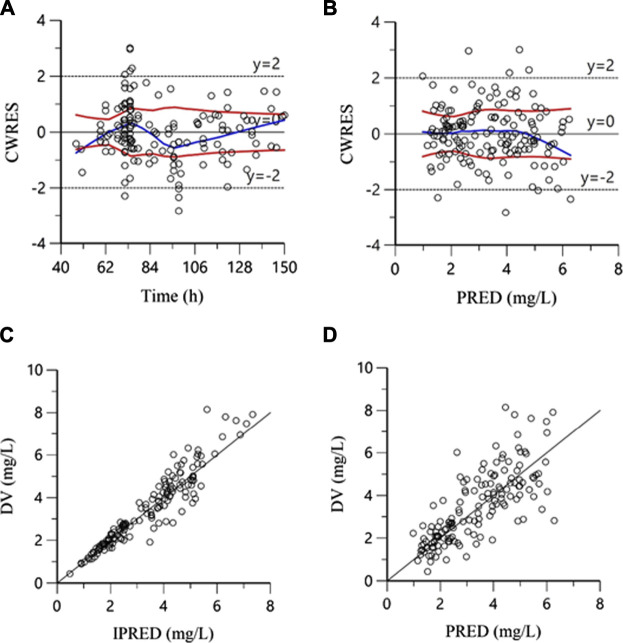
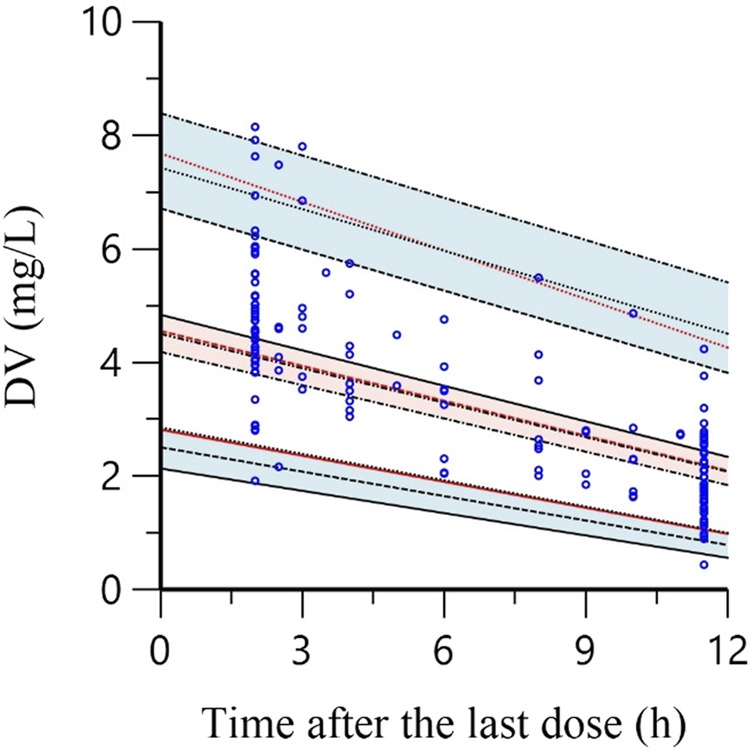
Currently, polymyxin B has been widely used in the treatment of multidrug-resistant Gram-negative pathogen infections. Due to the limited pharmacokinetic/pharmacodynamic data, the optimal dosage regimen for the recently proposed therapeutic target of the area under the concentration-time curve over 24 h in steady state divided by the minimum inhibitory concentration 50-100 mg⋅h/L has not yet been established. Moreover, most studies have focused on critically ill patients, yet there have been no studies in the field of renal transplantation. To optimize the dosage strategy and reduce the risk of toxicity, a population pharmacokinetics model of polymyxin B with the Phoenix NLME program was developed in our study. A total of 151 plasma samples from 50 patients were collected in the present study. Polymyxin B plasma concentrations were measured by high-performance liquid chromatography-tandem mass spectrometry. A one-compartment model adequately described the data, and the clearance and volume of distribution were 1.18 L/h and 12.09 L, respectively. A larger creatinine clearance was associated with increased clearance of polymyxin B ( < 0.01). Monte Carlo simulation showed that a regimen of a 75 mg loading dose with a 50 mg maintenance dose was a better option to achieve an optimal therapeutic effect (minimum inhibitory concentration ≤1 mg/L) and to reduce the incidence of side effects for patients with renal impairments. The developed model suggested that dosing adjustment should be based on renal function in renal transplant patients.
目前,多黏菌素B已广泛用于治疗多重耐药革兰氏阴性病原菌感染。由于药代动力学/药效学数据有限,针对最近提出的稳态下24小时浓度-时间曲线下面积除以最低抑菌浓度50 - 100 mg⋅h/L这一治疗靶点的最佳给药方案尚未确立。此外,大多数研究集中在危重症患者,而肾移植领域尚无相关研究。为优化给药策略并降低毒性风险,我们的研究采用Phoenix NLME程序建立了多黏菌素B的群体药代动力学模型。本研究共收集了50例患者的151份血浆样本。多黏菌素B血浆浓度通过高效液相色谱-串联质谱法测定。单室模型能充分描述数据,清除率和分布容积分别为1.18 L/h和12.09 L。肌酐清除率越高,多黏菌素B的清除率越高(<0.01)。蒙特卡洛模拟显示,对于肾功能受损患者,75 mg负荷剂量加50 mg维持剂量的给药方案是实现最佳治疗效果(最低抑菌浓度≤1 mg/L)并降低副作用发生率的更好选择。所建立的模型表明,肾移植患者的给药调整应基于肾功能。