Department of Haematology and Genetic Pathology, Flinders University and Medical Centre, Bedford Park, South Australia, Australia 5042.
Nucleic Acids Res. 2012 Oct;40(18):e144. doi: 10.1093/nar/gks588. Epub 2012 Jun 25.
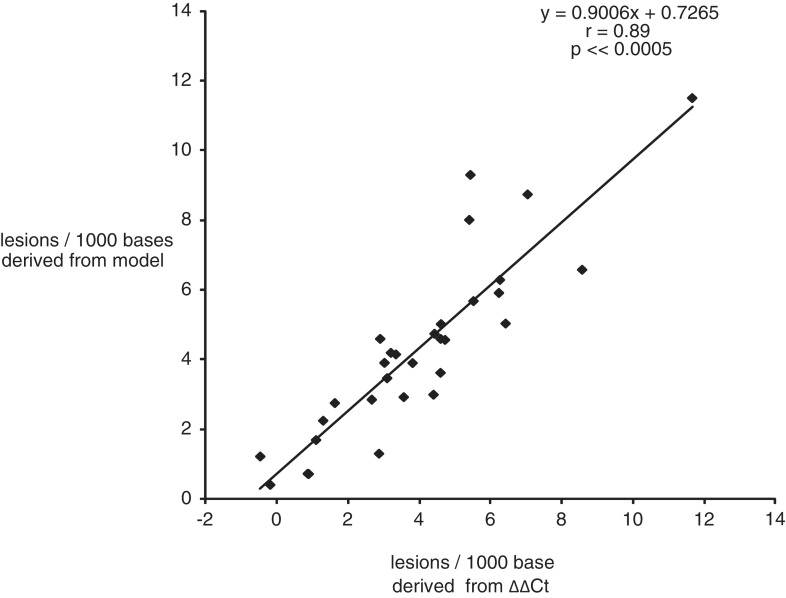
RNA degradation can distort or prevent measurement of RNA transcripts. A mathematical model for degradation was constructed, based on random RNA damage and exponential polymerase chain reaction (PCR) amplification. Degradation, measured as the number of lesions/base, can be quantified by amplifying several sequences of a reference gene, calculating the regression of C(t) on amplicon length and determining the slope. Reverse transcriptase-quantitative PCR (RT-qPCR) data can then be corrected for degradation using lesions/base, amplicon length(s) and the relevant equation obtained from the model. Several predictions of the model were confirmed experimentally; degradation in a sample quantified using the model correlated with degradation quantified using an additional control sample and the ΔΔCt method and application of the model corrected erroneous results for relative quantification resulting from degradation and differences in amplicon length. Compared with RIN, the method was quantitative, simpler, more sensitive and spanned a wider range of RNA damage. The method can use either random or specifically primed complementary DNA and it enables relative and absolute quantification of RNA to be corrected for degradation. The model and method should be applicable to many situations in which RNA is quantified, including quantification of RNA by methods other than nucleic acid amplification.
RNA 降解会扭曲或阻止 RNA 转录本的测量。我们构建了一个基于随机 RNA 损伤和指数聚合酶链反应 (PCR) 扩增的降解数学模型。通过扩增几个参考基因序列,可以定量测量降解,计算 C(t) 与扩增子长度的回归,并确定斜率。然后可以使用损伤/碱基、扩增子长度和从模型中获得的相关方程来校正 RT-qPCR 数据的降解。该模型的几个预测得到了实验的证实;使用模型定量的样本中的降解与使用附加对照样本和 ΔΔCt 方法定量的降解以及校正因降解和扩增子长度差异而导致的相对定量错误结果的应用相关。与 RIN 相比,该方法是定量的、更简单、更灵敏,且涵盖了更广泛的 RNA 损伤范围。该方法可以使用随机或特异性引物的互补 DNA,并且可以校正降解对 RNA 的相对和绝对定量的影响。该模型和方法应该适用于许多需要定量 RNA 的情况,包括非核酸扩增方法的 RNA 定量。