Rahimzadeh Mitra, Hajizadeh Ebrahim, Feizi Sepehr
Department of Biostatistics, Tarbiat Modares University, Tehran, Iran.
J Ophthalmic Vis Res. 2010 Jul;5(3):145-50.
To estimate cure rate following graft rejection in bilateral corneal transplants in Iranian patients with keratoconus and to determine risk factors associated with rejection.
In this retrospective study, data were compiled from records of patients who had undergone bilateral penetrating keratoplasty (PK) for keratoconus between 1988 and 2007. In order to estimate cure rate in patients with and without corneal vascularization, we adopted the cure rate frailty model with a Bayesian approach.
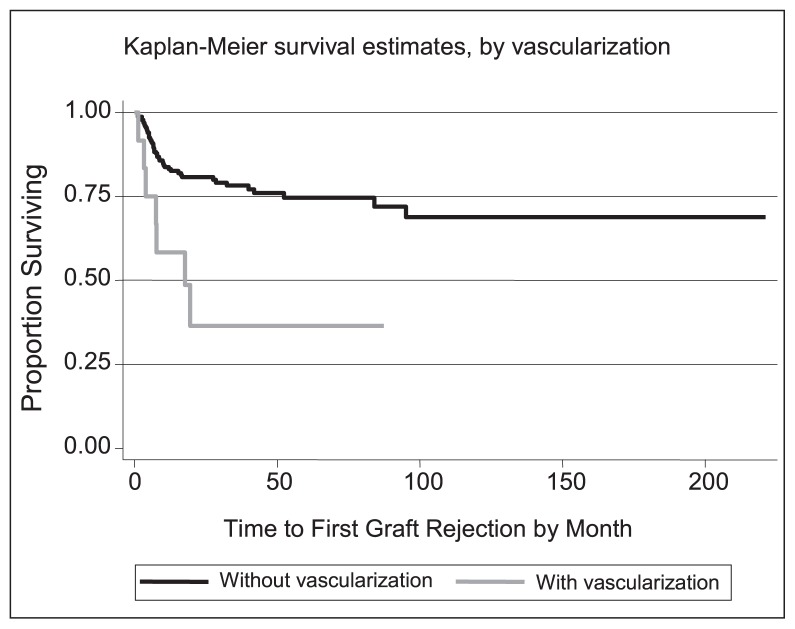
Two hundred and thirty-eight eyes of 119 patients underwent bilateral corneal transplantion for keratoconus, of which 22.7% experienced graft rejections. Cure rates for patients with and without corneal vascularization were 41% and 79%, respectively. Cure rate decreased 12% per decade of increase in recipient age. The 1, 5, and 10-year survival of corneal transplants without any graft rejection episodes were 82%, 74%, and 70% respectively.
The most important risk factor predisposing to rejection in patients undergoing bilateral PK for keratoconus was corneal vascularization. Cure rate for patients without vascularization was high in this data set, indicating that penetrating keratoplasty in keratoconus patients without vascularization is an efficient and reliable procedure.
评估伊朗圆锥角膜患者双侧角膜移植术后排斥反应后的治愈率,并确定与排斥反应相关的危险因素。
在这项回顾性研究中,收集了1988年至2007年间因圆锥角膜接受双侧穿透性角膜移植术(PK)患者的记录数据。为了评估有和没有角膜血管化患者的治愈率,我们采用了贝叶斯方法的治愈率脆弱模型。
119例患者的238只眼因圆锥角膜接受了双侧角膜移植,其中22.7%发生了移植排斥反应。有和没有角膜血管化患者的治愈率分别为41%和79%。随着受者年龄每增加十岁,治愈率下降12%。没有任何移植排斥反应事件的角膜移植的1年、5年和10年生存率分别为82%、74%和70%。
圆锥角膜患者接受双侧PK术后发生排斥反应的最重要危险因素是角膜血管化。在该数据集中,没有血管化患者的治愈率很高,这表明在没有血管化的圆锥角膜患者中进行穿透性角膜移植是一种有效且可靠的手术。