Department of Urology, Weill Cornell Medical College, New York-Presbyterian Hospital, New York, NY 10065, USA.
Eur Urol. 2013 Jun;63(6):1082-90. doi: 10.1016/j.eururo.2012.06.029. Epub 2012 Jun 22.
Cigarette smoking is a common risk factor for developing upper tract urothelial carcinoma (UTUC).
To assess the impact of cigarette smoking status, cumulative smoking exposure, and time from cessation on oncologic UTUC outcomes in patients treated with radical nephroureterectomy (RNU).
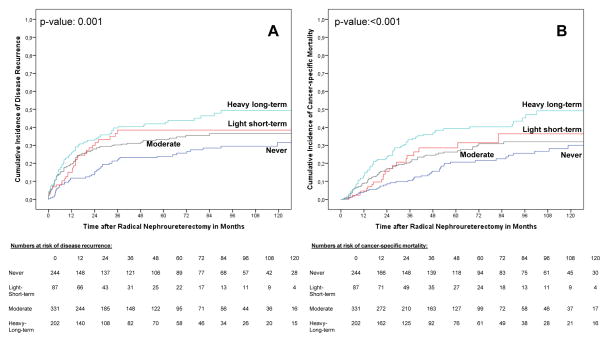
DESIGN, SETTING, AND PARTICIPANTS: A total of 864 patients underwent RNU at five institutions. The median follow-up in this retrospective study was 50 mo. Smoking history included smoking status, quantity of cigarettes per day (CPD), duration in years, and years from smoking cessation. The cumulative smoking exposure was categorized as light-short-term (≤ 19 CPD and ≤ 19.9 yr), moderate (all combinations except light-short-term and heavy-long-term), and heavy-long-term (≥ 20 CPD and ≥ 20 yr).
RNU with or without lymph node dissection. No patient received neoadjuvant chemotherapy.
Univariable and multivariable logistic regression and competing risk regression analyses assessed the effects of smoking on oncologic outcomes.
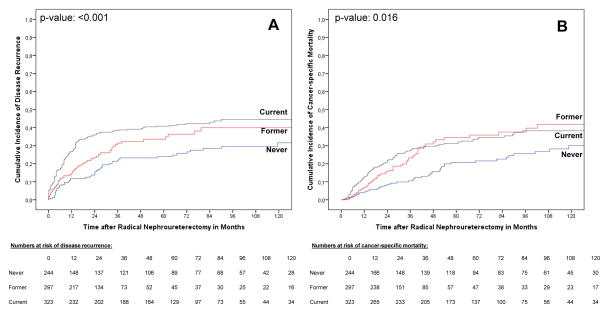
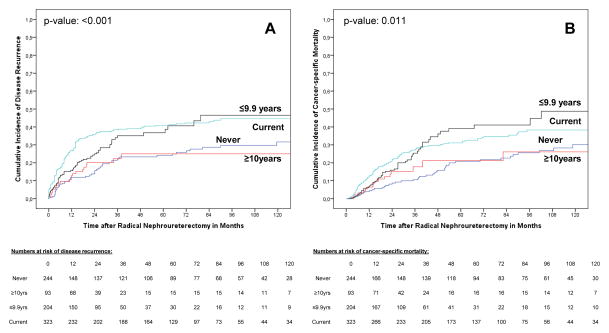
A total of 244 patients (28.2%) never smoked; 297 (34.4%) and 323 (37.4%) were former and current smokers, respectively. Among smokers, 87 (10.1%), 331 (38.3%), and 202 (23.4%) were light-short-term, moderate, and heavy-long-term smokers, respectively. Current smoking status, smoking ≥ 20 CPD, ≥ 20 yr, and heavy-long-term smoking were associated with advanced disease (p values ≤ 0.004), greater likelihood of disease recurrence (p values ≤ 0.01), and cancer-specific mortality (p values ≤ 0.05) on multivariable analyses that adjusted for standard features. Patients who quit smoking ≥ 10 yr prior to RNU did not differ from never smokers regarding advanced tumor stages, disease recurrence, and cancer-specific mortality, but they had better oncologic outcomes then current smokers and those patients who quit smoking <10 yr prior to RNU. The study is limited by its retrospective nature.
Cigarette smoking is significantly associated with advanced disease stages, disease recurrence, and cancer-specific mortality in patients treated with RNU for UTUC. Current smokers and those with a heavy and long-term smoking exposure have the highest risk for poor oncologic outcomes. Smoking cessation >10 yr prior to RNU seems to mitigate some detrimental effects. These results underscore the need for smoking cessation and prevention programs.
吸烟是导致上尿路上皮癌(UTUC)的常见危险因素。
评估吸烟状态、累积吸烟暴露量和戒烟时间对接受根治性肾输尿管切除术(RNU)治疗的 UTUC 患者肿瘤学结局的影响。
设计、地点和参与者:共有 864 名患者在五家机构接受了 RNU。本回顾性研究的中位随访时间为 50 个月。吸烟史包括吸烟状态、每天吸烟量(CPD)、吸烟年限和戒烟年限。累积吸烟暴露量分为轻度短期(≤19 CPD 和≤19.9 年)、中度(除轻度短期和重度长期之外的所有组合)和重度长期(≥20 CPD 和≥20 年)。
RNU 加或不加淋巴结清扫术。没有患者接受新辅助化疗。
单变量和多变量逻辑回归及竞争风险回归分析评估了吸烟对肿瘤学结局的影响。
共有 244 名患者(28.2%)从不吸烟;297 名(34.4%)和 323 名(37.4%)为既往吸烟者和当前吸烟者。在吸烟者中,87 名(10.1%)、331 名(38.3%)和 202 名(23.4%)为轻度短期、中度和重度长期吸烟者。当前吸烟状态、吸烟≥20 CPD、≥20 年和重度长期吸烟与晚期疾病(p 值≤0.004)、疾病复发的可能性更大(p 值≤0.01)和癌症特异性死亡率(p 值≤0.05)相关,这些都是在调整了标准特征的多变量分析中得出的。与从不吸烟者相比,戒烟≥10 年的患者在肿瘤分期、疾病复发和癌症特异性死亡率方面没有差异,但他们的肿瘤学结局优于当前吸烟者和戒烟<10 年的患者。本研究的局限性在于其回顾性。
吸烟与接受 RNU 治疗的 UTUC 患者的晚期疾病分期、疾病复发和癌症特异性死亡率显著相关。当前吸烟者和重度长期吸烟者的肿瘤预后最差。RNU 前戒烟>10 年似乎可以减轻一些不利影响。这些结果强调了戒烟和预防计划的必要性。