
颗粒动力学:超顺磁性氧化铁纳米颗粒沉积过程的计算分析。
Particokinetics: computational analysis of the superparamagnetic iron oxide nanoparticles deposition process.
机构信息
Instituto do Cérebro, Hospital Israelita Albert Einstein, São Paulo, Brazil.
出版信息
Int J Nanomedicine. 2012;7:2699-712. doi: 10.2147/IJN.S30074. Epub 2012 Jun 1.
BACKGROUND
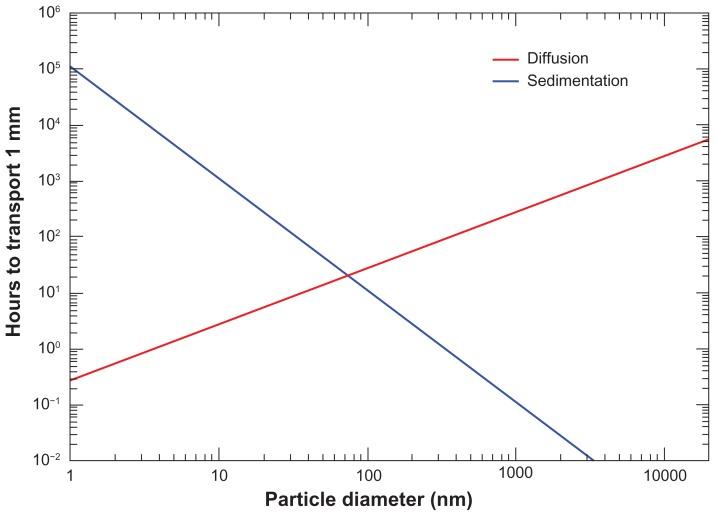
Nanoparticles in suspension are often utilized for intracellular labeling and evaluation of toxicity in experiments conducted in vitro. The purpose of this study was to undertake a computational modeling analysis of the deposition kinetics of a magnetite nanoparticle agglomerate in cell culture medium.
METHODS
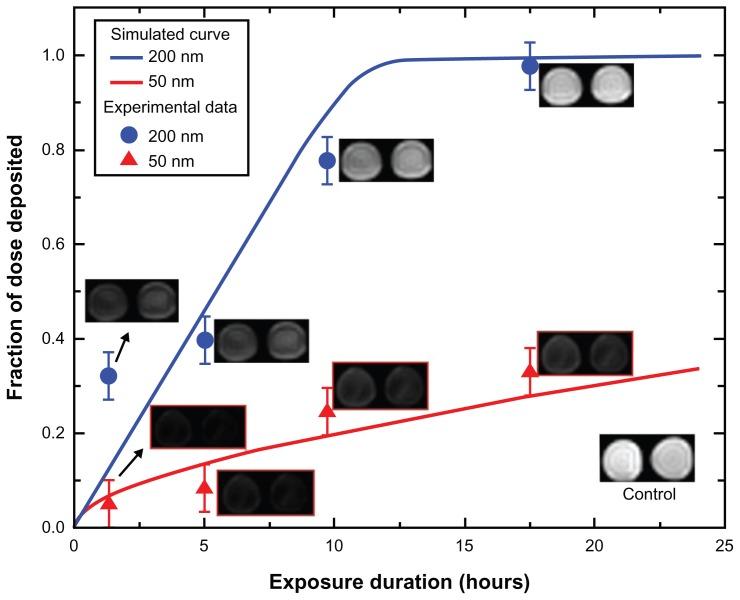
Finite difference methods and the Crank-Nicolson algorithm were used to solve the equation of mass transport in order to analyze concentration profiles and dose deposition. Theoretical data were confirmed by experimental magnetic resonance imaging.
RESULTS
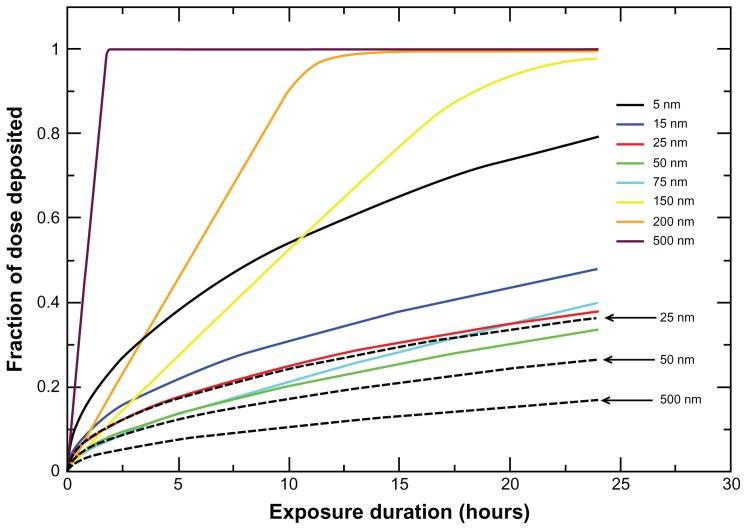
Different behavior in the dose fraction deposited was found for magnetic nanoparticles up to 50 nm in diameter when compared with magnetic nanoparticles of a larger diameter. Small changes in the dispersion factor cause variations of up to 22% in the dose deposited. The experimental data confirmed the theoretical results.
CONCLUSION
These findings are important in planning for nanomaterial absorption, because they provide valuable information for efficient intracellular labeling and control toxicity. This model enables determination of the in vitro transport behavior of specific magnetic nanoparticles, which is also relevant to other models that use cellular components and particle absorption processes.
背景
悬浮中的纳米粒子常用于体外实验中的细胞内标记和毒性评估。本研究的目的是对磁颗粒团聚体在细胞培养液中的沉积动力学进行计算建模分析。
方法
采用有限差分法和 Crank-Nicolson 算法求解传质方程,以分析浓度分布和剂量沉积。通过实验磁共振成像对理论数据进行了验证。
结果
与直径较大的磁性纳米颗粒相比,直径在 50nm 以下的磁性纳米颗粒的剂量沉积分数表现出不同的行为。分散因子的微小变化会导致剂量沉积的变化高达 22%。实验数据证实了理论结果。
结论
这些发现对于纳米材料吸收的规划非常重要,因为它们为高效的细胞内标记和控制毒性提供了有价值的信息。该模型可以确定特定磁性纳米颗粒的体外传输行为,这对于使用细胞成分和颗粒吸收过程的其他模型也具有重要意义。






 Zotero 插件