Department of Medicine, University of Florida College of Medicine, Gainesville, FL 32610, USA.
BMC Immunol. 2012 Jul 2;13:33. doi: 10.1186/1471-2172-13-33.
Anthrax lethal toxin (LT), produced by the Gram-positive bacterium Bacillus anthracis, is a highly effective zinc dependent metalloprotease that cleaves the N-terminus of mitogen-activated protein kinase kinases (MAPKK or MEKs) and is known to play a role in impairing the host immune system during an inhalation anthrax infection. Here, we present the transcriptional responses of LT treated human monocytes in order to further elucidate the mechanisms of LT inhibition on the host immune system.
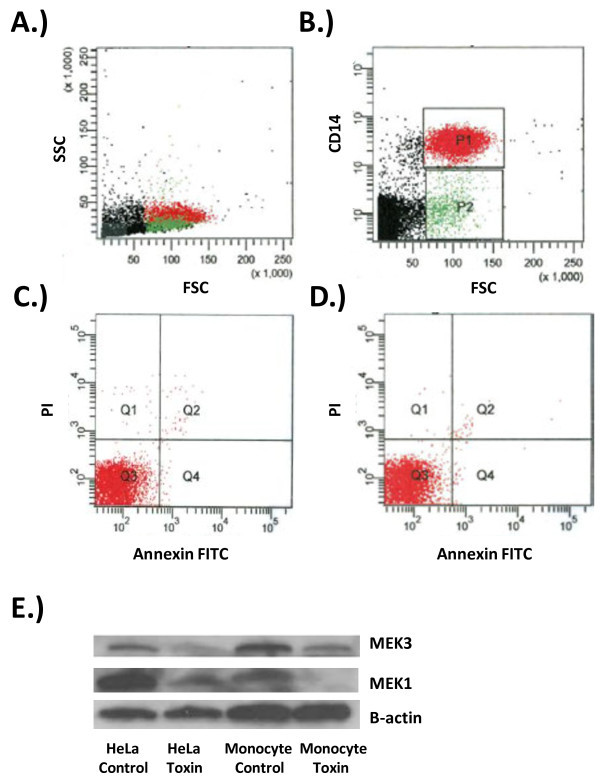
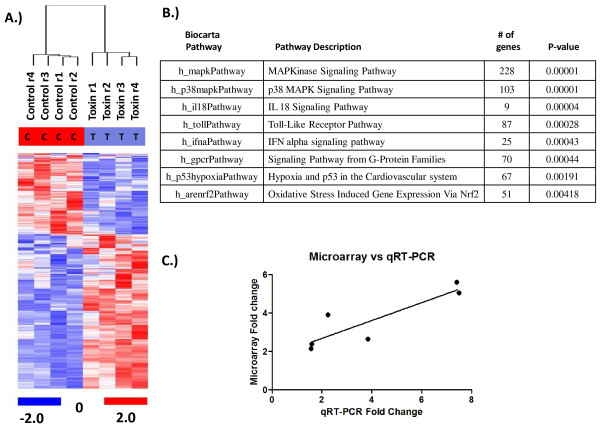
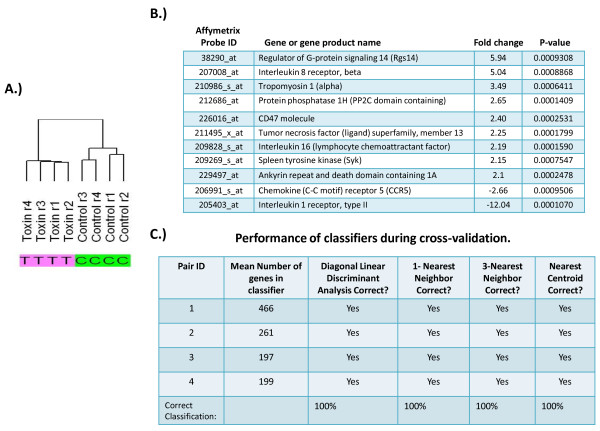
Western Blot analysis demonstrated cleavage of endogenous MEK1 and MEK3 when human monocytes were treated with 500 ng/mL LT for four hours, proving their susceptibility to anthrax lethal toxin. Furthermore, staining with annexin V and propidium iodide revealed that LT treatment did not induce human peripheral monocyte apoptosis or necrosis. Using Affymetrix Human Genome U133 Plus 2.0 Arrays, we identified over 820 probe sets differentially regulated after LT treatment at the p <0.001 significance level, interrupting the normal transduction of over 60 known pathways. As expected, the MAPKK signaling pathway was most drastically affected by LT, but numerous genes outside the well-recognized pathways were also influenced by LT including the IL-18 signaling pathway, Toll-like receptor pathway and the IFN alpha signaling pathway. Multiple genes involved in actin regulation, signal transduction, transcriptional regulation and cytokine signaling were identified after treatment with anthrax LT.
We conclude LT directly targets human peripheral monocytes and causes multiple aberrant gene responses that would be expected to be associated with defects in human monocyte's normal signaling transduction pathways and function. This study provides further insights into the mechanisms associated with the host immune system collapse during an anthrax infection, and suggests that anthrax LT may have additional downstream targets outside the well-known MAPK pathway.
炭疽致死毒素(LT)由革兰氏阳性细菌炭疽芽孢杆菌产生,是一种高效的锌依赖性金属蛋白酶,可切割丝裂原活化蛋白激酶激酶(MAPKK 或 MEKs)的 N 端,已知在吸入性炭疽感染过程中,其在损害宿主免疫系统方面发挥作用。在这里,我们展示了 LT 处理的人单核细胞的转录反应,以进一步阐明 LT 对宿主免疫系统抑制的机制。
Western Blot 分析表明,当人单核细胞用 500ng/ml LT 处理 4 小时时,内源性 MEK1 和 MEK3 被切割,证明其对炭疽致死毒素敏感。此外,用 Annexin V 和碘化丙啶染色显示 LT 处理不会诱导人外周单核细胞凋亡或坏死。使用 Affymetrix Human Genome U133 Plus 2.0 Arrays,我们在 LT 处理后发现超过 820 个探针集在 p<0.001 显著性水平上差异调节,干扰了超过 60 个已知通路的正常转导。不出所料,MAPKK 信号通路受到 LT 的影响最大,但 LT 还影响了许多不在公认通路中的基因,包括 IL-18 信号通路、Toll 样受体通路和 IFNα信号通路。在炭疽 LT 处理后,鉴定出多个涉及肌动蛋白调节、信号转导、转录调节和细胞因子信号的基因。
我们得出结论,LT 直接靶向人外周单核细胞,并导致多种异常基因反应,这些反应预计与单核细胞正常信号转导通路和功能的缺陷有关。本研究进一步深入了解与炭疽感染过程中宿主免疫系统崩溃相关的机制,并表明炭疽 LT 可能在已知的 MAPK 通路之外具有其他下游靶标。