Department of Biology, University of Utah, Salt Lake City, UT 84112, USA.
Mol Phylogenet Evol. 2012 Oct;65(1):335-8. doi: 10.1016/j.ympev.2012.06.014. Epub 2012 Jun 26.
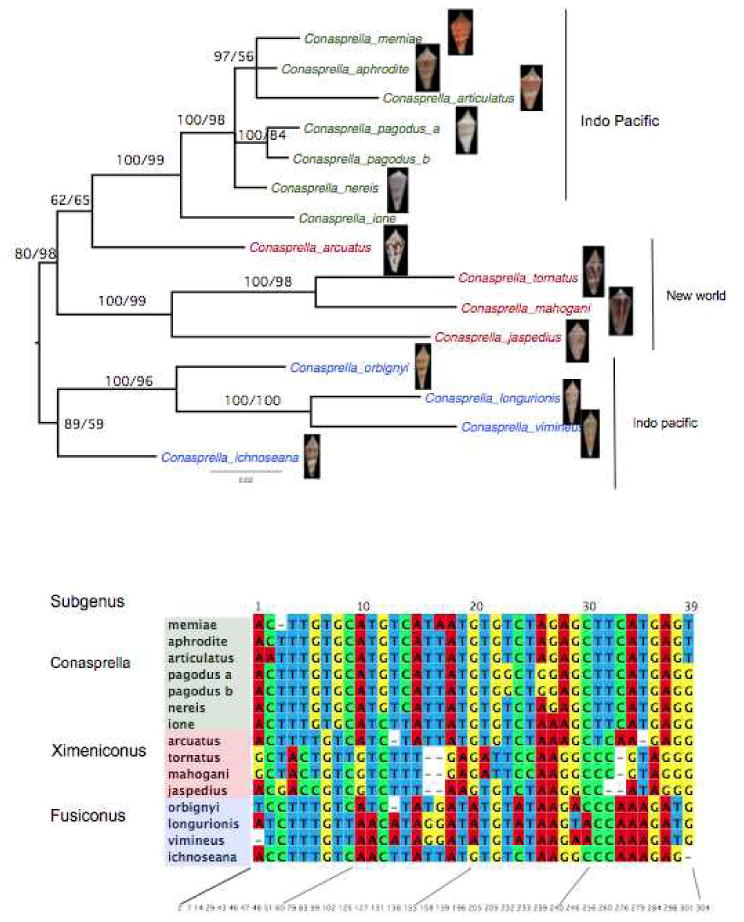
The traditional taxonomy of ca. 700 cone snails assigns all species to a single genus, Conus Linnaeus 1758. However, an increasing body of evidence suggests that some belong to a phylogenetically distinct clade that is sometimes referred to as Conasprella. Previous work (Kraus et al., 2011) showed that a short (259 bp) conserved intronic sequence (CIS) of the γ-glutamyl carboxylase gene (intron 9) can be used to delineate deep phylogenetic relationships among some groups of Conus. The work described here uses intron 9 (338 bp) to resolve problematic relationships among the conasprellans and to distinguish them from Conus proper. Synapomorphic mutations at just 39 sites can resolve several groups within Conasprella because the informative region of intron 9 is so well conserved that the phylogenetic signal is not obscured by homoplasies at conflicting sites. Intron 9 also unambiguously distinguishes Conasprella as a whole from Conus because the conserved regions that are so well conserved within each group are not alignable and clearly not homologous between them. This pattern suggests that expression of the γ-glutamyl carboxylase gene may have undergone a functionally significant change in Conus or Conasprella shortly after they diverged.
传统的约 700 种圆锥蜗牛的分类学将所有物种都归入一个单一的属,即锥螺属(Conus Linnaeus 1758)。然而,越来越多的证据表明,有些物种属于一个在系统发育上截然不同的分支,有时被称为 Conasprella。之前的研究(Kraus 等人,2011)表明,γ-谷氨酰羧化酶基因(内含子 9)的一段短(259 bp)保守内含子序列(CIS)可用于描绘某些锥螺属之间的深层系统发育关系。本研究使用内含子 9(338 bp)来解决 conasprellans 之间存在的问题关系,并将它们与真正的锥螺属区分开来。仅在 39 个位点的共变突变就可以解决 Conasprella 内部的几个群体,因为内含子 9 的信息区域保存得非常好,所以不会被冲突位点的同形性掩盖系统发育信号。内含子 9也明确地将 Conasprella 作为一个整体与 Conus 区分开来,因为在每个群体中保存得非常好的保守区域不能对齐,并且它们之间显然不是同源的。这种模式表明,γ-谷氨酰羧化酶基因的表达在锥螺属或 Conasprella 分化后不久可能发生了功能上的显著变化。