Department of Surgery, University of Melbourne, The Royal Melbourne Hospital, Parkville, VIC, Australia.
Oncogene. 2013 May 9;32(19):2433-41. doi: 10.1038/onc.2012.260. Epub 2012 Jul 2.
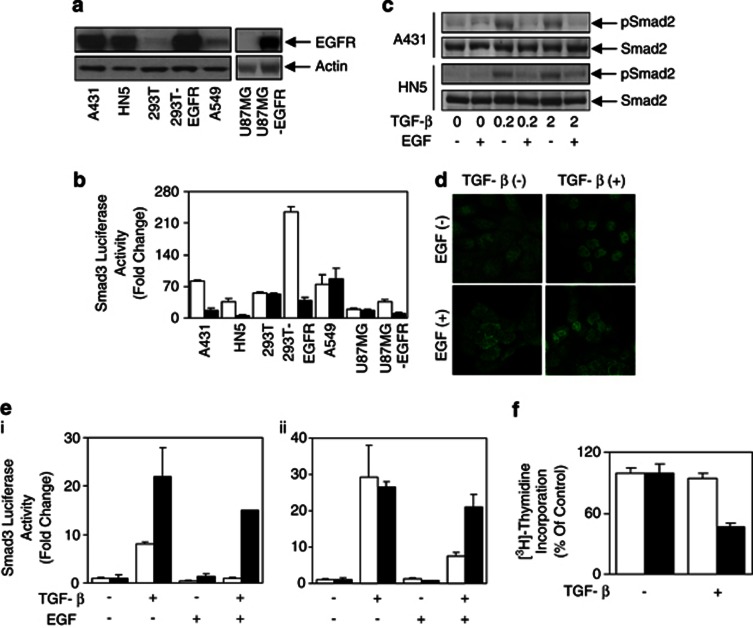
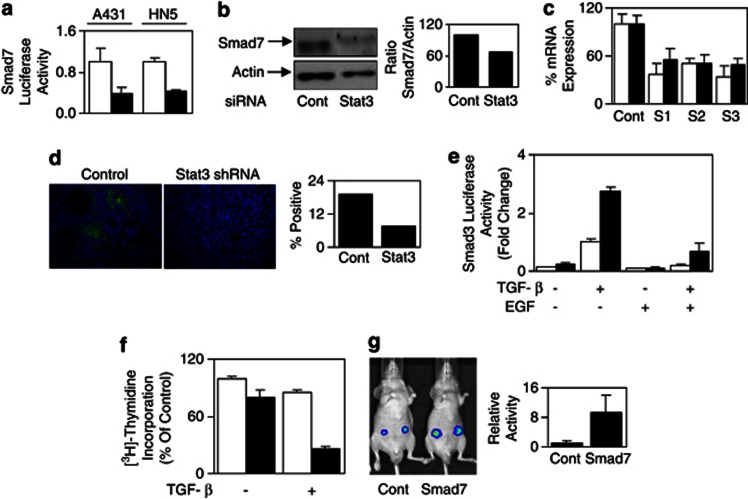
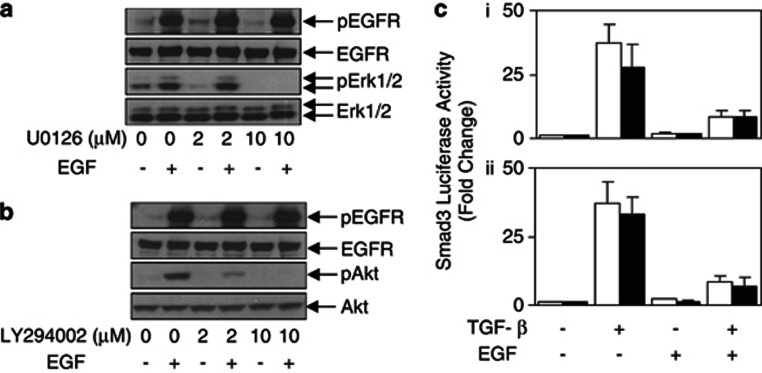
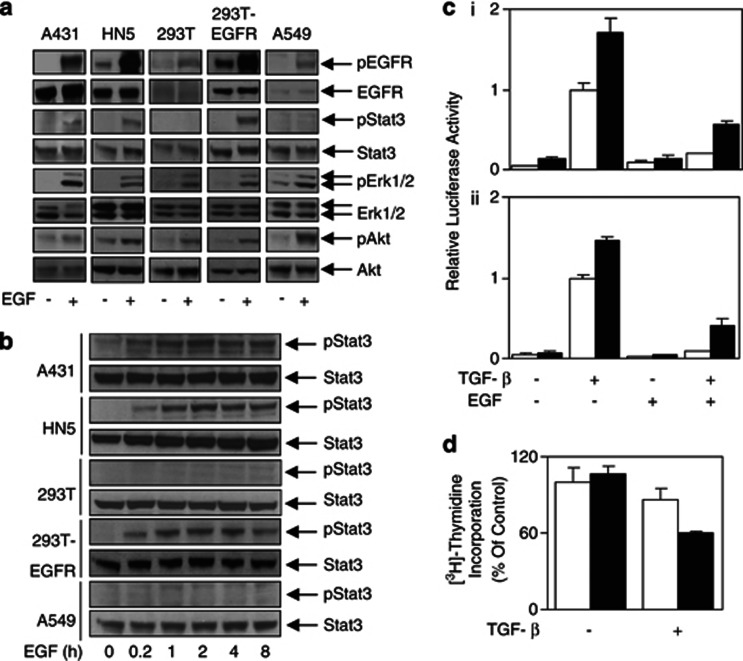
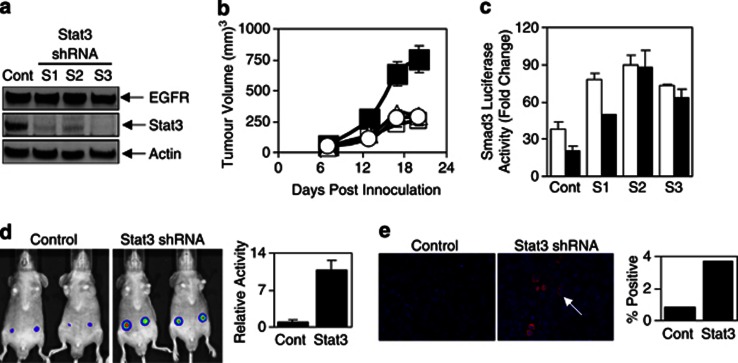
Transforming Growth Factor-β (TGF-β) and Epidermal Growth Factor (EGF) signaling pathways are both independently implicated as key regulators in tumor formation and progression. Here, we report that the tumor-associated overexpression of epidermal growth factor receptor (EGFR) desensitizes TGF-β signaling and its cytostatic regulation through specific and persistent Stat3 activation and Smad7 induction in vivo. In human tumor cell lines, reduction of TGF-β-mediated Smad2 phosphorylation, nuclear translocation and Smad3 target gene activation were observed when EGFR was overexpressed, but not in cells that expressed EGFR at normal levels. We identified Stat3, which is activated specifically and persistently by overexpressed EGFR, as a key signaling molecule responsible for the reduced TGF-β sensitivity. Stable knockdown of Stat3 using small hairpin RNA(shRNA) in Head and Neck (HN5) and Epidermoid (A431) tumor cell lines resulted in reduced growth compared with control shRNA-transfected cells when grown as subcutaneous tumor xenografts. Furthermore, xenografts with Stat3 knockdown displayed increased Smad3 transcriptional activity, increased Smad2 phosphorylation and decreased Smad7 expression compared with control xenografts in vivo. Consistently, Smad7 mRNA and protein expression was also significantly reduced when EGFR activity was blocked by a specific tyrosine kinase inhibitor, AG1478, or in Stat3 knockdown tumors. Similarly, Smad7 knockdown also resulted in enhanced Smad3 transcriptional activity in vivo. Importantly, there was no uptake of subcutaneous HN5 xenografts with Smad7 knockdown. Taken together, we demonstrate here that targeting Stat3 or Smad7 for knockdown results in resensitization of TGF-β's cytostatic regulation in vivo. Overall, these results establish EGFR/Stat3/Smad7/TGF-β signaling axis driving tumor growth, which can be targeted therapeutically.
转化生长因子-β(TGF-β)和表皮生长因子(EGF)信号通路都被独立地认为是肿瘤形成和进展的关键调节因子。在这里,我们报告说,肿瘤相关的表皮生长因子受体(EGFR)过表达使 TGF-β信号失敏,并通过体内特异性和持续性 Stat3 激活和 Smad7 诱导来抑制其细胞增殖调节作用。在人肿瘤细胞系中,当 EGFR 过表达时,观察到 TGF-β介导的 Smad2 磷酸化、核转位和 Smad3 靶基因激活减少,但在表达正常水平 EGFR 的细胞中则没有。我们确定 Stat3 是一种关键的信号分子,它被过表达的 EGFR 特异性和持续性激活,负责降低 TGF-β的敏感性。使用短发夹 RNA(shRNA)在头颈部(HN5)和表皮样(A431)肿瘤细胞系中稳定敲低 Stat3,与对照 shRNA 转染的细胞相比,当作为皮下肿瘤异种移植物生长时,生长速度降低。此外,与对照异种移植物相比,Stat3 敲低的异种移植物在体内显示出增加的 Smad3 转录活性、增加的 Smad2 磷酸化和降低的 Smad7 表达。一致地,当 EGFR 活性被特定的酪氨酸激酶抑制剂 AG1478 阻断或在 Stat3 敲低的肿瘤中时,Smad7 mRNA 和蛋白表达也显著降低。同样,Smad7 敲低也导致体内 Smad3 转录活性增强。重要的是,Smad7 敲低的皮下 HN5 异种移植物没有摄取。总之,我们在这里证明,针对 Stat3 或 Smad7 进行敲低会导致体内 TGF-β的细胞增殖调节重新敏感化。总的来说,这些结果确立了 EGFR/Stat3/Smad7/TGF-β 信号轴驱动肿瘤生长,可作为治疗靶点。