Center of Excellence in Neuroergonomics, Technology, and Cognition and Department of Psychology, George Mason University, Fairfax, Virginia, United States of America.
PLoS One. 2012;7(6):e39675. doi: 10.1371/journal.pone.0039675. Epub 2012 Jun 27.
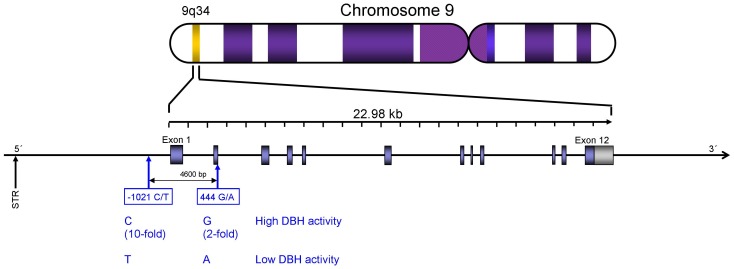
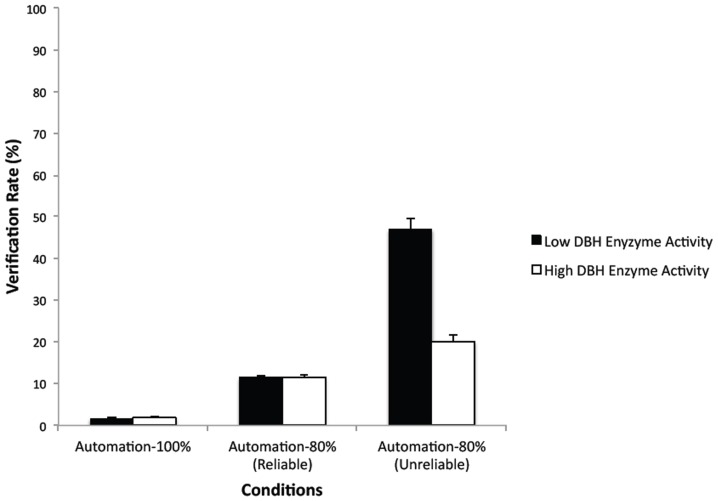
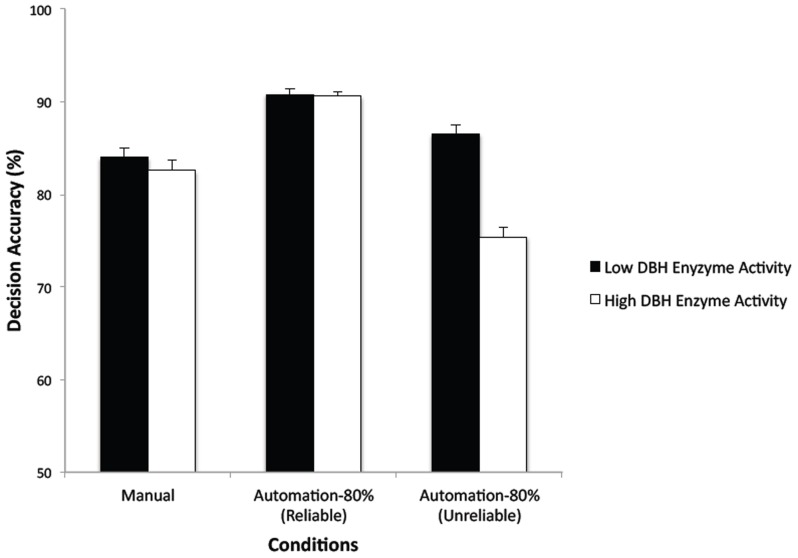
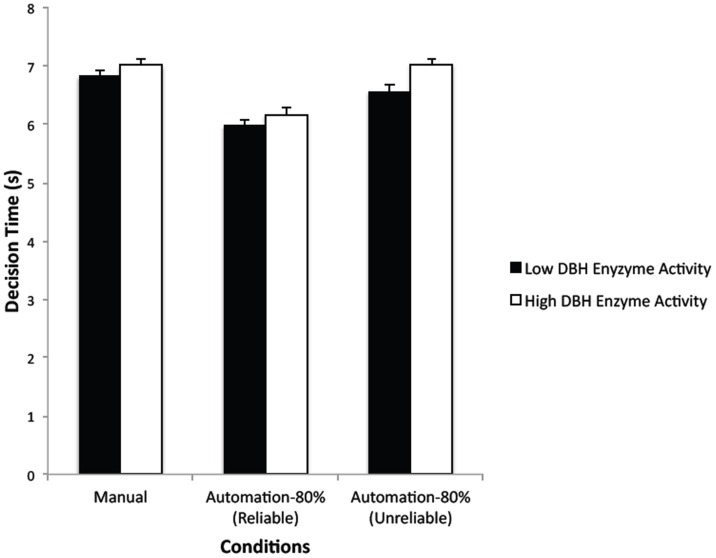
Computerized aiding systems can assist human decision makers in complex tasks but can impair performance when they provide incorrect advice that humans erroneously follow, a phenomenon known as "automation bias." The extent to which people exhibit automation bias varies significantly and may reflect inter-individual variation in the capacity of working memory and the efficiency of executive function, both of which are highly heritable and under dopaminergic and noradrenergic control in prefrontal cortex. The dopamine beta hydroxylase (DBH) gene is thought to regulate the differential availability of dopamine and norepinephrine in prefrontal cortex. We therefore examined decision-making performance under imperfect computer aiding in 100 participants performing a simulated command and control task. Based on two single nucleotide polymorphism (SNPs) of the DBH gene, -1041 C/T (rs1611115) and 444 G/A (rs1108580), participants were divided into groups of low and high DBH enzyme activity, where low enzyme activity is associated with greater dopamine relative to norepinephrine levels in cortex. Compared to those in the high DBH enzyme activity group, individuals in the low DBH enzyme activity group were more accurate and speedier in their decisions when incorrect advice was given and verified automation recommendations more frequently. These results indicate that a gene that regulates relative prefrontal cortex dopamine availability, DBH, can identify those individuals who are less susceptible to bias in using computerized decision-aiding systems.
计算机辅助系统可以帮助人类决策者完成复杂任务,但如果它们提供错误的建议而人类错误地遵循,就会影响性能,这种现象被称为“自动化偏差”。人们表现出自动化偏差的程度差异很大,可能反映了个体间工作记忆容量和执行功能效率的差异,这两者都高度可遗传,并且在额叶皮质中受到多巴胺和去甲肾上腺素的控制。多巴胺β羟化酶(DBH)基因被认为可以调节前额叶皮质中多巴胺和去甲肾上腺素的差异可用性。因此,我们在 100 名参与者执行模拟指挥和控制任务的情况下,检查了不完善的计算机辅助下的决策表现。基于 DBH 基因的两个单核苷酸多态性(SNP),-1041 C/T(rs1611115)和 444 G/A(rs1108580),参与者被分为低和高 DBH 酶活性组,其中低酶活性与皮质中相对较高的多巴胺与去甲肾上腺素水平相关。与高 DBH 酶活性组相比,当提供错误建议并验证自动化建议时,低 DBH 酶活性组的个体在决策时更加准确和迅速,并且更频繁地验证自动化建议。这些结果表明,一种调节前额叶皮质多巴胺相对可用性的基因,即 DBH,可以识别那些不太容易受到计算机辅助决策系统偏差影响的个体。