Institute for Human Genetics, University Medical Center Hamburg-Eppendorf, Martinistr. 52, D-20246 Hamburg, Germany.
Sci Rep. 2012;2:484. doi: 10.1038/srep00484. Epub 2012 Jul 2.
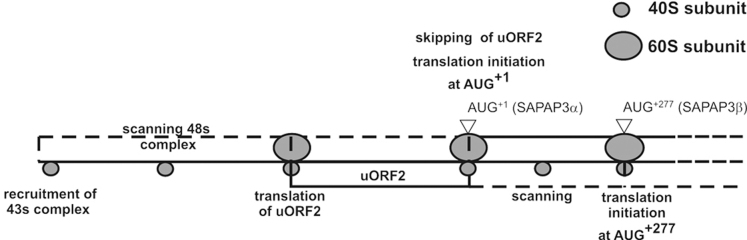
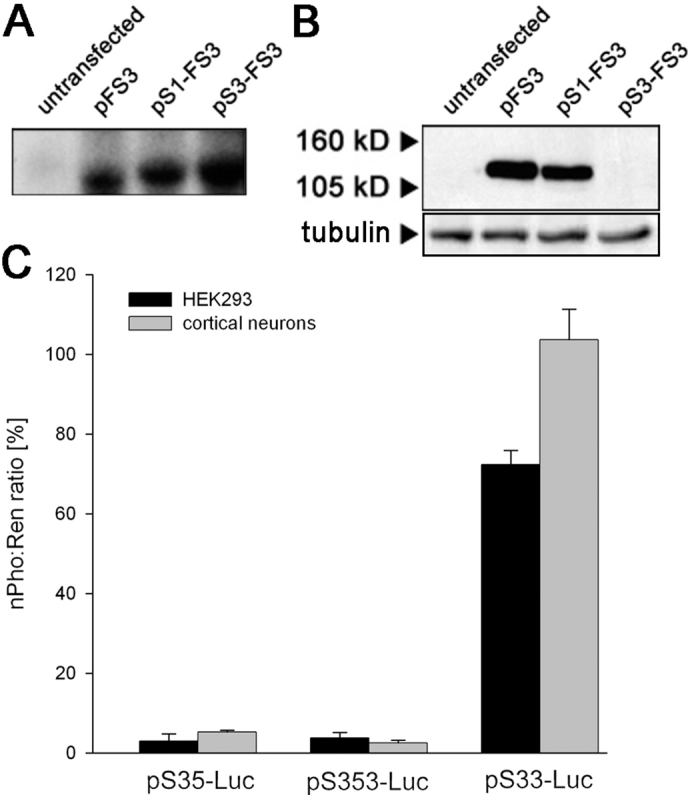
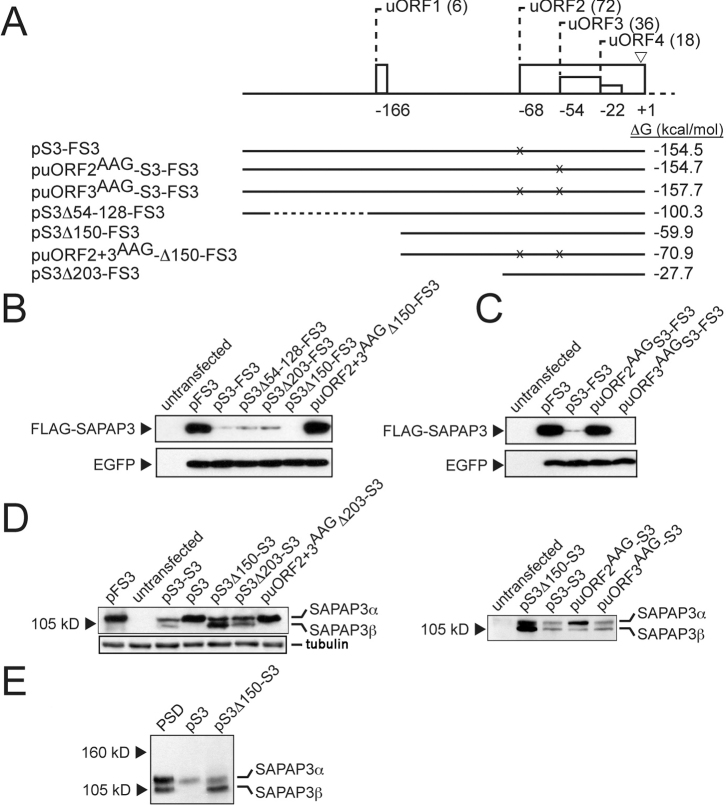
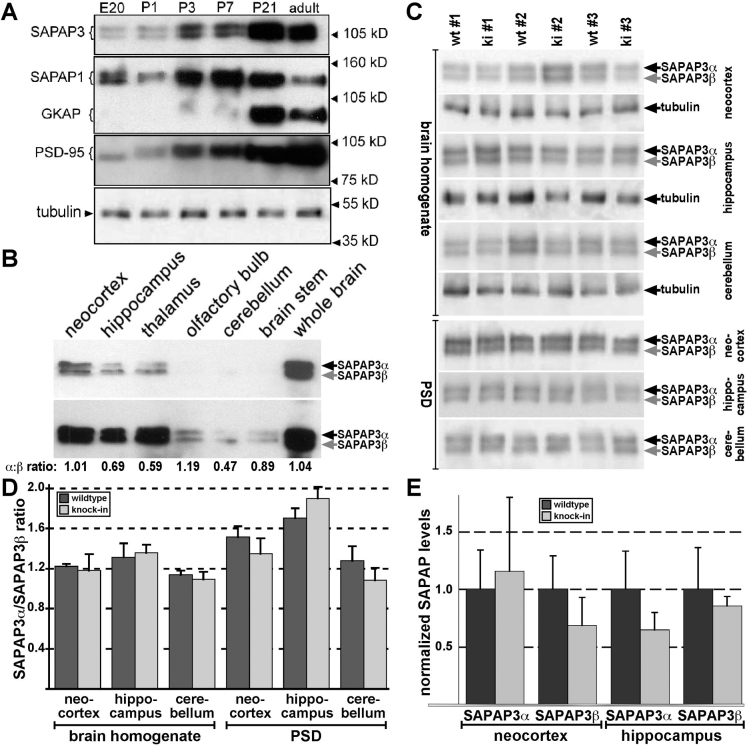
In mammalian neurons, targeting and translation of specific mRNAs in dendrites contribute to synaptic plasticity. After nuclear export, mRNAs designated for dendritic transport are generally assumed to be translationally dormant and activity of individual synapses may locally trigger their extrasomatic translation. We show that the long, GC-rich 5'-untranslated region of dendritic SAPAP3 mRNA restricts translation initiation via a mechanism that involves an upstream open reading frame (uORF). In addition, the uORF enables the use of an alternative translation start site, permitting synthesis of two SAPAP3 isoforms from a single mRNA. While both isoforms progressively accumulate at postsynaptic densities during early rat brain development, their levels relative to each other vary in different adult rat brain areas. Thus, alternative translation initiation events appear to regulate relative expression of distinct SAPAP3 isoforms in different brain regions, which may function to influence synaptic plasticity.
在哺乳动物神经元中,特定 mRNA 在树突中的靶向和翻译有助于突触可塑性。核输出后,通常假定用于树突运输的 mRNA 处于翻译休眠状态,并且单个突触的活动可能会局部触发其细胞外翻译。我们表明,树突状 SAPAP3 mRNA 的长、GC 丰富的 5'非翻译区通过涉及上游开放阅读框 (uORF) 的机制限制翻译起始。此外,uORF 允许使用替代翻译起始位点,从而允许从单个 mRNA 合成两种 SAPAP3 同工型。虽然两种同工型在早期大鼠大脑发育过程中逐渐积累在突触后密度处,但它们彼此之间的水平在不同的成年大鼠脑区中有所不同。因此,替代翻译起始事件似乎调节不同脑区中不同 SAPAP3 同工型的相对表达,这可能有助于影响突触可塑性。