Faculty of Public Health and Policy, London School of Hygiene and Tropical Medicine, Keppel Street, London, WC1E 7HT, UK.
BMC Health Serv Res. 2012 Jul 7;12:190. doi: 10.1186/1472-6963-12-190.
The prevalence of obesity is over 25 % in many developed countries. Obesity is strongly associated with an increased risk of fatal and chronic conditions such as cardiovascular disease and type 2 diabetes. Therefore it has become a major public health concern for many economies. E-learning devices are a relatively novel approach to promoting dietary change. The new generation of devices are 'adaptive' and use interactive electronic media to facilitate teaching and learning. E-Learning has grown out of recent developments in information and communication technology, such as the Internet, interactive computer programmes, interactive television and mobile phones. The aim of this study is to assess the cost-effectiveness of e-learning devices as a method of promoting weight loss via dietary change.
An economic evaluation was performed using decision modelling techniques. Outcomes were expressed in terms of Quality-Adjusted Life-Years (QALYs) and costs were estimated from a health services perspective. All parameter estimates were derived from the literature. A systematic review was undertaken to derive the estimate of relative treatment effect.
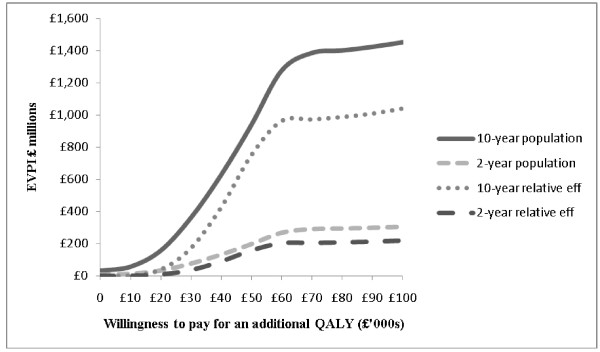
The base case results from the e-Learning Economic Evaluation Model (e-LEEM) suggested that the incremental cost-effectiveness ratio was approximately £102,000 per Quality-Adjusted Life-Year (QALY) compared to conventional care. This finding was robust to most alternative assumptions, except a much lower fixed cost of providing e-learning devices. Expected value of perfect information (EVPI) analysis showed that while the individual level EVPI was arguably negligible, the population level value was between £37 M and £170 M at a willingness to pay between £20,000 to £30,000 per additional QALY.
The current economic evidence base suggests that e-learning devices for managing the weight of obese individuals are unlikely to be cost-effective unless their fixed costs are much lower than estimated or future devices prove to be much more effective.
在许多发达国家,肥胖的患病率超过 25%。肥胖与致命和慢性疾病的风险增加密切相关,如心血管疾病和 2 型糖尿病。因此,它已成为许多经济体的主要公共卫生关注点。电子学习设备是促进饮食改变的一种相对较新的方法。新一代设备是“适应性”的,使用交互式电子媒体来促进教学和学习。电子学习源于信息和通信技术的最新发展,如互联网、交互式计算机程序、交互式电视和移动电话。本研究旨在评估电子学习设备作为通过饮食改变促进减肥的方法的成本效益。
使用决策模型技术进行经济评估。结果以质量调整生命年 (QALY) 表示,成本从卫生服务角度估算。所有参数估计均源自文献。系统评价用于得出相对治疗效果的估计值。
电子学习经济评估模型 (e-LEEM) 的基本情况结果表明,与常规护理相比,每增加一个质量调整生命年 (QALY) 的增量成本效益比约为 102,000 英镑。除了提供电子学习设备的固定成本低得多之外,这一发现对大多数替代假设都是稳健的。完全信息的预期价值 (EVPI) 分析表明,虽然个人水平的 EVPI 可以说是微不足道的,但在支付意愿为 20,000 至 30,000 英镑之间,每额外增加一个 QALY 时,人群水平的价值在 3700 万至 1.7 亿英镑之间。
目前的经济证据基础表明,除非电子学习设备的固定成本远低于估计值,或者未来的设备证明更有效,否则管理肥胖个体体重的电子学习设备不太可能具有成本效益。