Department of Biochemistry and Molecular Genetics, American University of Beirut, Beirut, Lebanon.
BMC Complement Altern Med. 2012 Jul 9;12:89. doi: 10.1186/1472-6882-12-89.
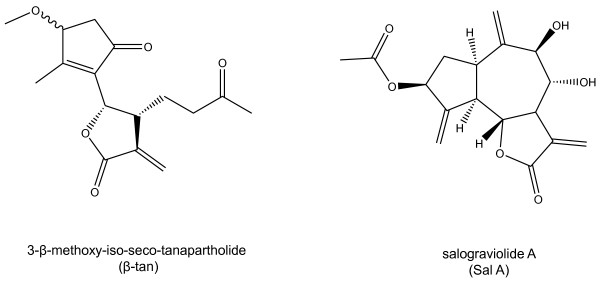
Sesquiterpene lactones (SL) are plant secondary metabolites that are known for their anti-fungal, anti-bacterial, anti-inflammatory, and anti-tumor properties. Considering that several SL-derived drugs are currently in cancer clinical trials, we have tested two SL molecules, 3-β-methoxy-iso-seco-tanapartholide (β-tan) isolated from Achillea falcata and salograviolide A (Sal A) isolated from Centaurea ainetensis, for their anti-tumor properties. We used the mouse epidermal JB6P + cells as a model for tumor promotion and cellular transformation. Key players that are involved in cellular transformation and tumorigenesis are the AP-1 and NF-κB transcription factors; therefore, we assessed how β-tan and Sal A modulate their signaling pathways in JB6P + cells.
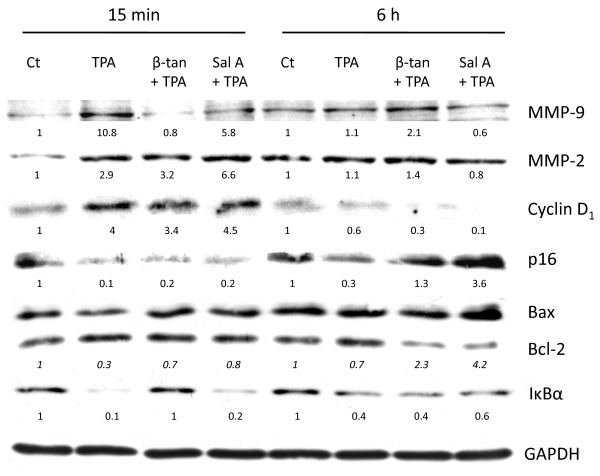
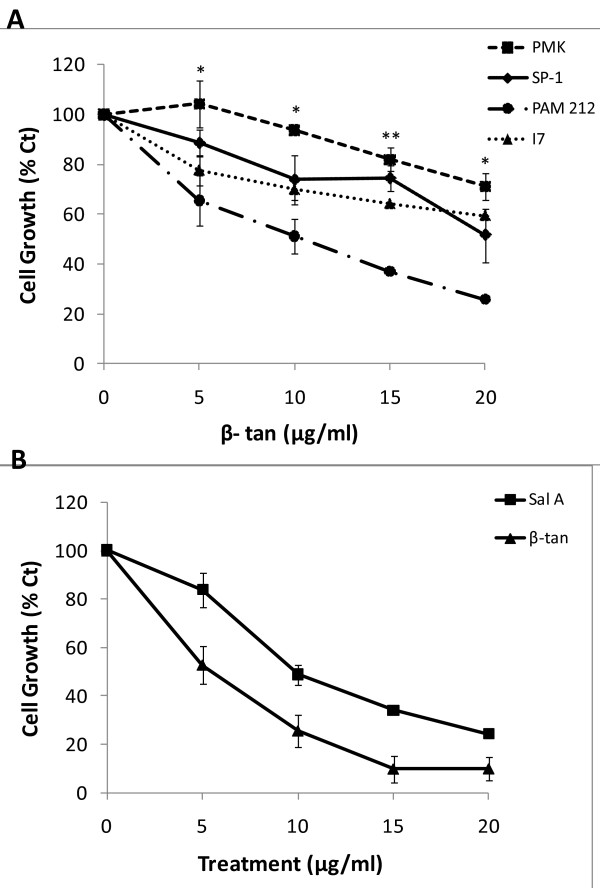
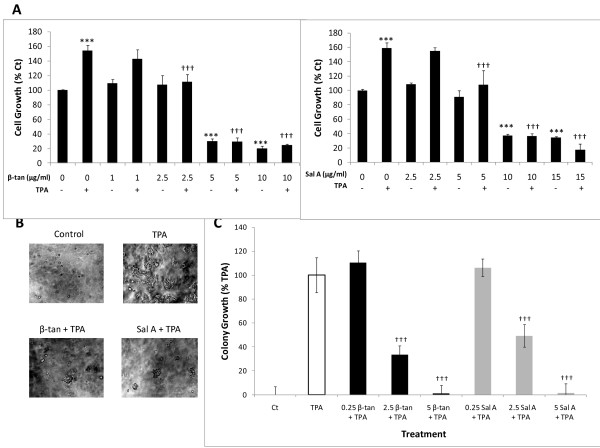
The effects of β-tan and Sal A on the growth of normal and neoplastic keratinocytes and on the tumor promotion-responsive JB6P + cells were determined using the MTT assay. Anchorage-independent cell growth transformation assays were used to evaluate the anti-tumor promoting properties of these SL molecules in JB6P + cells and dual luciferase reporter assays and western blot analysis were used to investigate their effects on tumor promoter-induced AP-1 and NF-κB activities and protein levels of key AP-1 and NF-кB target genes.
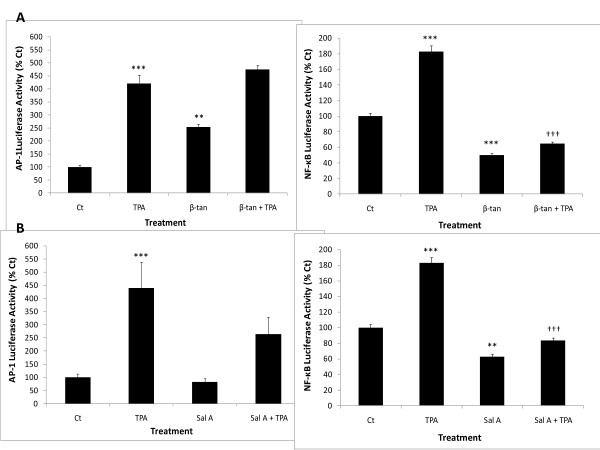
β-tan and Sal A selectively inhibited tumor promoter-induced cell growth and transformation of JB6P + cells at concentrations that do not affect JB6P + and primary keratinocytes basal cell growth. In addition, both molecules reduced basal and tumor promoter-induced NF-κB transcriptional activities, differentially regulated basal and tumor promoter-induced AP-1 transcriptional activities, and modulated key players of the AP-1 and NF-κB signaling pathways.
These results highlight the anti-tumor promoting properties of β-tan and Sal A. These SL molecules isolated from two plant species native to the Middle East may provide opportunities for complementary medicine practices.
倍半萜内酯(SL)是植物次生代谢产物,具有抗真菌、抗细菌、抗炎和抗肿瘤特性。鉴于目前有几种 SL 衍生药物正在进行癌症临床试验,我们测试了两种 SL 分子,即从 Achillea falcata 中分离得到的 3-β-甲氧基-异-山金车烯内酯(β-tan)和从 Centaurea ainetensis 中分离得到的 salograviolide A(Sal A),以研究它们的抗肿瘤特性。我们使用小鼠表皮 JB6P + 细胞作为肿瘤促进和细胞转化的模型。参与细胞转化和肿瘤发生的关键因子是 AP-1 和 NF-κB 转录因子;因此,我们评估了 β-tan 和 Sal A 如何调节 JB6P + 细胞中的信号通路。
使用 MTT 测定法测定 β-tan 和 Sal A 对正常和肿瘤角质形成细胞生长以及肿瘤促进响应性 JB6P + 细胞生长的影响。使用非依赖性细胞生长转化测定法评估这些 SL 分子在 JB6P + 细胞中的抗肿瘤促进特性,并使用双荧光素酶报告基因测定法和 Western blot 分析评估它们对肿瘤促进剂诱导的 AP-1 和 NF-κB 活性以及关键 AP-1 和 NF-κB 靶基因蛋白水平的影响。
β-tan 和 Sal A 选择性抑制肿瘤促进剂诱导的 JB6P + 细胞生长和转化,其浓度不影响 JB6P + 和原代角质形成细胞的基础细胞生长。此外,这两种分子均降低了基础和肿瘤促进剂诱导的 NF-κB 转录活性,差异调节了基础和肿瘤促进剂诱导的 AP-1 转录活性,并调节了 AP-1 和 NF-κB 信号通路的关键因子。
这些结果强调了 β-tan 和 Sal A 的抗肿瘤促进特性。这些从两种原产于中东的植物中分离得到的 SL 分子可能为补充医学实践提供机会。