Department of Radiology, Samsung Medical Center, Sungkyunkwan University School of Medicine, Seoul 135-710, Korea.
Korean J Radiol. 2012 Jul-Aug;13(4):425-33. doi: 10.3348/kjr.2012.13.4.425. Epub 2012 Jun 18.
To identify the CT features that help differentiate gastric schwannomas (GS) from small (5 cm or smaller) gastrointestinal stromal tumors (GIST) and to assess the growth rates of both tumors.
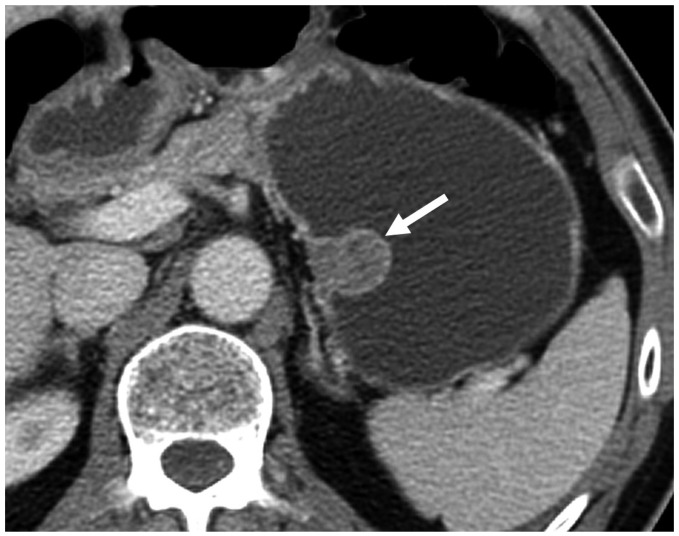
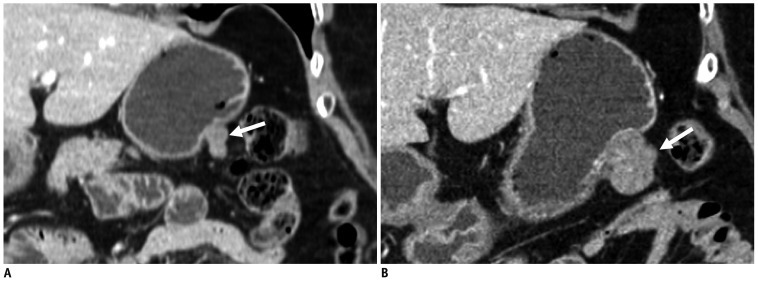
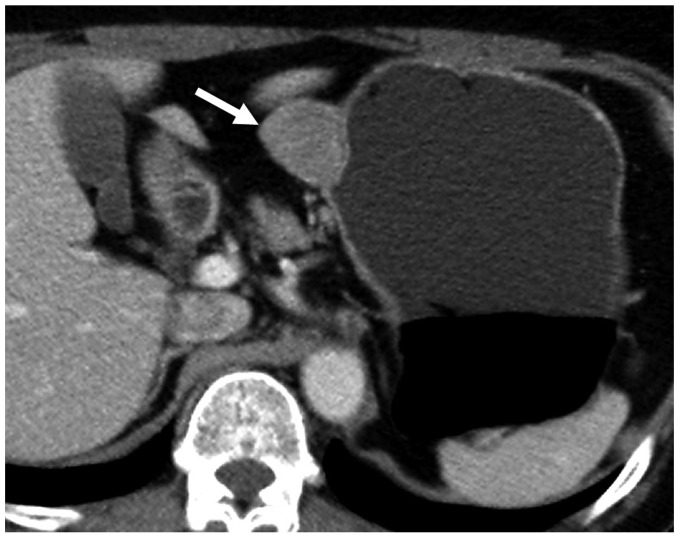
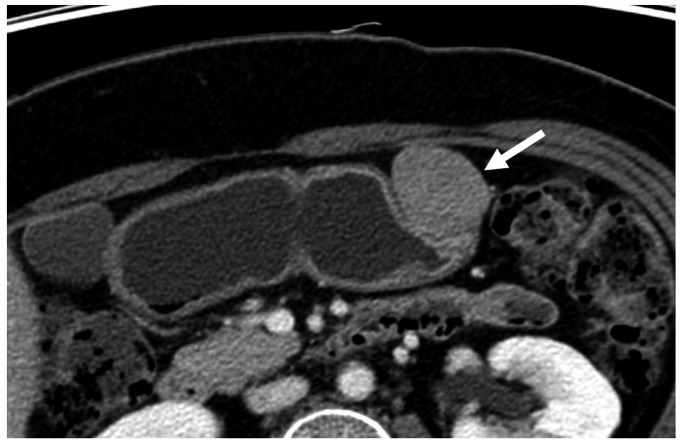
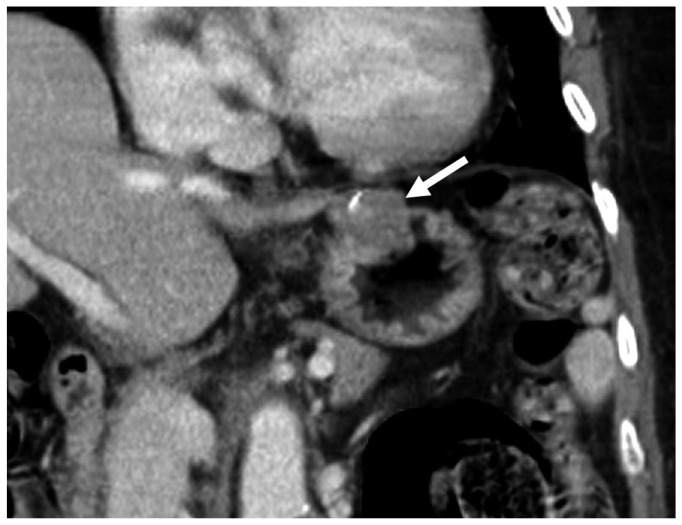
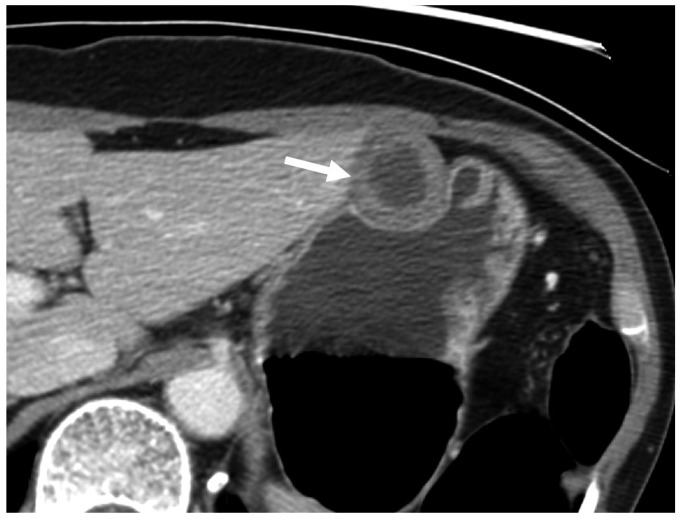
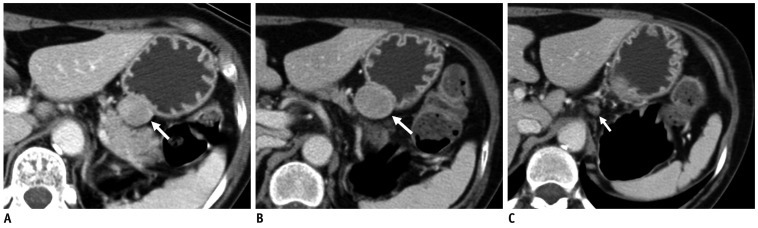
We included 16 small GSs and 56 GISTs located in the stomach. We evaluated the CT features including size, contour, surface pattern, margins, growth pattern, pattern and degree of contrast enhancement, and the presence of intralesional low attenuation area, hemorrhage, calcification, surface dimpling, fistula, perilesional lymph nodes (LNs), invasion to other organs, metastasis, ascites, and peritoneal seeding. We also estimated the tumor volume doubling time.
Compared with GISTs, GSs more frequently demonstrated a homogeneous enhancement pattern, exophytic or mixed growth pattern, and the presence of perilesional LNs (each p < 0.05). The intralesional low attenuation area was more common in GISTs than GSs (p < 0.05). Multivariate analyses indicated that a homogeneous enhancement pattern, exophytic or mixed growth pattern, and the presence of perilesional LNs were statistically significant (p < 0.05). Tumor volume doubling times for GSs (mean, 1685.4 days) were significantly longer than that of GISTs (mean, 377.6 days) (p = 0.004).
Although small GSs and GISTs show similar imaging findings, GSs more frequently show an exophytic or mixed growth pattern, homogeneous enhancement pattern, perilesional LNs and grow slower than GISTs.
确定有助于区分胃 schwannomas(GS)和小(5cm 或更小)胃肠道间质瘤(GIST)的 CT 特征,并评估两种肿瘤的生长速度。
我们纳入了 16 个位于胃中的小 GS 和 56 个 GIST。我们评估了 CT 特征,包括大小、轮廓、表面形态、边缘、生长方式、对比增强模式和程度,以及内部低衰减区、出血、钙化、表面凹陷、瘘管、周围淋巴结(LN)、侵犯其他器官、转移、腹水和腹膜播种的存在。我们还估计了肿瘤体积倍增时间。
与 GIST 相比,GS 更常表现出均匀强化模式、外生性或混合生长模式以及周围 LN 的存在(均 p<0.05)。内部低衰减区在 GIST 中比 GS 更常见(p<0.05)。多变量分析表明,均匀强化模式、外生性或混合生长模式以及周围 LN 的存在具有统计学意义(p<0.05)。GS 的肿瘤体积倍增时间(平均 1685.4 天)明显长于 GIST 的肿瘤体积倍增时间(平均 377.6 天)(p=0.004)。
尽管小 GS 和 GIST 表现出相似的影像学表现,但 GS 更常表现出外生性或混合生长模式、均匀强化模式、周围 LN,生长速度比 GIST 慢。