Faculty of Science and Technology, Department of Engineering, Aarhus University,Research Centre Foulum, Blichers Allé 20, 8830 Tjele, Denmark.
Sensors (Basel). 2012;12(5):5349-62. doi: 10.3390/s120505349. Epub 2012 Apr 26.
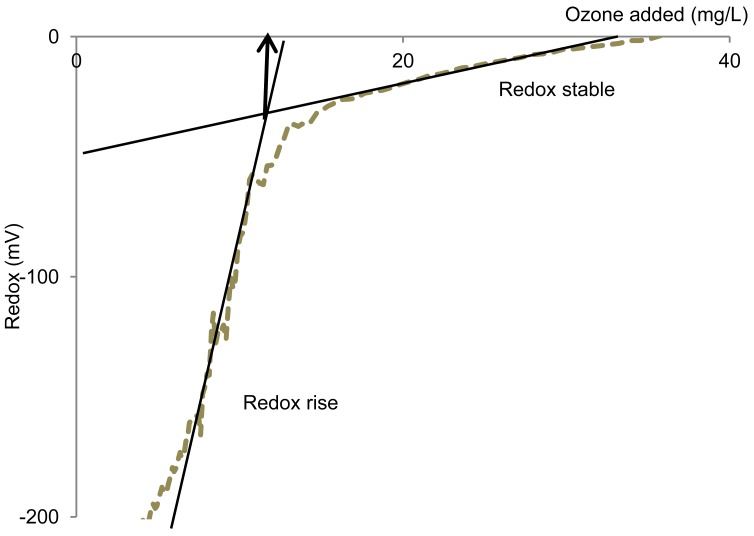
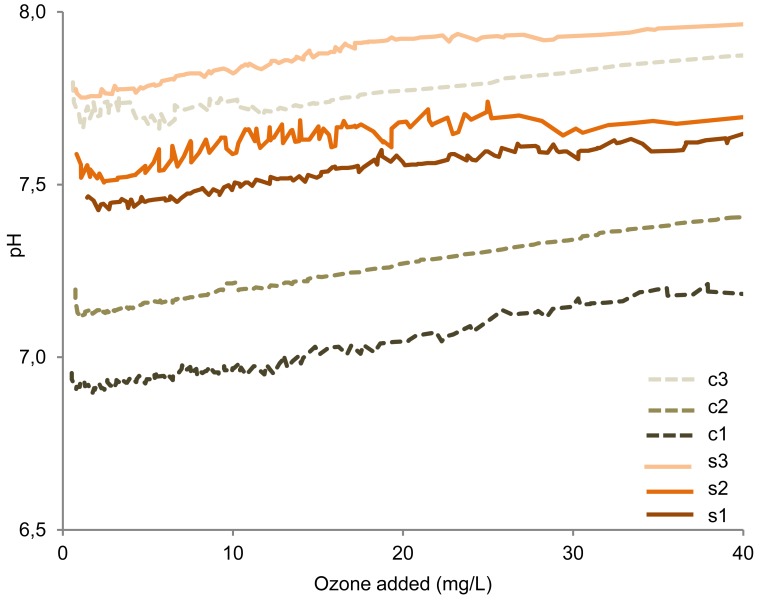
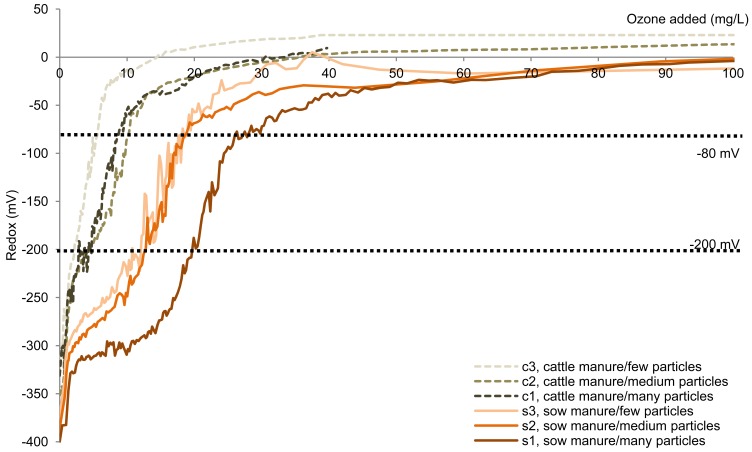
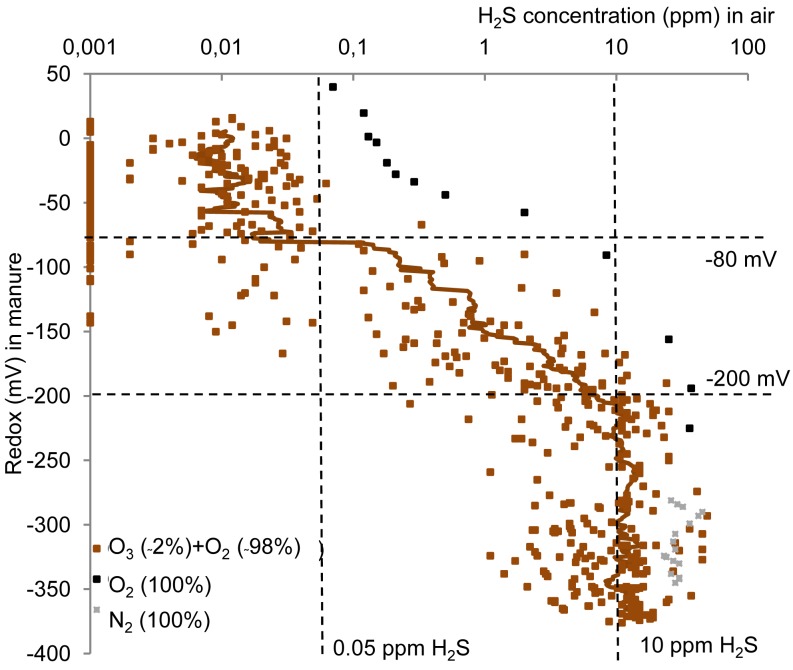
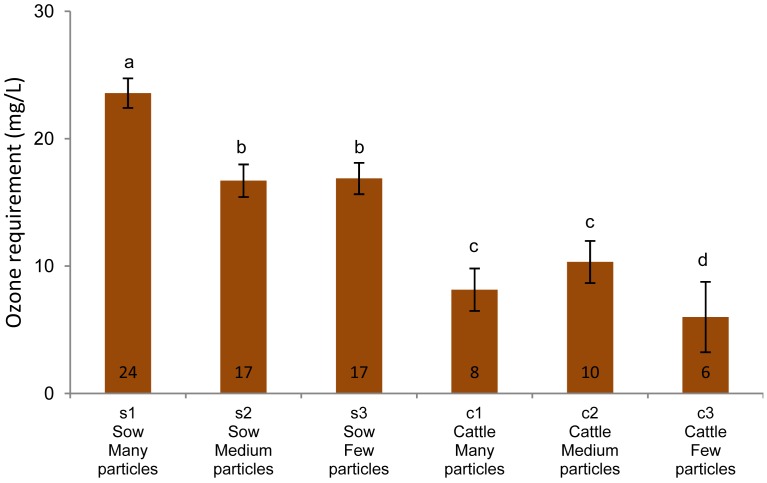
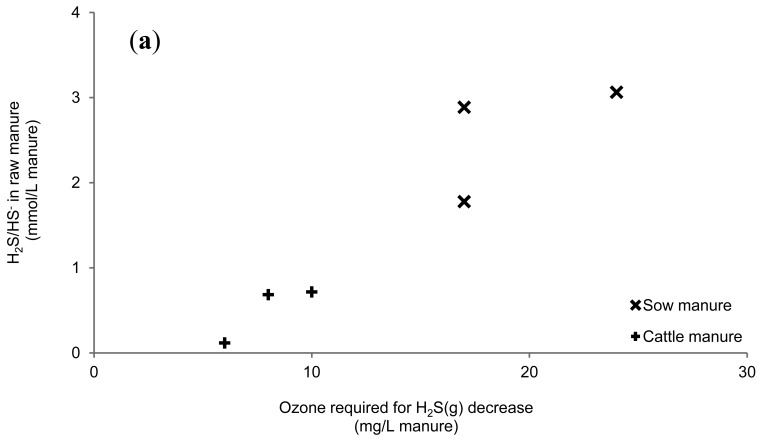
Slurry can be oxidized to eliminate undesirable emissions, including malodorous hydrogen sulfide (H(2)S). However, it is difficult to assess the optimal amount of oxidizing agent required. In this study, one cow and one pig manure, each in three particle size ranges were oxidized with 0-350 mg ozone/L manure. Redox and H(2)S concentration were measured continuously. During ozonation the manures gave equivalent redox potential curves. A relatively rapid rise in redox potential was observed within a range of -275 mV to -10 mV, with all manures changing as a minimum from -200 mV to -80 mV. The gaseous H(2)S emissions were decreased by 99.5% during the redox increase (-200 mV to -80 mV). This is attributed to H(2)S oxidation by ozone and oxygen, and is not due to H(2)S deprotonation or gas flushing. By identifying the initiation of the final redox level following the rise, the amount of ozone required to remove H(2)S from the manure samples was estimated to be in the range of 6-24 mg O(3)/L manure, depending on the type of manure. Hence, continuous monitoring of redox potential (termination of the redox rise) during the oxidation treatment is a simple method of achieving cost-effective minimization of H(2)S emissions from slurry.
泥浆可以被氧化以消除不想要的排放物,包括恶臭的硫化氢 (H(2)S)。然而,很难评估所需的最佳氧化剂用量。在这项研究中,将一头牛和一头猪的粪便分别在三个粒径范围内用 0-350mg 臭氧/L 粪便进行氧化。连续测量氧化还原电位和 H(2)S 浓度。在臭氧化过程中,粪便给出了等效的氧化还原电位曲线。在 -275 mV 到 -10 mV 的范围内观察到氧化还原电位的快速上升,所有粪便的变化都从 -200 mV 到 -80 mV 作为最小值。在氧化还原电位上升期间 (-200 mV 至 -80 mV),气态 H(2)S 排放减少了 99.5%。这归因于臭氧和氧气对 H(2)S 的氧化,而不是由于 H(2)S 的去质子化或气体冲洗。通过确定在上升之后最终氧化还原水平的起始点,可以估计从粪便样品中去除 H(2)S 所需的臭氧量在 6-24mgO(3)/L 粪便范围内,具体取决于粪便的类型。因此,在氧化处理过程中连续监测氧化还原电位(氧化还原上升的终止)是一种实现从泥浆中经济有效地最小化 H(2)S 排放的简单方法。