Houston VA HSR&D Center of Excellence, Michael E, DeBakey VA Medical Center, Houston, TX, USA.
Implement Sci. 2012 Jul 11;7:64. doi: 10.1186/1748-5908-7-64.
Despite the availability of evidence-based psychotherapies for depression and anxiety, they are underused in non-mental health specialty settings such as primary care. Hybrid effectiveness-implementation designs have the potential to evaluate clinical and implementation outcomes of evidence-based psychotherapies to improve their translation into routine clinical care practices.
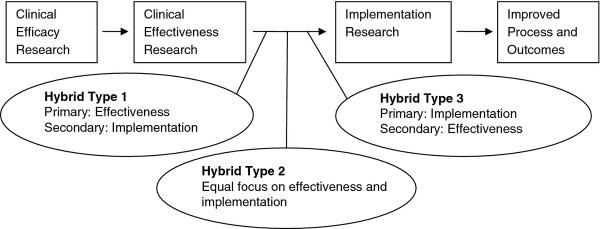
This protocol article discusses the study methodology and implementation strategies employed in an ongoing, hybrid, type 2 randomized controlled trial with two primary aims: (1) to determine whether a brief, manualized cognitive behavioral therapy administered by Veterans Affairs Primary Care Mental Health Integration program clinicians is effective in treating depression and anxiety in a sample of medically ill (chronic cardiopulmonary diseases) primary care patients and (2) to examine the acceptability, feasibility, and preliminary outcomes of a focused implementation strategy on improving adoption and fidelity of brief cognitive behavioral therapy at two Primary Care-Mental Health Integration clinics. The study uses a hybrid type 2 effectiveness/implementation design to simultaneously test clinical effectiveness and to collect pilot data on a multifaceted implementation strategy that includes an online training program, audit and feedback of session content, and internal and external facilitation. Additionally, the study engages the participation of an advisory council consisting of stakeholders from Primary Care-Mental Health Integration, as well as regional and national mental health leaders within the Veterans Administration. It targets recruitment of 320 participants randomized to brief cognitive behavioral therapy (n = 200) or usual care (n = 120). Both effectiveness and implementation outcomes are being assessed using mixed methods, including quantitative evaluation (e.g., intent-to-treat analyses across multiple time points) and qualitative methods (e.g., focus interviews and surveys from patients and providers). Patient-effectiveness outcomes include measures of depression, anxiety, and physical health functioning using blinded independent evaluators. Implementation outcomes include patient engagement and adherence and clinician brief cognitive behavioral therapy adoption and fidelity.
Hybrid designs are needed to advance clinical effectiveness and implementation knowledge to improve healthcare practices. The current article describes the rationale and challenges associated with the use of a hybrid design for the study of brief cognitive behavioral therapy in primary care. Although trade-offs exist between scientific control and external validity, hybrid designs are part of an emerging approach that has the potential to rapidly advance both science and practice.
NCT01149772 at http://www.clinicaltrials.gov/ct2/show/NCT01149772.
尽管有基于证据的心理疗法可用于治疗抑郁和焦虑,但在初级保健等非精神科专业环境中,这些疗法的使用并不充分。混合有效性-实施设计有可能评估基于证据的心理疗法的临床和实施结果,以改善其向常规临床护理实践的转化。
本文讨论了一项正在进行的混合、2 型随机对照试验的研究方法和实施策略,该试验有两个主要目的:(1)确定退伍军人事务部初级保健精神健康整合项目临床医生实施的简短、标准化认知行为疗法是否对患有慢性心肺疾病的初级保健患者中的抑郁和焦虑有效;(2)检查在两个初级保健-精神健康整合诊所中,采用专注的实施策略对提高简短认知行为疗法的采用和一致性的可接受性、可行性和初步结果。该研究采用混合 2 型有效性/实施设计,同时测试临床有效性,并收集关于包括在线培训计划、会议内容审核和反馈以及内部和外部促进在内的多方面实施策略的试点数据。此外,该研究还邀请了一个由初级保健-精神健康整合领域的利益相关者以及退伍军人事务部内的区域和国家精神卫生领导人组成的咨询委员会参与。该研究的目标是招募 320 名参与者,随机分为简短认知行为疗法组(n=200)或常规护理组(n=120)。使用混合方法评估有效性和实施结果,包括定量评估(例如,多个时间点的意向治疗分析)和定性方法(例如,来自患者和提供者的焦点访谈和调查)。患者有效性结果包括使用盲法独立评估者评估抑郁、焦虑和身体健康功能的措施。实施结果包括患者参与度和依从性以及临床医生对简短认知行为疗法的采用和一致性。
需要混合设计来推进临床有效性和实施知识,以改善医疗保健实践。本文描述了在初级保健中使用混合设计研究简短认知行为疗法的基本原理和相关挑战。虽然在科学控制和外部有效性之间存在权衡,但混合设计是一种新兴方法的一部分,该方法有可能迅速推进科学和实践。
NCT01149772,网址:http://www.clinicaltrials.gov/ct2/show/NCT01149772。