Morel Nicolas, Chabarttier Cyrille, Merson Laurent, Lelias Agathe, Bernard Jean-Christophe, Delaunay François, Dabadie Philippe, Janvier Gérard
Department of Adult Accident and Emergency, Intensive Care Unit, Pellegrin Hospital, Bordeaux, France.
J Emerg Trauma Shock. 2012 Apr;5(2):143-8. doi: 10.4103/0974-2700.96483.
Several series of patient studies have been published on the use of rFVIIa in traumatic haemorrhagic shock, although to date no international recommendations have been produced. France does not currently recognise traumatic haemorrhagic shock as an appropriate indication for the use of rFVIIa.
In this retrospective study, we present our experience in the use of rFVIIa in traumatic haemorrhagic shock.
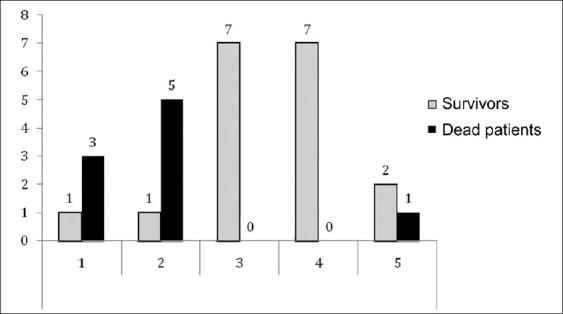
Twenty-seven patients treated with rFVIIa after a traumatic injury between May 2005 and December 2008 were included. Average age was 46 years old. Eighty per cent of patients were polytransfused. Mortality rate was 33%. Adjusted mortality rate, using the Boffard study criteria, was 8.3%. We observed significant differences between the group of patients who died and the group of survivors in pH, PT, Hb, ionised calcaemia, temperature and platelet count. We observed significant differences between the successful rFVIIa group and the failed rFVIIa group in pH, Hb, platelet count and ionised calcaemia. Ten patients had an rFVIIa injection only and 17 patients had an rFVIIa injection combined with a mechanical procedure to stop the bleeding. Two patients presented with thromboembolic complications. We observed a tendency to recommend an rFVIIa injection before radical treatment is applied.
It seems to us legitimate to recommend earlier use of rFVIIa in cases of traumatic haemorrhagic shock in the context of haematological damage control combined with the use of an algorithm to predict the risk involved in polytransfusion and a more aggressive transfusion strategy.
关于重组活化凝血因子 VII(rFVIIa)在创伤性失血性休克中的应用,已有多系列患者研究发表,尽管迄今为止尚未出台国际推荐意见。法国目前不认可创伤性失血性休克是使用 rFVIIa 的合适适应证。
在这项回顾性研究中,我们介绍了使用 rFVIIa 治疗创伤性失血性休克的经验。
纳入了 2005 年 5 月至 2008 年 12 月期间 27 例创伤后接受 rFVIIa 治疗的患者。平均年龄为 46 岁。80%的患者接受了多次输血。死亡率为 33%。按照博法德研究标准调整后的死亡率为 8.3%。我们观察到死亡患者组与存活患者组在 pH 值、凝血酶原时间(PT)、血红蛋白(Hb)、离子钙血症、体温和血小板计数方面存在显著差异。我们还观察到 rFVIIa 治疗成功组与失败组在 pH 值、Hb、血小板计数和离子钙血症方面存在显著差异。10 例患者仅接受了 rFVIIa 注射,17 例患者接受了 rFVIIa 注射并联合了机械止血操作。2 例患者出现了血栓栓塞并发症。我们观察到一种倾向,即在进行根治性治疗前推荐注射 rFVIIa。
在我们看来,在创伤性失血性休克的情况下,结合使用算法预测多次输血的风险以及更积极的输血策略,在血液学损伤控制的背景下更早使用 rFVIIa 是合理的。