Department of Radiology and Diagnostic Imaging, Collegium Medicum, Nicolaus Copernicus University, ul. M. Skłodowskiej-Curie 9, 85-094, Bydgoszcz, Poland.
Neuroradiology. 2012 Dec;54(12):1381-8. doi: 10.1007/s00234-012-1063-3. Epub 2012 Jul 13.
The possibility of recanalization and the need for retreatment are the most important limitations of intracranial aneurysm embolization. The purpose of the study was to compare the size of aneurysm remnants measured at follow-up with three-dimensional digital subtracted angiography (3D-DSA) and magnetic resonance angiography (MRA).
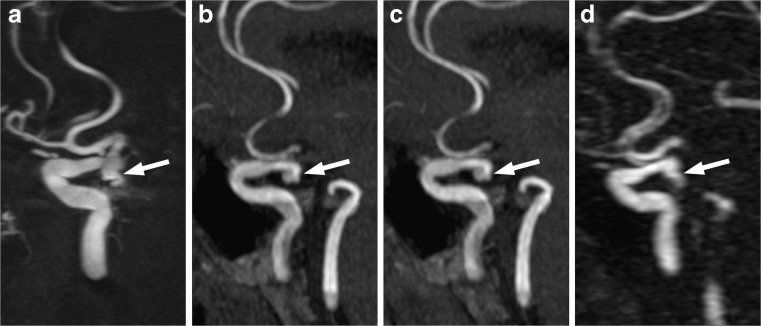
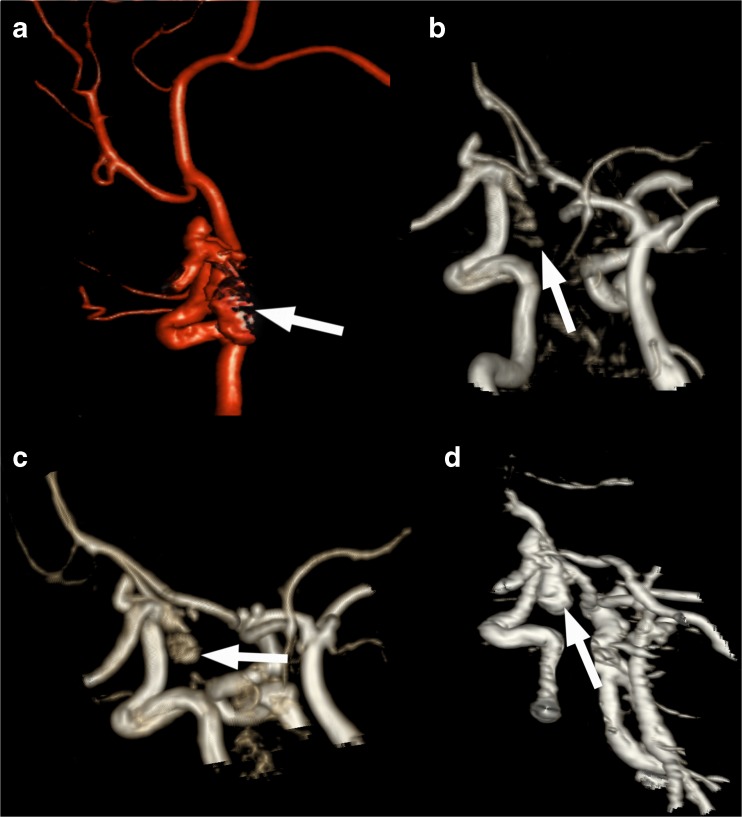
Twenty-six aneurysms were found incompletely occluded in 72 consecutively examined patients at a follow-up after 3 months. The diameters and volume of aneurysm remnants were compared between 3D-DSA, time-of-flight MRA (TOF-MRA), contrast-enhanced TOF-MRA (CE-TOF-MRA), and contrast-enhanced MRA (CE-MRA) at 1.5 T.
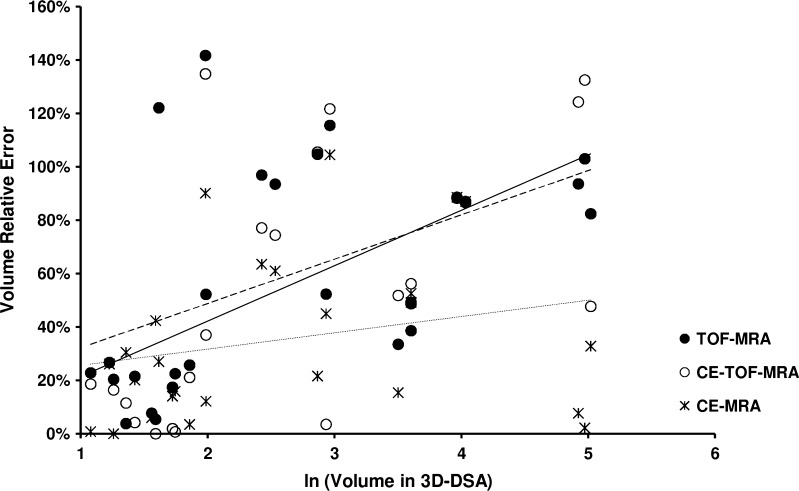
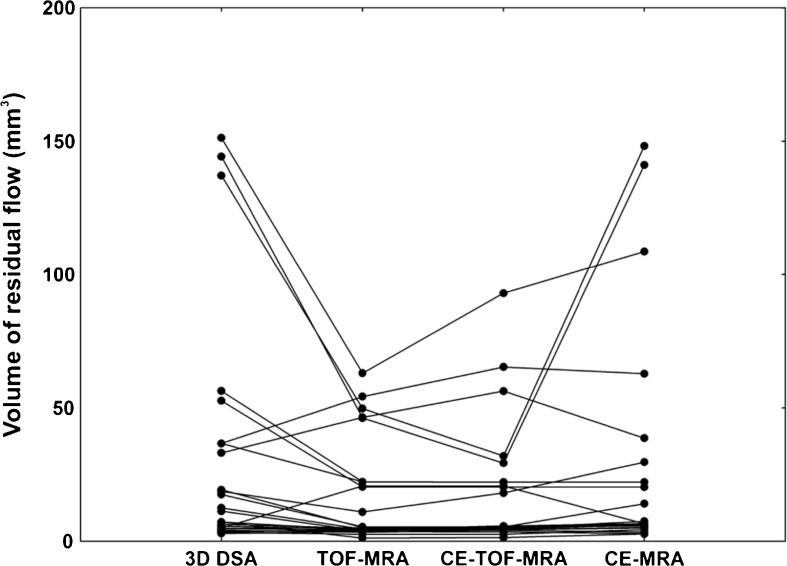
There was a significant correlation between remnant volumes calculated based on 3D-DSA and all MRA modalities. The intraobserver variability of the measurements ranged from 3.4 to 4.1 % and the interobserver variability from 5.8 to 7.3 %. There were no significant differences in the variability between the techniques. The mean residual filling volume ranged from 16.3 ± 19.0 mm(3) in TOF-MRA to 30.5 ± 44.6 mm(3) in 3D-DSA (P < 0.04). Significant differences were found in the volumes measured with 3D-DSA and CE-MRA as compared to TOF-MRA and CE-TOF-MRA (P < 0.01). There was a moderate significant correlation between the residual filling and the relative error of measurement in the case of TOF-MRA and CE-TOF-MRA.
TOF-MRA seems to underestimate the size of aneurysm remnants detected at follow-up and should not be used as a sole imaging method to decide on re-embolization.
血管内治疗颅内动脉瘤的主要局限性在于血管再通的可能性和再次治疗的需要。本研究旨在比较三维数字减影血管造影(3D-DSA)和磁共振血管造影(MRA)随访时测量的残余动脉瘤大小。
对 72 例连续检查患者的 3 个月随访中发现 26 个动脉瘤不完全闭塞。比较 3D-DSA、时间飞越磁共振血管造影(TOF-MRA)、对比增强时间飞越磁共振血管造影(CE-TOF-MRA)和对比增强磁共振血管造影(CE-MRA)在 1.5T 下的残余动脉瘤直径和体积。
3D-DSA 计算的残余体积与所有 MRA 模式之间存在显著相关性。测量的观察者内变异性范围为 3.4%至 4.1%,观察者间变异性范围为 5.8%至 7.3%。不同技术之间的变异性没有显著差异。残余充盈体积的平均值从 TOF-MRA 的 16.3±19.0mm3到 3D-DSA 的 30.5±44.6mm3(P<0.04)。3D-DSA 与 CE-MRA 测量的体积与 TOF-MRA 和 CE-TOF-MRA 相比差异显著(P<0.01)。TOF-MRA 和 CE-TOF-MRA 测量的残余充盈体积与相对测量误差之间存在中度显著相关性。
TOF-MRA 似乎低估了随访时检测到的残余动脉瘤的大小,不应单独用作决定再次栓塞的成像方法。