Wang Nan, De Bock Marijke, Decrock Elke, Bol Mélissa, Gadicherla Ashish, Vinken Mathieu, Rogiers Vera, Bukauskas Feliksas F, Bultynck Geert, Leybaert Luc
Department of Basic Medical Sciences, Ghent University, Ghent, Belgium.
Biochim Biophys Acta. 2013 Jan;1828(1):35-50. doi: 10.1016/j.bbamem.2012.07.002. Epub 2012 Jul 13.
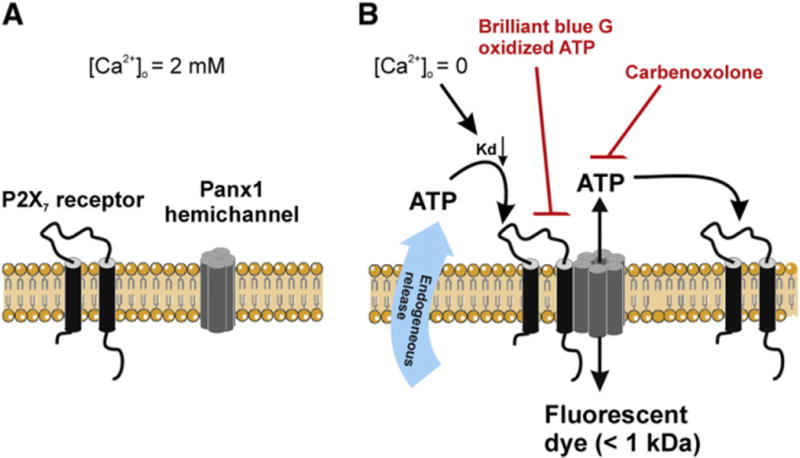
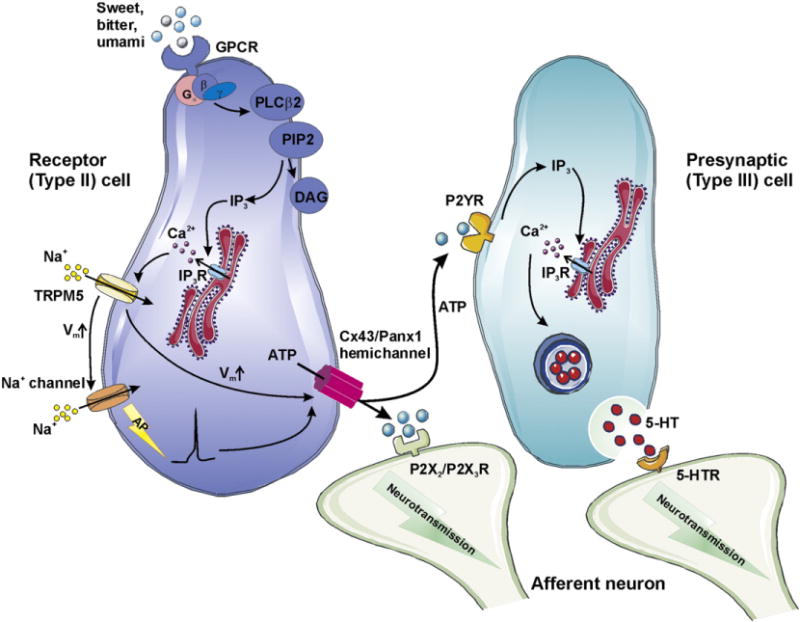
Plasma membrane hemichannels composed of connexin (Cx) proteins are essential components of gap junction channels but accumulating evidence suggests functions of hemichannels beyond the communication provided by junctional channels. Hemichannels not incorporated into gap junctions, called unapposed hemichannels, can open in response to a variety of signals, electrical and chemical, thereby forming a conduit between the cell's interior and the extracellular milieu. Open hemichannels allow the bidirectional passage of ions and small metabolic or signaling molecules of below 1-2kDa molecular weight. In addition to connexins, hemichannels can also be formed by pannexin (Panx) proteins and current evidence suggests that Cx26, Cx32, Cx36, Cx43 and Panx1, form hemichannels that allow the diffusive release of paracrine messengers. In particular, the case is strong for ATP but substantial evidence is also available for other messengers like glutamate and prostaglandins or metabolic substances like NAD(+) or glutathione. While this field is clearly in expansion, evidence is still lacking at essential points of the paracrine signaling cascade that includes not only messenger release, but also downstream receptor signaling and consequent functional effects. The data available at this moment largely derives from in vitro experiments and still suffers from the difficulty of separating the functions of connexin-based hemichannels from gap junctions and from pannexin hemichannels. However, messengers like ATP or glutamate have universal roles in the body and further defining the contribution of hemichannels as a possible release pathway is expected to open novel avenues for better understanding their contribution to a variety of physiological and pathological processes. This article is part of a Special Issue entitled: The Communicating junctions, roles and dysfunctions.
由连接蛋白(Cx)构成的质膜半通道是间隙连接通道的重要组成部分,但越来越多的证据表明,半通道的功能不仅仅局限于连接通道所提供的通讯功能。未整合到间隙连接中的半通道,即未对接半通道,可响应多种电信号和化学信号而开放,从而在细胞内部与细胞外环境之间形成一条通道。开放的半通道允许离子以及分子量低于1 - 2kDa的小分子代谢或信号分子双向通过。除了连接蛋白外,半通道也可由泛连接蛋白(Panx)构成,目前的证据表明,Cx26、Cx32、Cx36、Cx43和Panx1可形成半通道,允许旁分泌信使分子的扩散释放。特别是,ATP的情况很明显,但也有大量证据表明其他信使分子如谷氨酸和前列腺素或代谢物质如NAD(+)或谷胱甘肽也能通过半通道释放。虽然这个领域显然在不断扩展,但在旁分泌信号级联反应的关键环节仍缺乏证据,旁分泌信号级联反应不仅包括信使分子的释放,还包括下游受体信号传导以及随之而来的功能效应。目前可用的数据主要来自体外实验,并且仍然难以区分基于连接蛋白的半通道与间隙连接以及泛连接蛋白半通道的功能。然而,像ATP或谷氨酸这样的信使分子在体内具有普遍作用,进一步明确半通道作为一种可能的释放途径的作用,有望为更好地理解它们对各种生理和病理过程的贡献开辟新的途径。本文是名为“通讯连接、作用与功能障碍”的特刊的一部分。