Eppley Institute for Research in Cancer and Allied Diseases, University of Nebraska Medical Center, Omaha, NE 68198, USA.
Int J Oncol. 2012 Oct;41(4):1464-74. doi: 10.3892/ijo.2012.1553. Epub 2012 Jul 13.
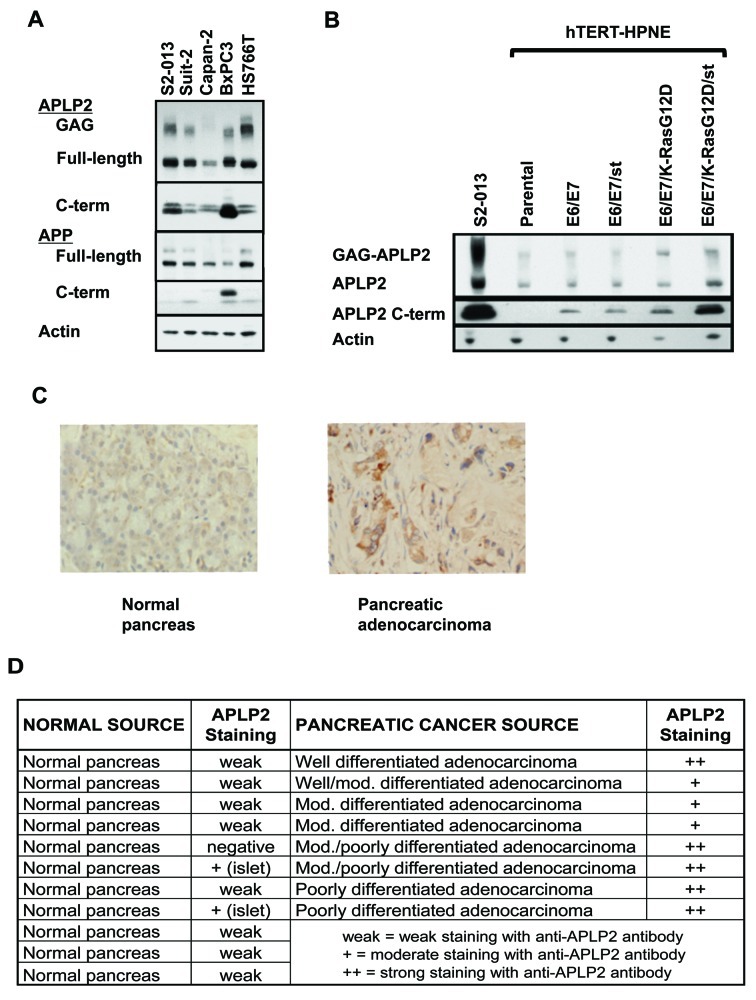
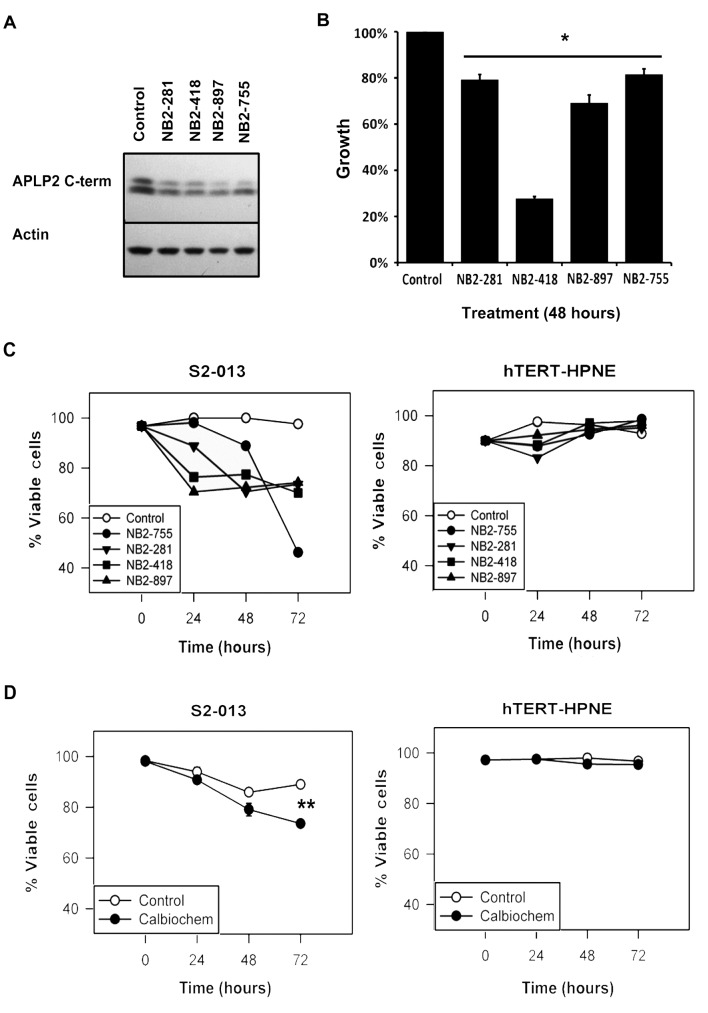
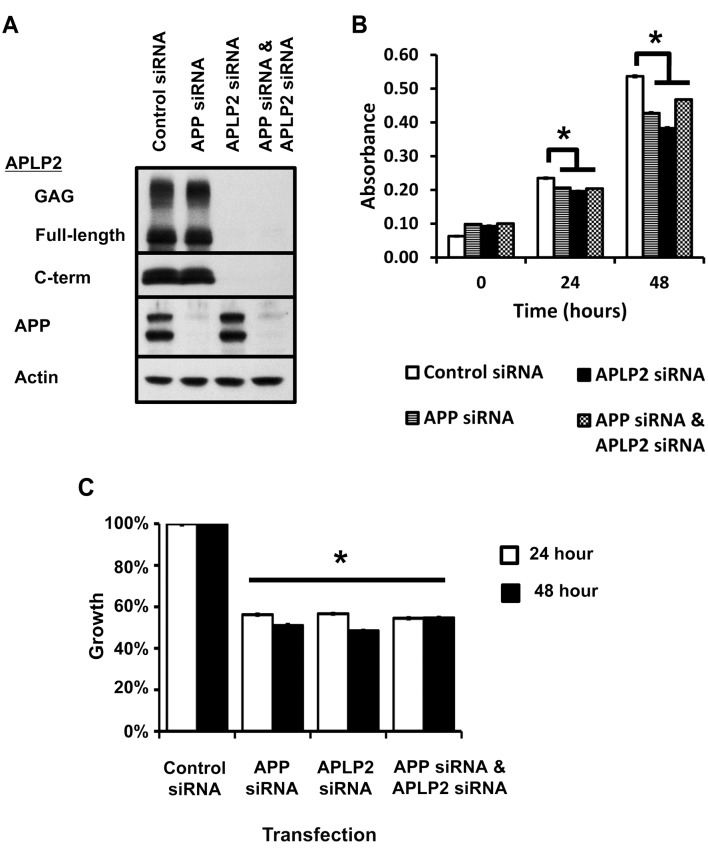
In some cellular systems, particularly neurons, amyloid precursor-like protein 2 (APLP2), and its highly homologous family member amyloid precursor protein (APP), have been linked to cellular growth. APLP2 and APP undergo regulated intramembrane proteolysis to produce C-terminal fragments. In this study, we found comprehensive expression of APLP2 C-terminal fragments in a panel of pancreatic cancer cell lines; however, APP C-terminal fragments were notably limited to the BxPC3 cell line. Extensive glycosaminoglycan modification on APLP2 was also found in the majority of pancreatic cancer cell lines. Glycosaminoglycan-modified and -unmodified APLP2, and particularly APLP2 C-terminal fragments, also demonstrated increased expression in oncogene-transformed pancreatic ductal cells. Additionally, elevated APLP2 levels were confirmed in human pancreatic cancer tissue. Downregulation of APLP2 and APP expression, alone or in combination, caused a decrease in the growth of a pancreatic cancer cell line with representatively low APP C-terminal fragment expression, the S2-013 cell line. Furthermore, we found that treatment with β-secretase inhibitors to block formation of APLP2 C-terminal fragments decreased the growth and viability of S2-013 cells, without affecting the survival of a non-transformed pancreatic ductal cell line. In conclusion, our studies demonstrate that abundant APLP2, but not APP, C-terminal fragment expression is conserved in pancreatic cancer cell lines; however, APP and APLP2 equally regulated the growth of S2-013 pancreatic cancer cells. Chiefly, our discoveries establish a role for APLP2 in the growth of pancreatic cancer cells and show that inhibitors preventing APLP2 cleavage reduce the viability of pancreatic cancer cells.
在某些细胞系统中,特别是神经元中,淀粉样前体样蛋白 2(APLP2)及其高度同源的家族成员淀粉样前体蛋白(APP)与细胞生长有关。APLP2 和 APP 经历调节的膜内蛋白水解以产生 C 端片段。在这项研究中,我们发现 APLP2 C 端片段在一系列胰腺癌细胞系中广泛表达;然而,APP C 端片段明显仅限于 BxPC3 细胞系。在大多数胰腺癌细胞系中还发现 APLP2 广泛的糖胺聚糖修饰。糖胺聚糖修饰和未修饰的 APLP2,特别是 APLP2 C 端片段,也在致癌基因转化的胰腺导管细胞中表达增加。此外,在人胰腺癌细胞组织中也证实了 APLP2 水平升高。APLP2 和 APP 表达的单独或联合下调,导致具有代表性的低 APP C 端片段表达的胰腺癌细胞系(S2-013 细胞系)生长减少。此外,我们发现用β-分泌酶抑制剂处理以阻断 APLP2 C 端片段的形成,可降低 S2-013 细胞的生长和活力,而不影响非转化的胰腺导管细胞系的存活。总之,我们的研究表明,丰富的 APLP2,但不是 APP,C 端片段表达在胰腺癌细胞系中是保守的;然而,APP 和 APLP2 同样调节 S2-013 胰腺癌细胞的生长。主要是,我们的发现确立了 APLP2 在胰腺癌细胞生长中的作用,并表明防止 APLP2 切割的抑制剂可降低胰腺癌细胞的活力。