Division of Retrovirology, HPA-NIBSC, Blanche Lane, South Mimms, Potters Bar, Hertfordshire EN6 3QG, UK.
Retrovirology. 2012 Jul 16;9:56. doi: 10.1186/1742-4690-9-56.
Current data suggest that an efficacious human immunodeficiency virus type 1 (HIV-1) vaccine should elicit both adaptive humoral and cell mediated immune responses. Such a vaccine will also need to protect against infection from a range of heterologous viral variants. Here we have developed a simian-human immunodeficiency virus (SHIV) based model in cynomolgus macaques to investigate the breadth of protection conferred by HIV-1W61D recombinant gp120 vaccination against SHIVsbg and SHIVSF33 challenge, and to identify correlates of protection.
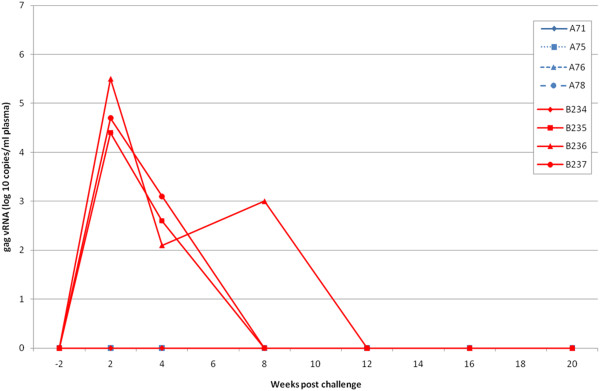
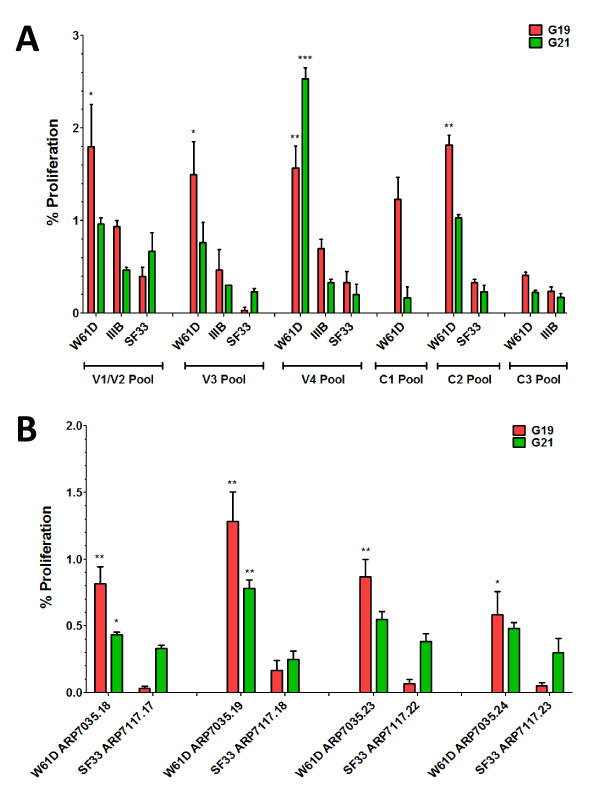
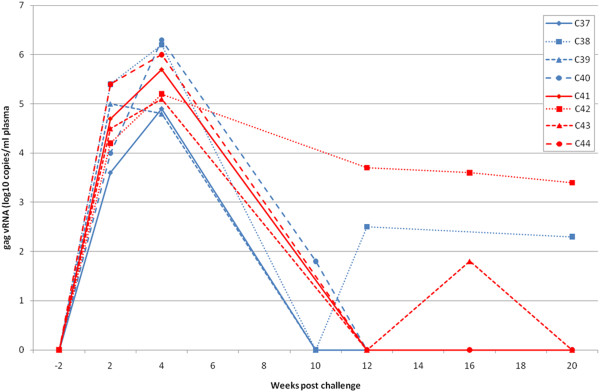
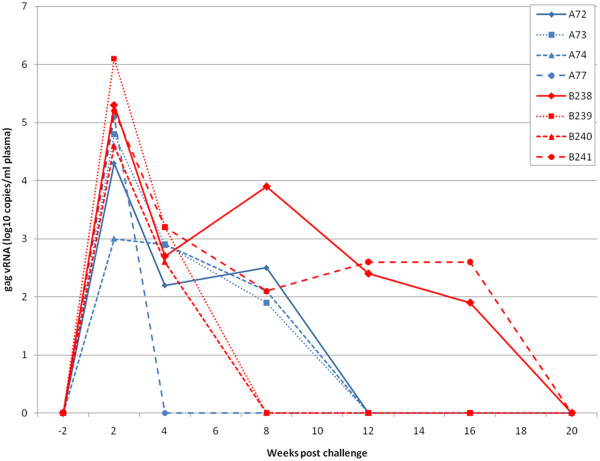
High titres of anti-envelope antibodies were detected in all vaccinees. The antibodies reacted with both the homologous HIV-1W61D and heterologous HIV-1IIIB envelope rgp120 which has an identical sequence to the SHIVsbg challenge virus. Significant titres of virus neutralising antibodies were detected against SHIVW61D expressing an envelope homologous with the vaccine, but only limited cross neutralisation against SHIVsbg, SHIV-4 and SHIVSF33 was observed. Protection against SHIVsbg infection was observed in vaccinated animals but none was observed against SHIVSF33 challenge. Transfer of immune sera from vaccinated macaques to naive recipients did not confer protection against SHIVsbg challenge. In a follow-up study, T cell proliferative responses detected after immunisation with the same vaccine against a single peptide present in the second conserved region 2 of HIV-1 W61D and HIV-1 IIIB gp120, but not SF33 gp120.
Following extended vaccination with a HIV-1 rgp120 vaccine, protection was observed against heterologous virus challenge with SHIVsbg, but not SHIVSF33. Protection did not correlate with serological responses generated by vaccination, but might be associated with T cell proliferative responses against an epitope in the second constant region of HIV-1 gp120. Broader protection may be obtained with recombinant HIV-1 envelope based vaccines formulated with adjuvants that generate proliferative T cell responses in addition to broadly neutralising antibodies.
目前的数据表明,有效的人类免疫缺陷病毒 1 型(HIV-1)疫苗应引起适应性体液和细胞介导免疫反应。这样的疫苗还需要防止感染一系列不同的病毒变异体。在这里,我们在食蟹猴中建立了一种基于猿猴免疫缺陷病毒(SHIV)的模型,以研究 HIV-1W61D 重组 gp120 疫苗接种对 SHIVsbg 和 SHIVSF33 挑战的广泛保护作用,并确定保护的相关性。
所有疫苗接种者均检测到高滴度的抗包膜抗体。这些抗体与同源的 HIV-1W61D 和异源的 HIV-1IIIB 包膜 rgp120 反应,后者与 SHIVsbg 挑战病毒具有相同的序列。针对表达与疫苗同源包膜的 SHIVW61D ,检测到了显著的病毒中和抗体滴度,但仅观察到对 SHIVsbg、SHIV-4 和 SHIVSF33 的有限交叉中和作用。在接种疫苗的动物中观察到对 SHIVsbg 感染的保护,但对 SHIVSF33 挑战没有观察到。将免疫血清从接种的猕猴转移给未感染的受者不能防止 SHIVsbg 感染。在后续研究中,在用针对 HIV-1W61D 和 HIV-1III 包膜 gp120 第二保守区 2 中单个肽的相同疫苗免疫后,检测到 T 细胞增殖反应,但不能检测到 SF33 gp120。
在对 HIV-1 rgp120 疫苗进行长期接种后,观察到对 SHIVsbg 的异源病毒挑战的保护,但对 SHIVSF33 没有观察到。保护与疫苗接种产生的血清学反应无关,但可能与针对 HIV-1 gp120 第二恒定区表位的 T 细胞增殖反应有关。用含有佐剂的重组 HIV-1 包膜疫苗进行免疫接种可能会获得更广泛的保护作用,这些佐剂除了产生广泛中和抗体外,还能产生增殖性 T 细胞反应。