Freshwater Biology, Royal Belgian Institute of Natural Sciences, Brussels, Belgium.
PLoS One. 2012;7(7):e39844. doi: 10.1371/journal.pone.0039844. Epub 2012 Jul 3.
Fully asexually reproducing taxa lack outcrossing. Hence, the classic Biological Species Concept cannot be applied.
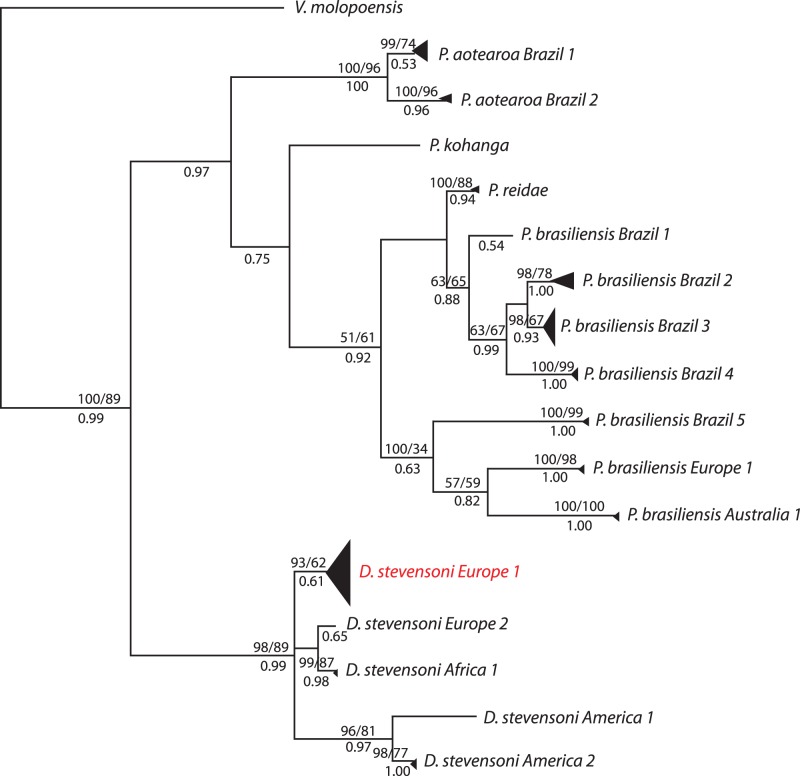
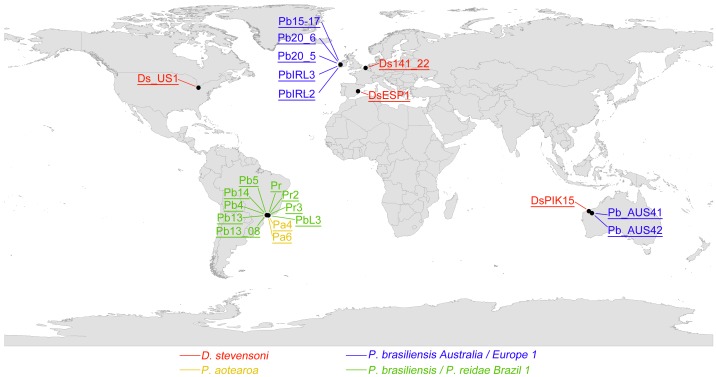
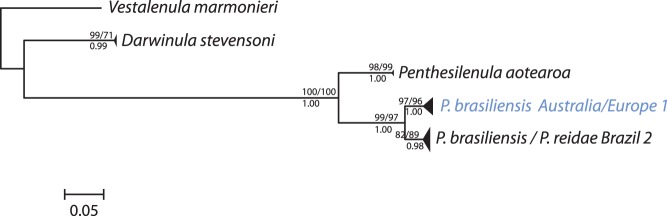
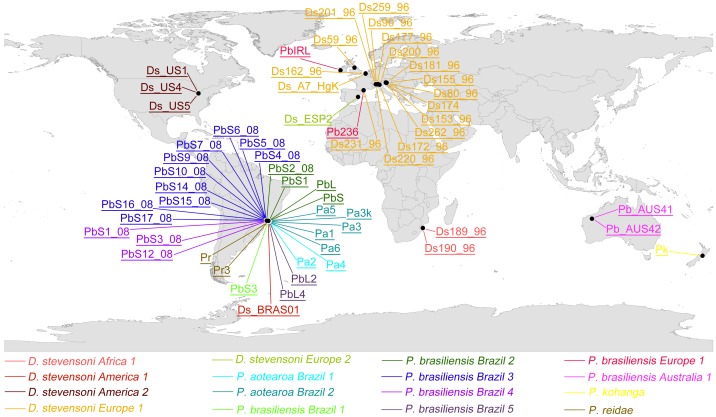
METHODOLOGY/PRINCIPAL FINDINGS: We used DNA sequences from the mitochondrial COI gene and the nuclear ITS2 region to check species boundaries according to the evolutionary genetic (EG) species concept in five morphospecies in the putative ancient asexual ostracod genera, Penthesilenula and Darwinula, from different continents. We applied two methods for detecting cryptic species, namely the K/θ method and the General Mixed Yule Coalescent model (GMYC). We could confirm the existence of species in all five darwinulid morphospecies and additional cryptic diversity in three morphospecies, namely in Penthesilenula brasiliensis, Darwinula stevensoni and in P. aotearoa. The number of cryptic species within one morphospecies varied between seven (P. brasiliensis), five to six (D. stevensoni) and two (P. aotearoa), respectively, depending on the method used. Cryptic species mainly followed continental distributions. We also found evidence for coexistence at the local scale for Brazilian cryptic species of P. brasiliensis and P. aotearoa. Our ITS2 data confirmed that species exist in darwinulids but detected far less EG species, namely two to three cryptic species in P. brasiliensis and no cryptic species at all in the other darwinulid morphospecies.
CONCLUSIONS/SIGNIFICANCE: Our results clearly demonstrate that both species and cryptic diversity can be recognized in putative ancient asexual ostracods using the EG species concept, and that COI data are more suitable than ITS2 for this purpose. The discovery of up to eight cryptic species within a single morphospecies will significantly increase estimates of biodiversity in this asexual ostracod group. Which factors, other than long-term geographic isolation, are important for speciation processes in these ancient asexuals remains to be investigated.
完全无性繁殖的分类单元缺乏杂交。因此,经典的生物物种概念无法应用。
方法/主要发现:我们使用来自线粒体 COI 基因和核 ITS2 区域的 DNA 序列,根据进化遗传(EG)物种概念,检查来自不同大陆的假定古老无性介形类属 Penthesilenula 和 Darwinula 中的五个形态物种的物种边界。我们应用了两种用于检测隐种的方法,即 K/θ 方法和广义混合 Yule 合并模型(GMYC)。我们能够确认所有五个达尔文类形态物种中存在物种,并且在三个形态物种中还存在额外的隐种多样性,即 Penthesilenula brasiliensis、Darwinula stevensoni 和 P. aotearoa。一个形态物种内的隐种数量分别为 7 种(P. brasiliensis)、5 到 6 种(D. stevensoni)和 2 种(P. aotearoa),具体取决于使用的方法。隐种主要遵循大陆分布。我们还在巴西 P. brasiliensis 和 P. aotearoa 的隐种中发现了局部尺度共存的证据。我们的 ITS2 数据证实,物种在达尔文类中存在,但检测到的 EG 物种要少得多,即在 P. brasiliensis 中只有 2 到 3 个隐种,而在其他达尔文类形态物种中则完全没有隐种。
结论/意义:我们的研究结果清楚地表明,使用 EG 物种概念可以在假定的古老无性介形类中识别出物种和隐种多样性,而 COI 数据比 ITS2 更适合用于此目的。在单个形态物种中发现多达 8 个隐种,将显著增加该无性介形类群的生物多样性估计。除了长期地理隔离之外,还有哪些因素对这些古老无性生物的物种形成过程很重要,这仍有待研究。