Department of Urology, Keio University School of Medicine, 35 Shinanomachi, Shinjuku-ku, Tokyo 160-8582, Japan.
Br J Cancer. 2012 Aug 7;107(4):652-7. doi: 10.1038/bjc.2012.321. Epub 2012 Jul 17.
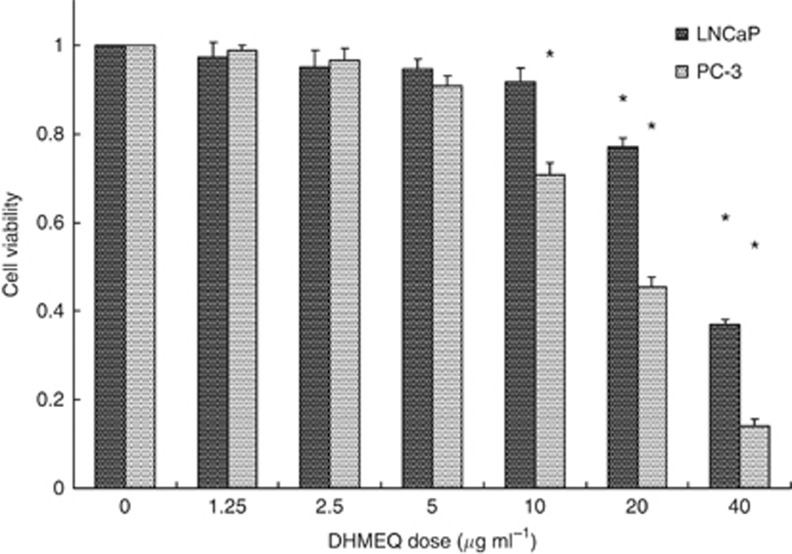
Inducible activation of nuclear factor (NF)-κB is one of the principal mechanisms through which resistant prostate cancer cells are protected from radiotherapy. We hypothesised that inactivation of inducible NF-κB with a novel NF-κB inhibitor, DHMEQ, would increase the therapeutic effects of radiotherapy.
PC-3 and LNCaP cells were exposed to irradiation and/or DHMEQ. Cell viability, cell cycle analysis, western blotting assay, and NF-κB activity were measured. The antitumour effect of irradiation combined with DHMEQ in vivo was also assessed.
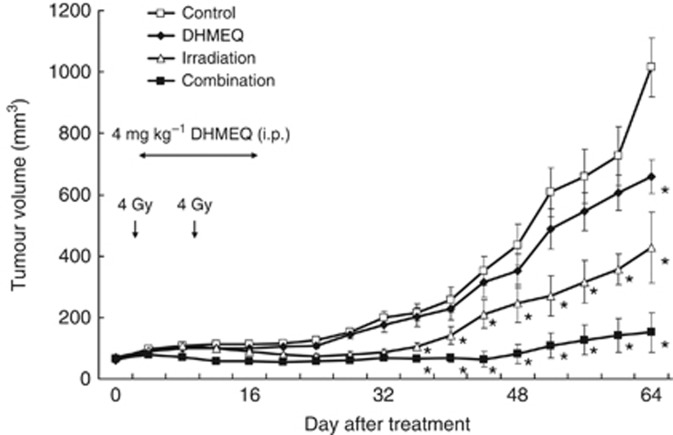
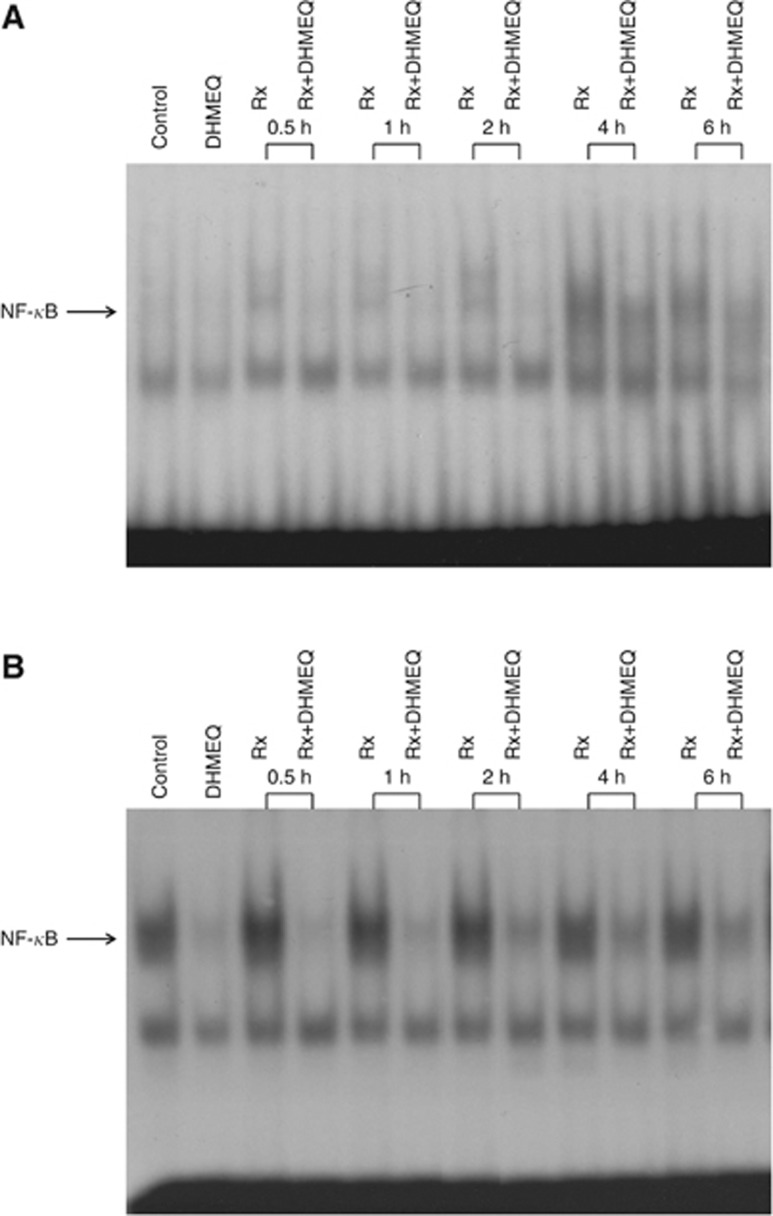
The combination of DHMEQ with irradiation resulted in cell growth inhibition and G2/M arrest relative to treatment with irradiation alone. Inducible NF-κB activity by irradiation was inhibited by DHMEQ treatment. The expression of p53 and p21 in LNCaP, and of 14-3-3σ in PC-3 cells, was increased in the combination treatment. In the in vivo study, 64 days after the start of treatment, tumour size was 85.1%, 77.1%, and 64.7% smaller in the combination treatment group than that of the untreated control, DHMEQ-treated alone, and irradiation alone groups, respectively.
Blockade of NF-κB activity induced by radiation with DHMEQ could overcome radio-resistant responses and may become a new therapeutic modality for treating prostate cancer.
诱导性核因子 (NF)-κB 的激活是保护耐药前列腺癌细胞免受放射治疗的主要机制之一。我们假设用新型 NF-κB 抑制剂 DHMEQ 失活诱导性 NF-κB 会增加放射治疗的疗效。
将 PC-3 和 LNCaP 细胞暴露于照射和/或 DHMEQ 下。测量细胞活力、细胞周期分析、western blot 分析和 NF-κB 活性。还评估了照射与 DHMEQ 联合在体内的抗肿瘤作用。
与单独照射相比,DHMEQ 与照射联合使用导致细胞生长抑制和 G2/M 期阻滞。DHMEQ 处理抑制了照射诱导的可诱导 NF-κB 活性。在 LNCaP 细胞中 p53 和 p21 的表达以及在 PC-3 细胞中 14-3-3σ的表达在联合治疗中增加。在体内研究中,与未治疗对照组、DHMEQ 单独治疗组和单独照射组相比,治疗开始后 64 天,联合治疗组的肿瘤大小分别小 85.1%、77.1%和 64.7%。
用 DHMEQ 阻断辐射诱导的 NF-κB 活性可能克服放射抵抗反应,可能成为治疗前列腺癌的新治疗模式。