Departamento de Medicina Molecular y Bioprocesos, Instituto de Biotecnología, Universidad Nacional Autónoma de México, Cuernavaca, Morelos, México.
PLoS One. 2012;7(7):e40700. doi: 10.1371/journal.pone.0040700. Epub 2012 Jul 10.
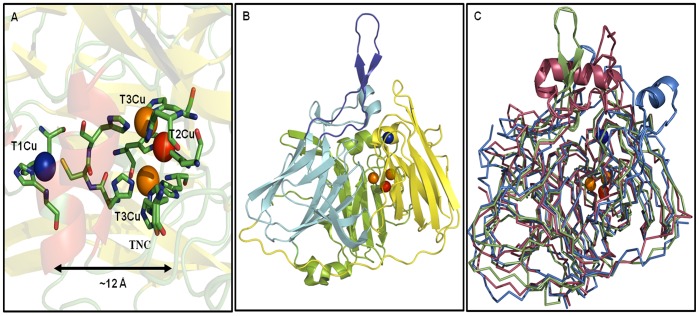
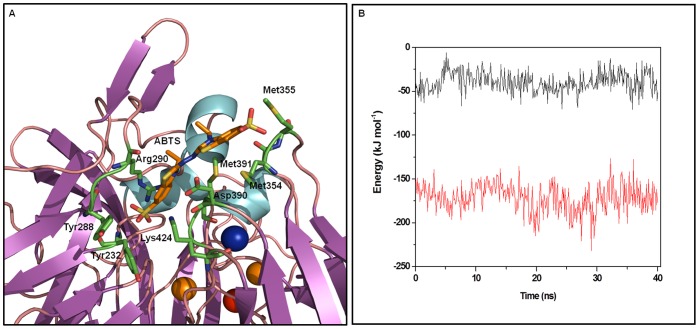
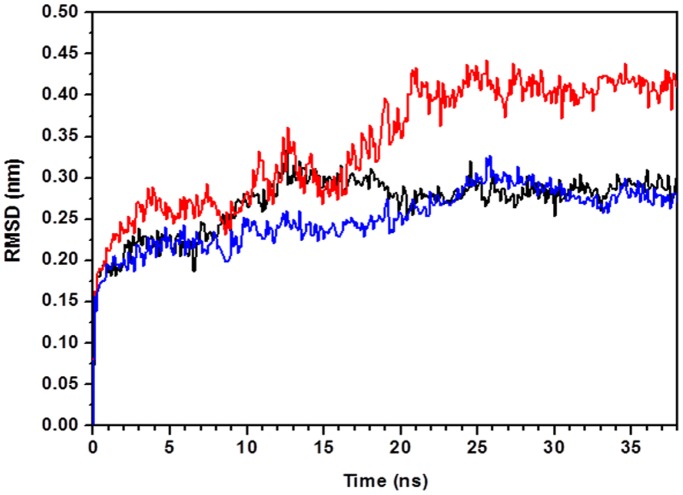
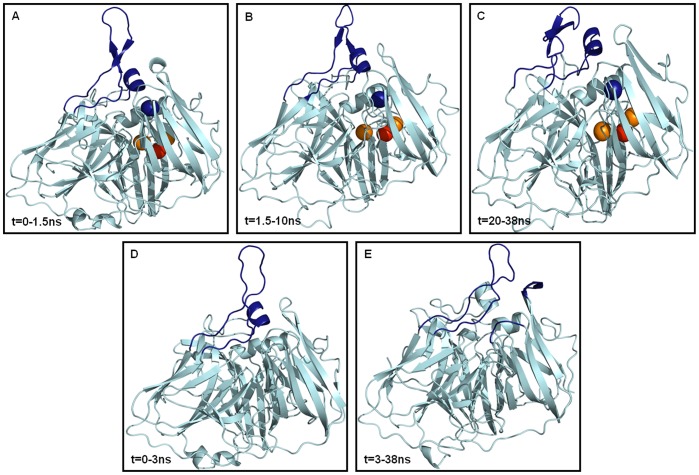
Molecular dynamic (MD) simulations have been performed on Tth-MCO, a hyperthermophilic multicopper oxidase from thermus thermophilus HB27, in the apo as well as the holo form, with the aim of exploring the structural dynamic properties common to the two conformational states. According to structural comparison between this enzyme and other MCOs, the substrate in process to electron transfer in an outer-sphere event seems to transiently occupy a shallow and overall hydrophobic cavity near the Cu type 1 (T1Cu). The linker connecting the β-strands 21 and 24 of the second domain (loop (β21-β24)(D2)) has the same conformation in both states, forming a flexible lid at the entrance of the electron-transfer cavity. Loop (β21-β24)(D2) has been tentatively assigned a role occluding the access to the electron-transfer site. The dynamic of the loop (β21-β24)(D2) has been investigated by MD simulation, and results show that the structures of both species have the same secondary and tertiary structure during almost all the MD simulations. In the simulation, loop (β21-β24)(D2) of the holo form undergoes a higher mobility than in the apo form. In fact, loop (β21-β24)(D2) of the holo form experiences a conformational change which enables exposure to the electron-transfer site (open conformation), while in the apo form the opposite effect takes place (closed conformation). To confirm the hypothesis that the open conformation might facilitate the transient electron-donor molecule occupation of the site, the simulation was extended another 40 ns with the electron-donor molecule docked into the protein cavity. Upon electron-donor molecule stabilization, loops near the cavity reduce their mobility. These findings show that coordination between the copper and the protein might play an important role in the general mobility of the enzyme, and that the open conformation seems to be required for the electron transfer process to T1Cu.
已对来自嗜热栖热菌的超嗜热多铜氧化酶 Tth-MCO 进行了分子动力学(MD)模拟,分别在 apo 和 holo 两种形式下,旨在探索两种构象状态共有的结构动态特性。根据该酶与其他 MCO 之间的结构比较,在外部球事件中进行电子转移的底物似乎会暂时占据靠近 Cu 型 1(T1Cu)的浅而整体疏水性腔。连接第二结构域的β-链 21 和 24 的连接子(loop(β21-β24)(D2))在两种状态下具有相同的构象,在电子转移腔的入口处形成一个灵活的盖子。loop(β21-β24)(D2)被暂时分配了阻塞电子转移位点进入的作用。通过 MD 模拟研究了 loop(β21-β24)(D2)的动力学,结果表明在几乎所有 MD 模拟中,两种物质的结构都具有相同的二级和三级结构。在模拟中,holo 形式的 loop(β21-β24)(D2)比 apo 形式的 loop(β21-β24)(D2)具有更高的流动性。实际上,holo 形式的 loop(β21-β24)(D2)经历构象变化,从而使电子转移部位暴露(开放构象),而 apo 形式则相反(封闭构象)。为了证实开放构象可能有利于瞬态电子供体分子占据该部位的假设,将模拟延长了另外 40 ns,将电子供体分子对接入蛋白质腔中。电子供体分子稳定后,腔附近的环降低了它们的流动性。这些发现表明,铜与蛋白质之间的配位可能在酶的整体流动性中起重要作用,并且开放构象似乎是 T1Cu 电子转移过程所必需的。