Department of Radiation Oncology, Seoul National University College of Medicine, Seoul, Korea.
J Gynecol Oncol. 2012 Jul;23(3):168-74. doi: 10.3802/jgo.2012.23.3.168. Epub 2012 Jul 2.
This study was to evaluate the treatment outcomes and prognostic factors of patients treated with salvage radiotherapy for the treatment of isolated lymph node recurrence of cervical cancer.
Between 1990 and 2009, 22 cervical cancer patients with lymph node recurrence who had previously undergone radical hysterectomy and pelvic lymph node dissection were treated with salvage radiotherapy with (n=18) or without (n=4) chemotherapy. Of the 22 patients, 10 had supraclavicular lymph node recurrence, 9 had para-aortic lymph node, and 3 had inguinal lymph node. The median total radiotherapy dose was 60 Gy (range, 40 to 70 Gy). Initial pathologic findings, latent period to lymph node recurrence and other clinical parameters such as squamous cell carcinoma antigen (SCC-Ag) level and concurrent chemotherapy were identified as prognostic factors for survival.
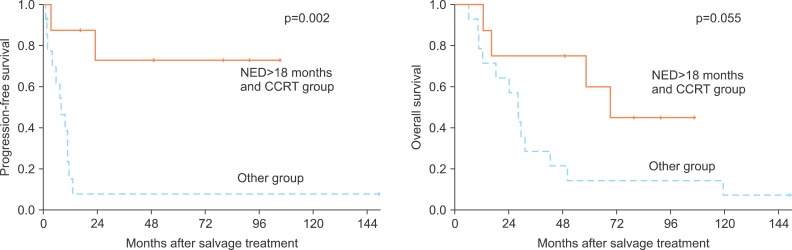
The median follow-up period after salvage radiotherapy was 31.2 months (range, 12.1 to 148.9 months). The 5-year progression-free and overall survival rates of all patients were 32.7% and 30.7%, respectively. Concurrent chemoradiotherapy (p=0.009) and longer latent period to lymph node recurrence (>18 months vs. ≤18 months, p=0.019) were significant predictors of progression-free survival and SCC-Ag level at the time of recurrence (>8 ng/dL vs. ≤8 ng/dL, p=0.008) and longer latent period to lymph node recurrence (p=0.040) for overall survival. Treatment failure after salvage radiotherapy occurred in 14 (63.6%) for the 22 patients (in field, 2; out of field, 10; both in and out field, 2). Grade 3 acute skin (n=2) and hematologic toxicity (n=1) developed in 3 patients.
For isolated lymph node recurrence of cervical cancer, salvage radiotherapy with concurrent chemotherapy should be considered, especially in patients with a long-term progression-free period.
本研究旨在评估接受挽救性放疗治疗宫颈癌单纯淋巴结复发患者的治疗效果和预后因素。
1990 年至 2009 年间,22 例接受根治性子宫切除术和盆腔淋巴结清扫术的宫颈癌患者出现淋巴结复发,接受挽救性放疗,其中 18 例患者联合化疗,4 例患者未联合化疗。22 例患者中,10 例出现锁骨上淋巴结复发,9 例出现腹主动脉旁淋巴结复发,3 例出现腹股沟淋巴结复发。中位总放疗剂量为 60 Gy(范围为 40 至 70 Gy)。初始病理结果、淋巴结复发潜伏期和其他临床参数,如鳞状细胞癌抗原(SCC-Ag)水平和同期化疗,被确定为生存的预后因素。
挽救性放疗后中位随访时间为 31.2 个月(范围为 12.1 至 148.9 个月)。所有患者的 5 年无进展生存率和总生存率分别为 32.7%和 30.7%。同期放化疗(p=0.009)和淋巴结复发潜伏期较长(>18 个月比≤18 个月,p=0.019)是无进展生存的显著预测因素,复发时 SCC-Ag 水平(>8ng/dL 比≤8ng/dL,p=0.008)和淋巴结复发潜伏期较长(p=0.040)是总生存的显著预测因素。22 例患者中,14 例(63.6%)治疗后出现失败(野内复发 2 例,野内及野外复发 10 例,野外复发 2 例)。3 例患者出现 3 级急性皮肤毒性(n=2)和血液学毒性(n=1)。
对于宫颈癌单纯淋巴结复发,应考虑采用同期放化疗的挽救性放疗,特别是在有较长无进展期的患者中。