Department of Biomedical Engineering, University of Texas at San Antonio, TX, USA.
J Cardiovasc Electrophysiol. 2012 Dec;23(12):1364-71. doi: 10.1111/j.1540-8167.2012.02400.x. Epub 2012 Jul 18.
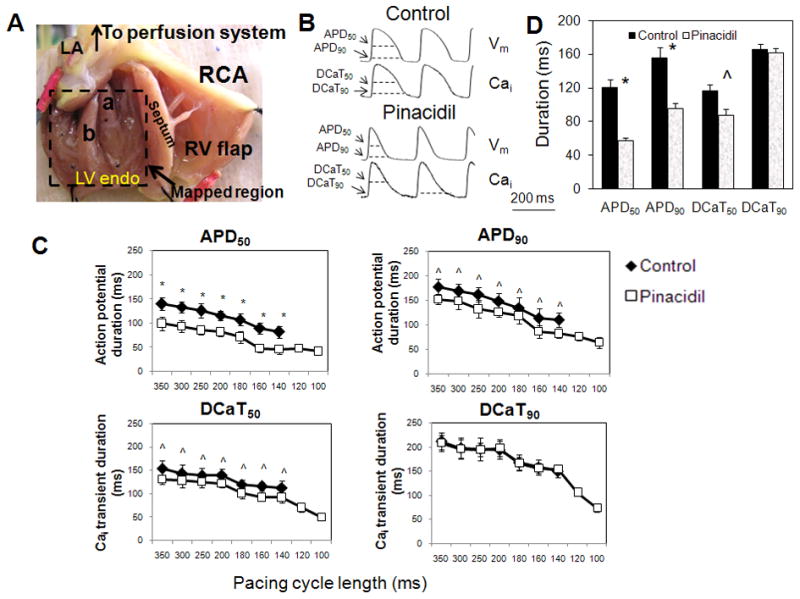
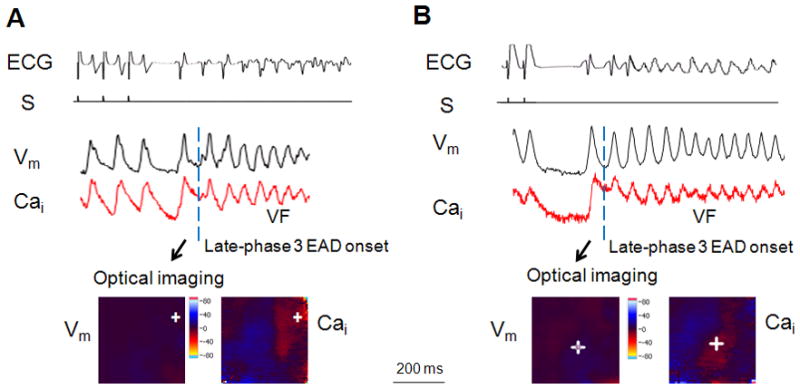
To elucidate the mechanism of late-phase 3 early after depolarization (EAD) in ventricular arrhythmogenesis, we hypothesized that intracellular calcium (Ca(i) ) overloading and action potential duration (APD) shortening may promote late-phase 3 EAD and triggered activity, leading to development of ventricular fibrillation (VF).
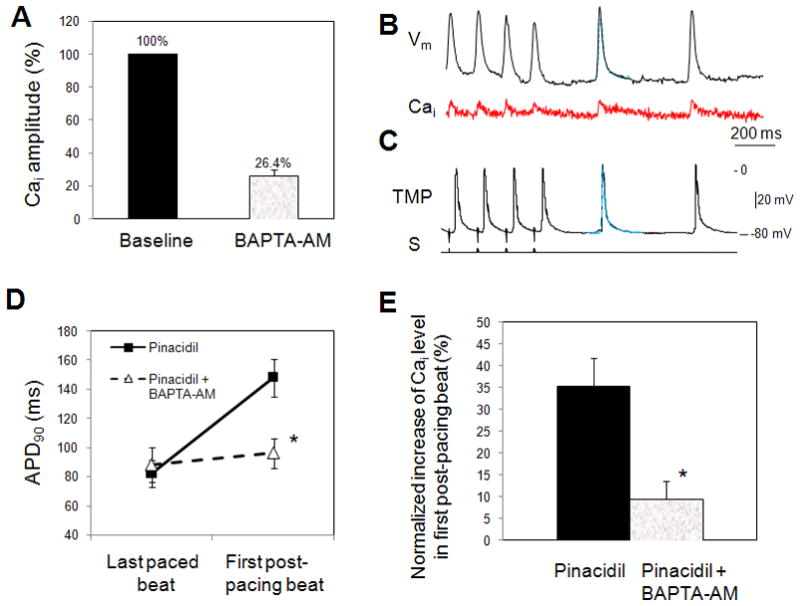
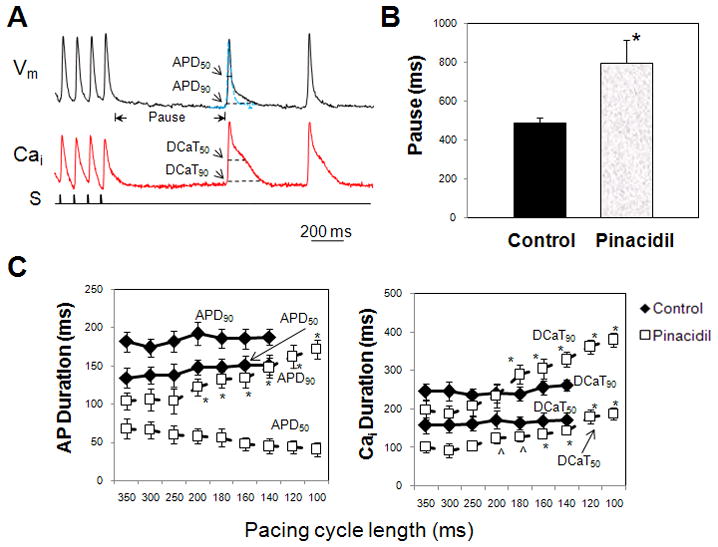
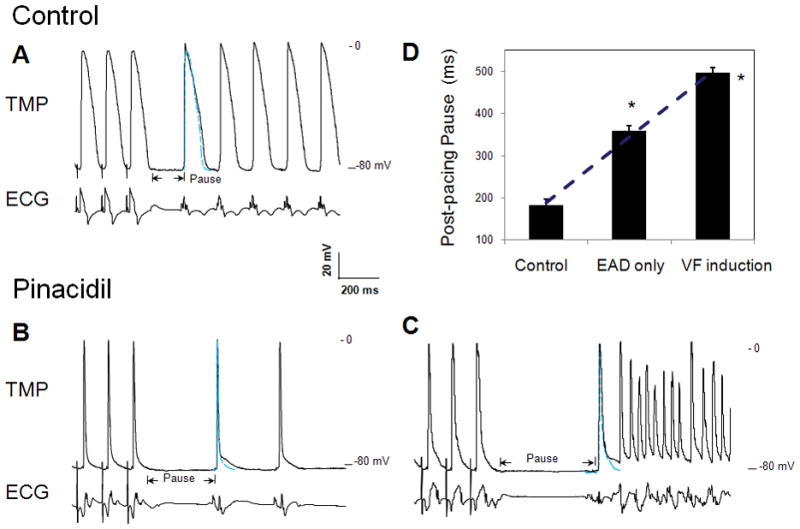
In isolated rabbit hearts, we performed microelectrode recording and simultaneous dual optical mapping of transmembrane potential (V(m) ) and Ca(i) transient on left ventricular endocardium. An I(KATP) channel opener, pinacidil, was used to abbreviate APD. Rapid pacing was then performed. Upon abrupt cessation of rapid pacing with cycle lengths of 60-200 milliseconds, there were APD(90) prolongation and the corresponding Ca(i) overloading in the first postpacing beats. The duration of Ca(i) transient recovered to 50% (DCaT(50) ) and 90% (DCaT(90) ) in the first postpacing beats was significantly longer than baseline. Abnormal Ca(i) elevation coupled with shortened APD produced late-phase 3 EAD induced triggered activity and VF. In additional 6 preparations, the heart tissues were treated with BAPTA-AM, a calcium chelator. BAPTA-AM significantly reduced the maximal Ca(i) amplitude (26.4 ± 3.5% of the control; P < 0.001) and the duration of Ca(i) transients in the mapped region, preventing the development of EAD and triggered activity that initiated VF.
I (KATP) channel activation along with Ca(i) overloading are associated with the development of late-phase 3 EAD and VF. Because acute myocardial ischemia activates the I(KATP) channel, late-phase 3 EADs may be a mechanism for VF initiation during acute myocardial ischemia.
为了阐明晚期 3 期晚除极(EAD)在室性心律失常发生机制中的作用,我们假设细胞内钙(Ca(i))超载和动作电位时程(APD)缩短可能促进晚期 3 期 EAD 和触发活动,导致心室颤动(VF)的发展。
在分离的兔心中,我们进行了微电极记录,并同时对左心室心内膜的跨膜电位(V(m))和 Ca(i)瞬变进行了双光学映射。使用 I(KATP)通道开放剂吡那地尔缩短 APD。然后进行快速起搏。当以 60-200 毫秒的周长突然停止快速起搏时,第一个起搏后心跳中会出现 APD(90)延长和相应的 Ca(i)超载。Ca(i)瞬变的恢复到 50%(DCaT(50))和 90%(DCaT(90))的时间在第一个起搏后心跳中明显长于基线。异常的 Ca(i)升高与 APD 缩短相结合,产生晚期 3 期 EAD 诱导的触发活动和 VF。在另外 6 个标本中,心脏组织用钙螯合剂 BAPTA-AM 处理。BAPTA-AM 显著降低了最大 Ca(i)幅度(对照组的 26.4±3.5%;P<0.001)和映射区域 Ca(i)瞬变的持续时间,防止 EAD 和触发活动的发展,从而引发 VF。
I(KATP)通道激活和 Ca(i)超载与晚期 3 期 EAD 和 VF 的发展有关。由于急性心肌缺血激活 I(KATP)通道,晚期 3 期 EAD 可能是急性心肌缺血期间 VF 起始的机制。