Department of Psychology at Guy's, Section of Health Psychology, King's College London, London SE1 9RT, UK.
BMJ. 2012 Jul 20;345:e4708. doi: 10.1136/bmj.e4708.
To test the hypothesis that communicating risk of developing Crohn's disease based on genotype and that stopping smoking can reduce this risk, motivates behaviour change among smokers at familial risk.
Parallel group, cluster randomised controlled trial.
Families with Crohn's disease in the United Kingdom.
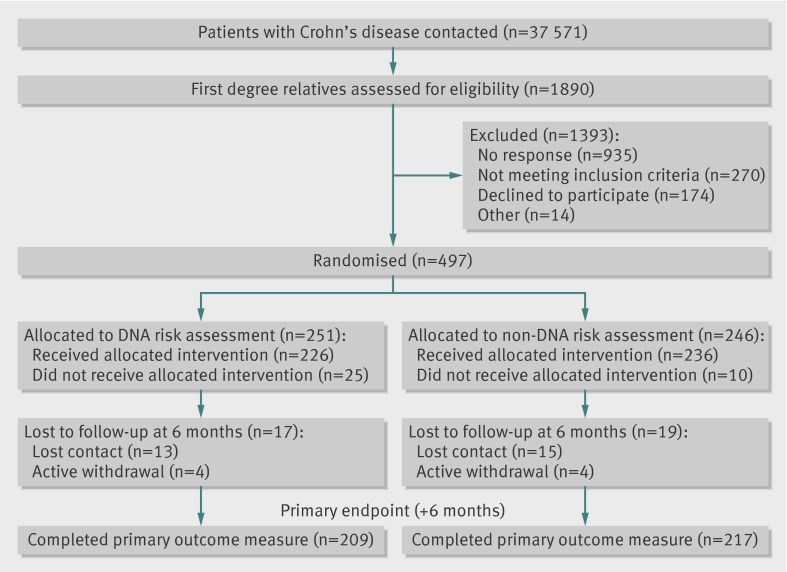
497 smokers (mean age 42.6 (SD 14.4) years) who were first degree relatives of probands with Crohn's disease, with outcomes assessed on 209/251 (based on DNA analysis) and 217/246 (standard risk assessment).
Communication of risk assessment for Crohn's disease by postal booklet based on family history of the disease and smoking status alone, or with additional DNA analysis for the NOD2 genotype. Participants were then telephoned by a National Health Service Stop Smoking counsellor to review the booklet and deliver brief standard smoking cessation intervention. Calls were tape recorded and a random subsample selected to assess fidelity to the clinical protocol.
The primary outcome was smoking cessation for 24 hours or longer, assessed at six months.
The proportion of participants stopping smoking for 24 hours or longer did not differ between arms: 35% (73/209) in the DNA arm versus 36% (78/217) in the non-DNA arm (difference -1%, 95% confidence interval -10% to 8%, P=0.83). The proportion making a quit attempt within the DNA arm did not differ between those who were told they had mutations putting them at increased risk (36%), those told they had none (35%), and those in the non-DNA arm (36%).
Among relatives of patients with Crohn's disease, feedback of DNA based risk assessments does not motivate behaviour change to reduce risk any more or less than standard risk assessment. These findings accord with those across a range of populations and behaviours. They do not support the promulgation of commercial DNA based tests nor the search for gene variants that confer increased risk of common complex diseases on the basis that they effectively motivate health related behaviour change.
Current Controlled Trials ISRCTN21633644.
验证假设,即基于基因型告知罹患克罗恩病的风险并建议停止吸烟可以降低家族性患病风险,从而促使吸烟者改变行为。
平行组、聚类随机对照试验。
英国克罗恩病患者家庭。
497 名吸烟者(平均年龄 42.6(14.4)岁),他们是克罗恩病患者的一级亲属,根据 DNA 分析的 209/251 例和标准风险评估的 217/246 例进行结果评估。
通过基于家族史和吸烟状况的邮寄手册进行克罗恩病风险评估的沟通,或者在 NOD2 基因型的基础上进行额外的 DNA 分析。然后,由国家卫生服务戒烟顾问通过电话联系参与者,审查手册并提供简短的标准戒烟干预。电话录音,随机选择子样本评估对临床方案的遵守情况。
主要结局是 6 个月时评估的 24 小时或更长时间的戒烟率。
停止吸烟 24 小时或更长时间的参与者比例在 DNA 组和非 DNA 组之间没有差异:DNA 组为 35%(73/209),非 DNA 组为 36%(78/217)(差异为-1%,95%置信区间为-10%至 8%,P=0.83)。在 DNA 组中,告知存在增加风险的突变的参与者(36%)、告知不存在突变的参与者(35%)和非 DNA 组的参与者(36%)之间,尝试戒烟的比例没有差异。
在克罗恩病患者的亲属中,基于 DNA 的风险评估反馈并不能比标准风险评估更能激发行为改变以降低风险。这些发现与各种人群和行为一致。它们不支持商业 DNA 测试的推广,也不支持寻找增加常见复杂疾病风险的基因变异的研究,因为它们不能有效地激发与健康相关的行为改变。
当前对照试验 ISRCTN21633644。