Department of Gastroenterology and Hepatology, Chinese PLA General Hospital, No. 28 Fuxing Road, Beijing 100853, China.
Gastroenterol Res Pract. 2012;2012:723183. doi: 10.1155/2012/723183. Epub 2012 Jul 5.
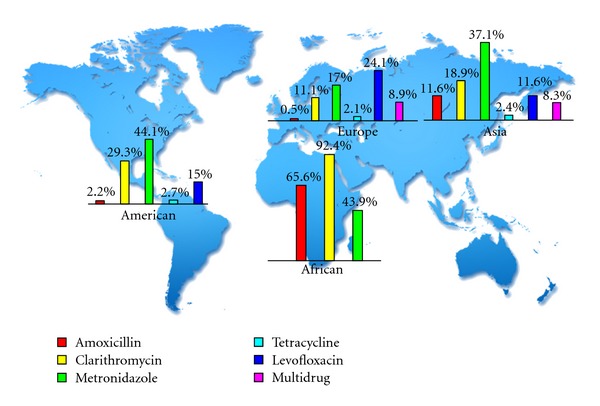
Antibiotics have been useful in the treatment of H. pylori-related benign and malignant gastroduodenal diseases. However, emergence of antibiotic resistance often decreases the eradication rates of H. pylori infections. Many factors have been implicated as causes of treatment failure, but the main antibiotic resistance mechanisms described to date are due to point mutations on the bacterial chromosome, a consequence of a significantly phenotypic variation in H. pylori. The prevalence of antibiotic (e.g., clarithromycin, metronidazole, tetracycline, amoxicillin, and furazolidone) resistance varies among different countries; it appears to be partly determined by geographical factors. Since the worldwide increase in the rate of antibiotic resistance represents a problem of relevance, some studies have been performed in order to identify highly active and well-tolerated anti-H. pylori therapies including sequential, concomitant quadruple, hybrid, and quadruple therapy. These represent a promising alternatives in the effort to overcome the problem of resistance. The aim of this paper is to review the current status of antibiotic resistance in H. pylori eradication, highlighting the evolutionary processes in detail at alternative approaches to treatment in the past decade. The underlying resistance mechanisms will be also followed.
抗生素在治疗与 H. pylori 相关的良性和恶性胃十二指肠疾病方面非常有效。然而,抗生素耐药性的出现往往会降低 H. pylori 感染的根除率。许多因素被认为是导致治疗失败的原因,但迄今为止描述的主要抗生素耐药机制是由于细菌染色体上的点突变,这是 H. pylori 表型明显变异的结果。抗生素(如克拉霉素、甲硝唑、四环素、阿莫西林和呋喃唑酮)耐药性的流行在不同国家之间有所不同;它似乎部分取决于地理因素。由于全球范围内抗生素耐药率的增加是一个相关的问题,因此已经进行了一些研究,以确定包括序贯、同时四联、混合和四联疗法在内的具有高活性和良好耐受性的抗 H. pylori 治疗方法。这些方法代表了克服耐药性问题的有希望的选择。本文的目的是回顾 H. pylori 根除治疗中抗生素耐药性的现状,详细强调过去十年中替代治疗方法的进化过程。还将遵循潜在的耐药机制。