Division of Preventive and Behavioral Medicine, Department of Medicine, University of Massachusetts Medical School, Worcester, MA, USA.
Diabetes Care. 2012 Nov;35(11):2226-34. doi: 10.2337/dc12-0412. Epub 2012 Jul 25.
To examine determinants of racial/ethnic differences in diabetes incidence among postmenopausal women participating in the Women's Health Initiative.
Data on race/ethnicity, baseline diabetes prevalence, and incident diabetes were obtained from 158,833 women recruited from 1993-1998 and followed through August 2009. The relationship between race/ethnicity, other potential risk factors, and the risk of incident diabetes was estimated using Cox proportional hazards models from which hazard ratios (HRs) and 95% CIs were computed.
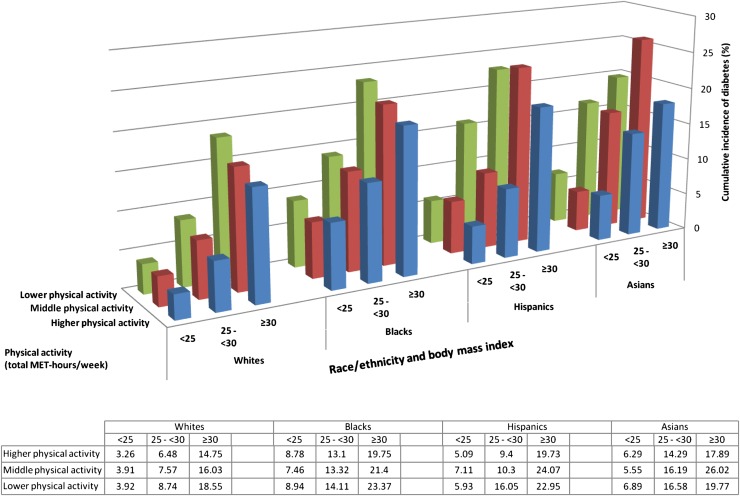
Participants were aged 63 years on average at baseline. The racial/ethnic distribution was 84.1% non-Hispanic white, 9.2% non-Hispanic black, 4.1% Hispanic, and 2.6% Asian. After an average of 10.4 years of follow-up, compared with whites and adjusting for potential confounders, the HRs for incident diabetes were 1.55 for blacks (95% CI 1.47-1.63), 1.67 for Hispanics (1.54-1.81), and 1.86 for Asians (1.68-2.06). Whites, blacks, and Hispanics with all factors (i.e., weight, physical activity, dietary quality, and smoking) in the low-risk category had 60, 69, and 63% lower risk for incident diabetes. Although contributions of different risk factors varied slightly by race/ethnicity, most findings were similar across groups, and women who had both a healthy weight and were in the highest tertile of physical activity had less than one-third the risk of diabetes compared with obese and inactive women.
Despite large racial/ethnic differences in diabetes incidence, most variability could be attributed to lifestyle factors. Our findings show that the majority of diabetes cases are preventable, and risk reduction strategies can be effectively applied to all racial/ethnic groups.
探讨参加妇女健康倡议的绝经后妇女中,糖尿病发病率的种族/民族差异的决定因素。
从 1993 年至 1998 年招募的 158833 名女性中获取了种族/民族、基线糖尿病患病率和糖尿病发病数据,并随访至 2009 年 8 月。使用 Cox 比例风险模型估计种族/民族、其他潜在风险因素与新发糖尿病风险之间的关系,由此计算出风险比(HR)和 95%置信区间(CI)。
参与者的平均基线年龄为 63 岁。种族/民族分布为 84.1%非西班牙裔白人、9.2%非西班牙裔黑人、4.1%西班牙裔和 2.6%亚裔。在平均 10.4 年的随访后,与白人相比,并调整了潜在混杂因素,黑人(95%CI 1.47-1.63)、西班牙裔(1.54-1.81)和亚裔(1.68-2.06)的新发糖尿病 HR 分别为 1.55、1.67 和 1.86。体重、身体活动、饮食质量和吸烟等所有因素处于低风险类别的白人、黑人及西班牙裔,新发糖尿病的风险分别降低了 60%、69%和 63%。尽管不同风险因素的贡献因种族/民族而异,但大多数发现在不同人群中相似,与肥胖且不活跃的女性相比,体重健康且处于身体活动最高三分位的女性发生糖尿病的风险要低三分之一。
尽管糖尿病发病率存在较大的种族/民族差异,但大多数差异可以归因于生活方式因素。我们的研究结果表明,大多数糖尿病病例是可以预防的,并且可以向所有种族/民族群体有效实施降低风险策略。