Department of Biomedical Engineering, Johns Hopkins University, High Throughput Biology Center, Johns Hopkins University School of Medicine, McKusick-Nathans Institute of Genetic Medicine, Baltimore, MD 21205, USA.
Nucleic Acids Res. 2012 Nov 1;40(20):e159. doi: 10.1093/nar/gks709. Epub 2012 Jul 27.
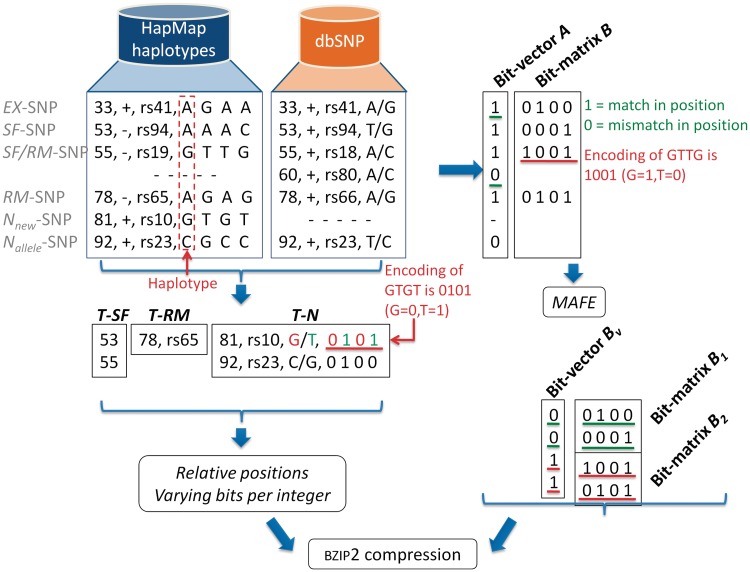
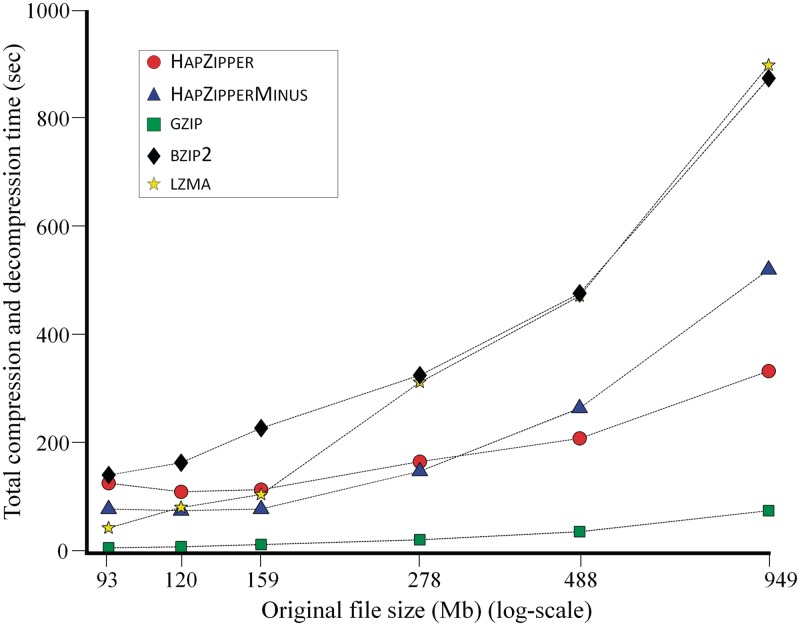
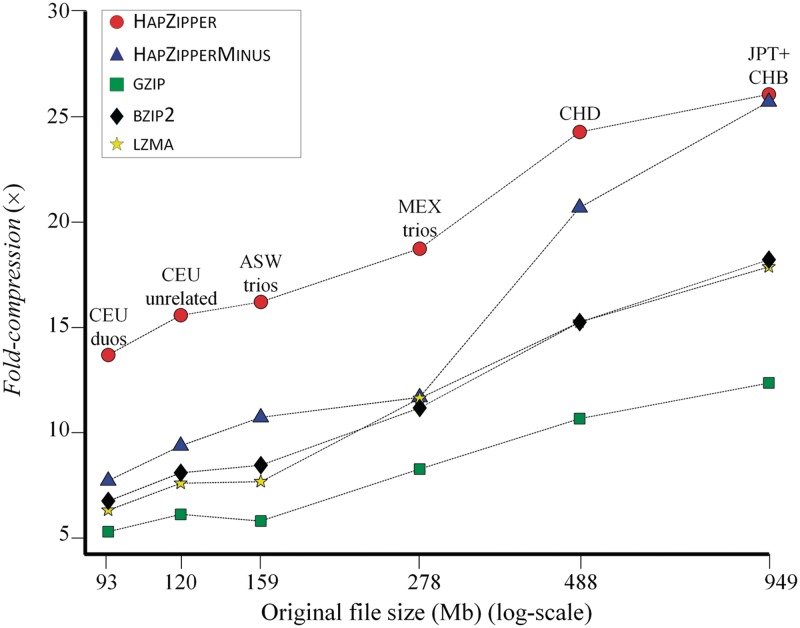
The rapidly growing amount of genomic sequence data being generated and made publicly available necessitate the development of new data storage and archiving methods. The vast amount of data being shared and manipulated also create new challenges for network resources. Thus, developing advanced data compression techniques is becoming an integral part of data production and analysis. The HapMap project is one of the largest public resources of human single-nucleotide polymorphisms (SNPs), characterizing over 3 million SNPs genotyped in over 1000 individuals. The standard format and biological properties of HapMap data suggest that a dedicated genetic compression method can outperform generic compression tools. We propose a compression methodology for genetic data by introducing HapZipper, a lossless compression tool tailored to compress HapMap data beyond benchmarks defined by generic tools such as gzip, bzip2 and lzma. We demonstrate the usefulness of HapZipper by compressing HapMap 3 populations to <5% of their original sizes. HapZipper is freely downloadable from https://bitbucket.org/pchanda/hapzipper/downloads/HapZipper.tar.bz2.
随着基因组序列数据的快速增长,新的数据存储和归档方法的开发变得尤为必要。大量被共享和处理的数据也给网络资源带来了新的挑战。因此,开发先进的数据压缩技术已成为数据生产和分析的重要组成部分。HapMap 项目是人类单核苷酸多态性(SNP)最大的公共资源之一,其特征是对 1000 多个个体中的超过 300 万个 SNP 进行了基因分型。HapMap 数据的标准格式和生物学特性表明,专门的遗传压缩方法可以胜过通用压缩工具。我们通过引入 HapZipper 为遗传数据提出了一种压缩方法,这是一种针对 HapMap 数据的无损压缩工具,可以对 HapMap 数据进行压缩,超出 gzip、bzip2 和 lzma 等通用工具定义的基准。我们通过将 HapMap 3 个群体压缩到原始大小的 5%以下,证明了 HapZipper 的有用性。HapZipper 可从 https://bitbucket.org/pchanda/hapzipper/downloads/HapZipper.tar.bz2 免费下载。