Clinical Cooperation Unit Neuropathology, German Cancer Center (DKFZ), Heidelberg, Germany.
PLoS One. 2012;7(7):e41298. doi: 10.1371/journal.pone.0041298. Epub 2012 Jul 23.
To investigate the dynamics of inter- and intratumoral molecular alterations during tumor progression in recurrent gliomas.
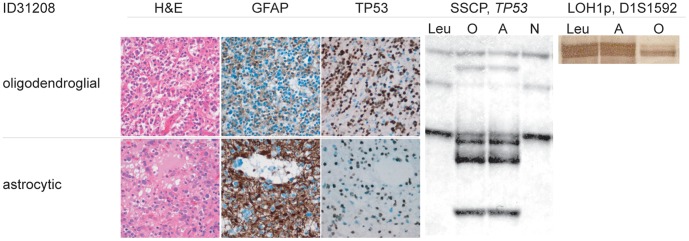
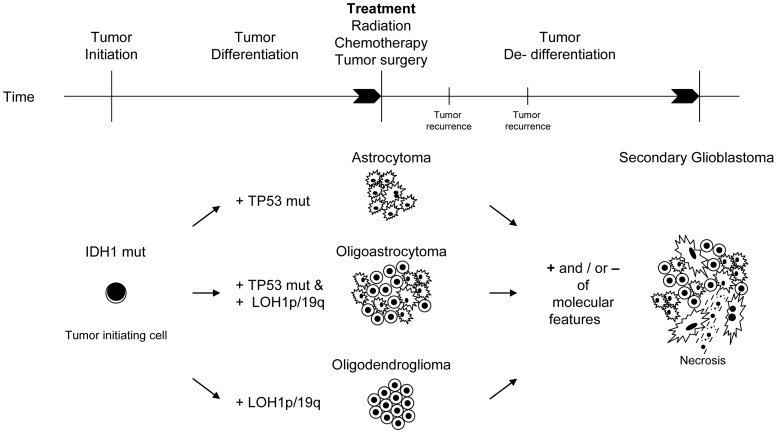
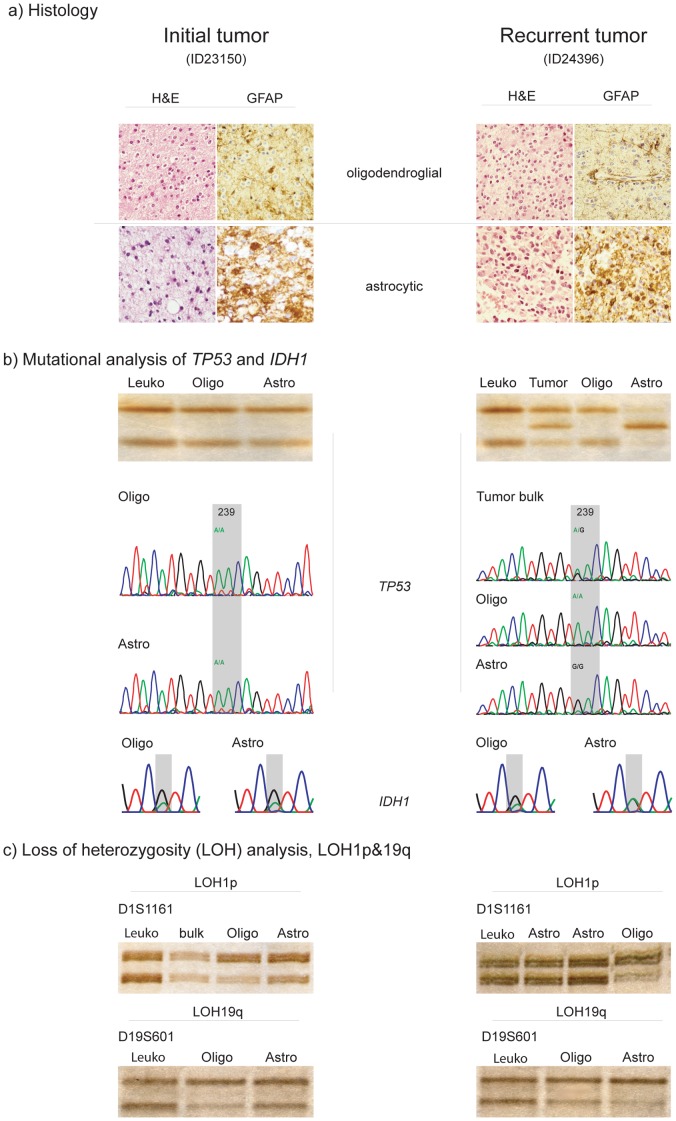
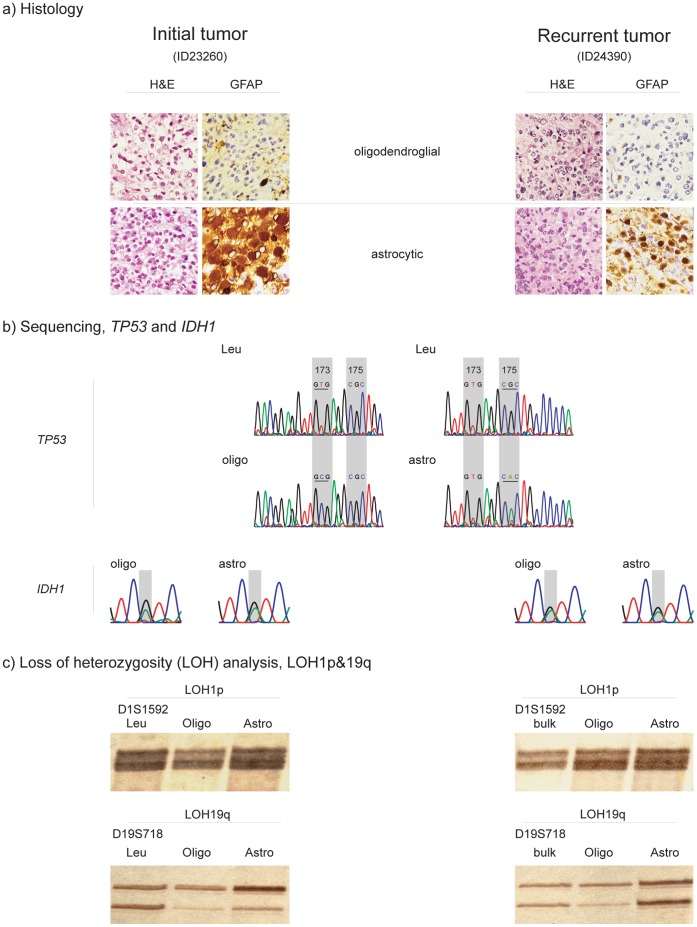
METHODOLOGY/PRINCIPAL FINDINGS: To address intertumoral heterogeneity we investigated non-microdissected tumor tissue of 106 gliomas representing 51 recurrent tumors. To address intratumoral heterogeneity a set of 16 gliomas representing 7 tumor pairs with at least one recurrence, and 4 single mixed gliomas were investigated by microdissection of distinct oligodendroglial and astrocytic tumor components. All tumors and tumor components were analyzed for allelic loss of 1p/19q (LOH 1p/19q), for TP53- mutations and for R132 mutations in the IDH1 gene. The investigation of non-microdissected tumor tissue revealed clonality in 75% (38/51). Aberrant molecular alterations upon recurrence were detected in 25% (13/51). 64% (9/14) of these were novel and associated with tumor progression. Loss of previously detected alterations was observed in 36% (5/14). One tumor pair (1/14; 7%) was significant for both. Intratumoral clonality was detected in 57% (4/7) of the microdissected tumor pairs and in 75% (3/4) of single microdissected tumors. 43% (3/7) of tumor pairs and one single tumor (25%) revealed intratumoral heterogeneity. While intratumoral heterogeneity affected both the TP53- mutational status and the LOH1p/19q status, all tumors with intratumoral heterogeneity shared the R132 IDH1- mutation as a common feature in both their microdissected components.
CONCLUSIONS/SIGNIFICANCE: The majority of recurrent gliomas are of monoclonal origin. However, the detection of divertive tumor cell clones in morphological distinct tumor components sharing IDH1- mutations as early event may provide insight into the tumorigenesis of true mixed gliomas.
为了研究复发性神经胶质瘤肿瘤进展过程中肿瘤内和肿瘤间分子改变的动态变化。
方法/主要发现:为了研究肿瘤间异质性,我们研究了 106 例代表 51 例复发性肿瘤的非微切割肿瘤组织。为了研究肿瘤内异质性,我们通过微切割不同的少突胶质细胞和星形胶质细胞瘤成分,研究了一组 16 例代表 7 对具有至少一次复发的肿瘤对和 4 例单独的混合神经胶质瘤。所有肿瘤和肿瘤成分均进行 1p/19q 等位基因缺失(LOH1p/19q)、TP53 突变和 IDH1 基因 R132 突变的分析。非微切割肿瘤组织的研究显示 75%(38/51)的克隆性。在 25%(13/51)的复发性肿瘤中发现了异常分子改变。其中 64%(9/14)是新的,与肿瘤进展有关。在 36%(5/14)的情况下,先前检测到的改变丢失。一个肿瘤对(1/14;7%)两者都显著。在微切割肿瘤对中,57%(4/7)检测到肿瘤内克隆性,在单个微切割肿瘤中,75%(3/4)检测到肿瘤内克隆性。肿瘤对的 43%(3/7)和单个肿瘤(25%)显示出肿瘤内异质性。虽然肿瘤内异质性影响 TP53 突变状态和 LOH1p/19q 状态,但所有具有肿瘤内异质性的肿瘤都共享 R132 IDH1 突变作为其微切割成分的共同特征。
结论/意义:大多数复发性神经胶质瘤为单克隆起源。然而,在形态学上明显不同的肿瘤成分中检测到具有 IDH1 突变的分化肿瘤细胞克隆作为早期事件,可能为真正的混合神经胶质瘤的肿瘤发生提供线索。